
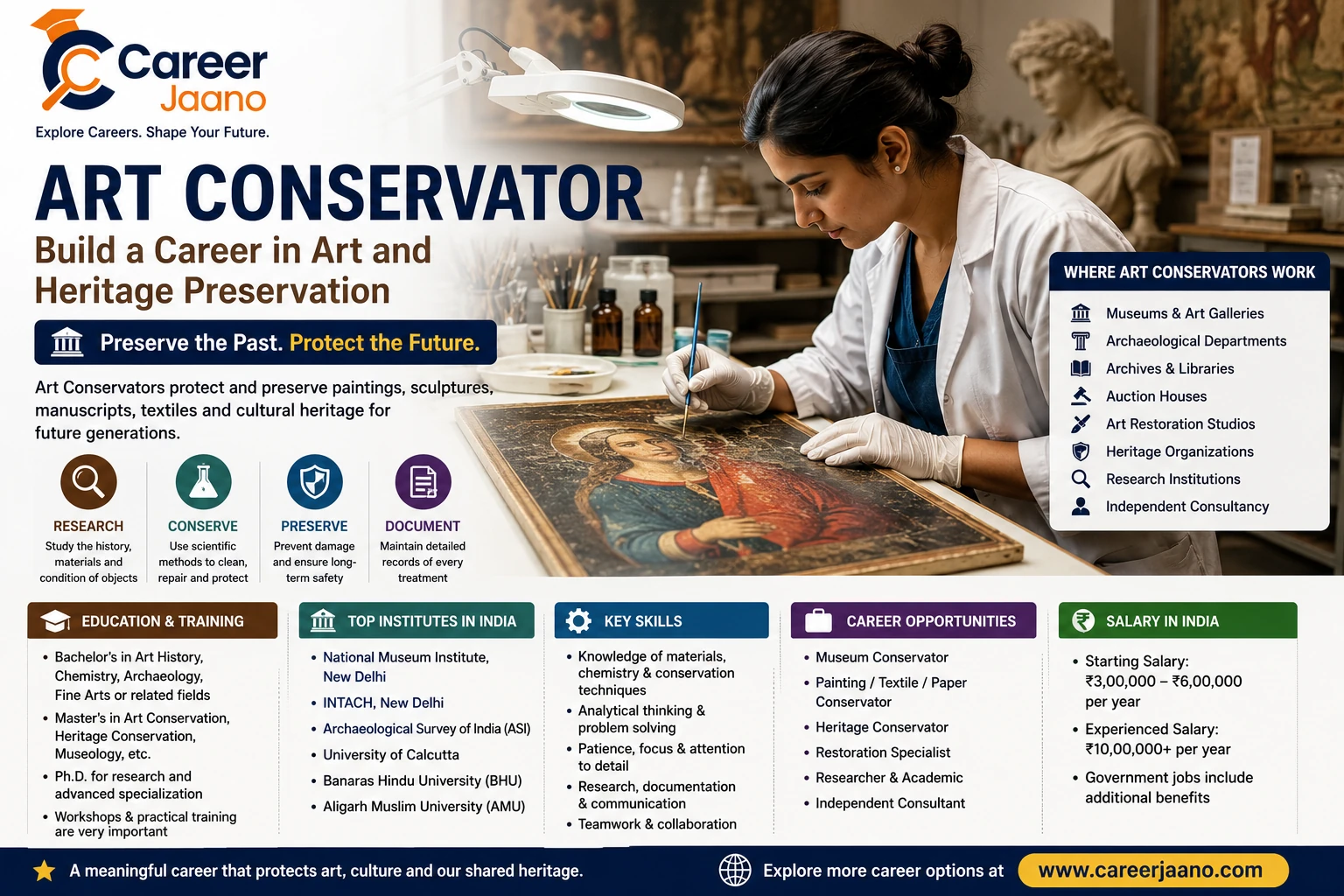
If you are interested in art, history, science, museums, and cultural heritage, then a career as an Art Conservator can be a very meaningful option for you.
An Art Conservator is a professional who protects and preserves paintings, sculptures, textiles, historical documents, manuscripts, artefacts, and other valuable cultural objects.
Their work is not only about repairing damaged art. They also study the scientific, chemical, physical, and historical condition of an object before deciding how it should be treated.
This career is a good choice for students who enjoy both creative work and scientific analysis.
Who is an Art Conservator?
An Art Conservator is a specialist who takes care of valuable artworks and cultural objects.
They may work with:
Paintings
Sculptures
Textiles
Manuscripts
Historical documents
Archaeological objects
Museum collections
Decorative art
Old photographs
Cultural artefacts
The main goal is to make sure these objects stay safe for future generations.
What Does an Art Conservator Do?
The work of an Art Conservator can include many different tasks.
1. Examine the Condition of Art
They carefully study an artwork or object to find damage, cracks, fading, moisture problems, chemical changes, or other issues.
2. Clean and Repair Objects
They use special methods to clean and repair damaged items without changing their original value.
3. Protect from Future Damage
Art Conservators also help protect objects from:
Humidity
Heat
Light
Dust
Insects
Pollution
Poor storage conditions
4. Scientific Testing
They may use scientific tools and methods to understand the materials used in an artwork.
5. Documentation
They maintain detailed records of the condition, treatment, and history of each object.
Education and Training
To build a career in Art Conservation, proper education and practical training are very important.
Bachelor's Degree
Students can start with subjects such as:
Art History
Chemistry
Archaeology
Fine Arts
History
Museum Studies
Heritage Studies
A background in Chemistry can be especially useful because conservation often involves understanding materials and chemical reactions.
Master's Degree
For specialised work, students can continue with postgraduate programmes in areas such as:
Art Conservation
Heritage Conservation
Museology
Archaeology
Conservation Science
Art History
Ph.D. and Research
Students interested in advanced research, teaching, or specialised conservation work can also choose a Ph.D.
Institutes and Training Options
Students can explore institutes and organisations connected with museums, archaeology, art history, and heritage conservation.
Some well-known names in India include:
National Museum Institute
INTACH
Archaeological Survey of India
Universities offering Museology, Archaeology, Heritage Studies, or Art History
Museums and conservation laboratories
International institutions also offer advanced programmes in conservation and heritage management.
Before joining any programme, always check the latest information about:
Eligibility
Course duration
Fees
Admission process
Practical training
Specialisation
from the official website of the institute.
Online Courses
Online courses can be useful for learning the basics of:
Art History
Museum Studies
Heritage Management
Conservation Science
Documentation
However, practical conservation work usually requires hands-on training.
Skills Required to Become an Art Conservator
A successful Art Conservator needs a mix of scientific knowledge, patience, creativity, and attention to detail.
1. Scientific Knowledge
Knowledge of chemistry and physical processes can help you understand how different materials react over time.
2. Knowledge of Art Materials
You should understand materials such as:
Paint
Canvas
Paper
Wood
Metal
Stone
Textile
Ceramics
3. Problem-Solving Skills
Every damaged artwork is different.
You need to decide the safest way to treat each object.
4. Attention to Detail
Conservation work often involves very small and delicate tasks.
Even a minor mistake can damage an important object.
5. Patience
Some conservation projects can take weeks or months.
You need patience and focus to work carefully.
6. Research Skills
You may need to study the history, material, artist, and earlier treatments of an object.
7. Communication Skills
Art Conservators often work with:
Historians
Museum professionals
Scientists
Archaeologists
Curators
Researchers
Good communication and teamwork are very important.
Career Opportunities in the Private Sector
Art Conservators can work in many private organisations.
Possible work areas include:
Private museums
Art galleries
Auction houses
Art restoration companies
Heritage organisations
Private collections
Conservation studios
Art dealers
Cultural foundations
Possible job roles include:
Art Conservator
Painting Conservator
Paper Conservator
Textile Conservator
Museum Conservator
Heritage Conservator
Restoration Specialist
Conservation Assistant
Collection Care Specialist
Freelance and Independent Work
Experienced Art Conservators can also work independently.
They may provide services to:
Private collectors
Art galleries
Museums
Heritage organisations
Auction houses
Historical institutions
Freelancing can give more flexibility, but strong skills and a good professional reputation are important.
Career Opportunities in the Government Sector
Government organisations also provide career opportunities in heritage protection, museums, archives, and archaeology.
Possible areas include:
Archaeological departments
National museums
State museums
Archives
Heritage departments
Cultural departments
Research institutions
Universities
Possible roles include:
Conservator
Conservation Assistant
Museum Professional
Heritage Specialist
Research Assistant
Restoration Expert
Documentation Specialist
Government recruitment rules and eligibility can be different for every post.
Students should always check official recruitment notifications.
Salary and Career Growth
The salary of an Art Conservator depends on experience, specialisation, employer, location, and type of work.
At the starting level, professionals may earn around ₹3 lakh to ₹6 lakh per year.
With experience and advanced skills, Art Conservators may earn around ₹8 lakh to ₹10 lakh per year or more.
Senior professionals, consultants, and specialised experts may earn even higher income depending on their projects and organisation.
Government salaries are usually based on the official pay structure of the department.
These figures are general estimates and actual income can vary.
Is Art Conservation a Good Career?
Yes, Art Conservation can be a very meaningful career if you are interested in:
Art
History
Science
Culture
Museums
Heritage
Research
It gives you the opportunity to protect valuable objects and help preserve history for future generations.
Who Should Choose This Career?
You may enjoy this career if:
You love art and history
You enjoy detailed work
You are patient
You are interested in science
You enjoy research
You like working with museums and heritage
You want to protect cultural objects
Before choosing any career, it is always better to understand your interests, skills, personality, and long-term goals.
If you are confused about your career direction, you can also take guidance from a professional career counsellor.
You can explore more career options on Career Jaano.
FAQs About Art Conservator Career
1. What does an Art Conservator do?
An Art Conservator protects, repairs, studies, and preserves paintings, sculptures, documents, textiles, and other valuable cultural objects.
2. Which course is best for becoming an Art Conservator?
Courses in Art Conservation, Art History, Chemistry, Archaeology, Museology, Heritage Studies, or Fine Arts can be useful.
3. Is Chemistry important for Art Conservation?
Yes. Chemistry can be very useful because Art Conservators often need to understand materials, pigments, ageing, and chemical changes.
4. Can I become an Art Conservator after Class 12?
Yes. After Class 12, you can choose a relevant bachelor's degree and later specialise in Art Conservation or Heritage Conservation.
5. Where can Art Conservators work?
They can work in museums, galleries, archives, archaeology departments, auction houses, restoration studios, heritage organisations, and private collections.
6. What is the salary of an Art Conservator in India?
A beginner may earn around ₹3 lakh to ₹6 lakh per year. Experienced professionals may earn ₹8 lakh to ₹10 lakh per year or more depending on their role and specialisation.
7. Is Art Conservation a good career in India?
Yes. It can be a good career for students who are interested in art, history, science, museums, and cultural heritage.