
Career Jaano Blog












Career Options After Digital Marketing Course: Jobs, Skills & Salary in IndiaIn todays digital world, businesses of every size are using websites, search engines, social media and online advertising to reach their customers. This has created a growing demand for professionals who understand how digital platforms work. A digital marketing course can help students develop these skills and explore diverse career opportunities across industries.
However, Digital Marketing is not just about posting on Instagram or creating advertisements. It combines marketing knowledge, creativity, technology, communication, data analysis and customer understanding.
For students and freshers, learning the right skills through a structured course, followed by practical projects and internships, can provide a strong foundation for entering the digital marketing industry.
Digital Marketing Course Syllabus Course Content
Before choosing a course, students should carefully check the digital marketing course syllabus and understand whether it provides practical as well as theoretical knowledge.
The digital marketing course content generally includes:
SEO (Search Engine Optimization) learning how to improve website visibility and rankings on search engines.
Google Ads creating and managing paid search and advertising campaigns.
Meta Ads understanding advertising on platforms such as Facebook and Instagram.
Social Media Marketing creating content strategies, managing social platforms and engaging with audiences.
Google Analytics GA4 analysing website traffic, user behaviour and campaign performance.
AI Tools for Digital Marketing using AI for content creation, research, campaign planning, analysis and productivity.
Performance Marketing focusing on measurable outcomes such as leads, conversions, sales and return on advertising spend.
Content Marketing Lead Generation creating relevant content and attracting potential customers.
A good course should ideally include live projects, practical assignments, campaign simulations, internships and portfolio development. A certificate is useful, but practical skills are what can make a fresher more job-ready.
Eligibility for a Digital Marketing Course
Digital Marketing is a relatively flexible career field. Students from different academic backgrounds can enter this profession. Graduates from BBA, BCA, B.Com, BA, BJMC, MBA and other disciplines can develop Digital Marketing skills.
There is no single academic stream that guarantees success in this field. For freshers, a combination of graduation, Digital Marketing certification, practical knowledge, communication skills and relevant projects can help build a strong profile.
Digital Marketing Career Options
One of the biggest advantages of Digital Marketing is its applicability across industries. IT companies, e-commerce businesses, educational institutions, banks, healthcare organisations, real estate companies, hospitality, automobile companies, startups and retail brands all require digital marketing professionals.
Some popular digital marketing career options are:
1. SEO Specialist
An SEO Specialist works on improving a website's visibility on search engines. The role can include keyword research, on-page SEO, content optimization, competitor analysis and monitoring search performance.
2. Google Ads Specialist
A Google Ads Specialist manages paid advertising campaigns. The professional works with keywords, audience targeting, ad copies, campaign budgets, conversions and performance optimisation.
3. Performance Marketing
Performance Marketing is focused on measurable business results such as leads, sales, conversions and customer acquisition. Professionals analyse campaign data and continuously optimise advertising performance.
4. Social Media Manager
A Social Media Manager develops social media strategies, manages content calendars, coordinates creative content, engages with audiences and monitors social media performance.
5. Digital Marketing Analyst
A Digital Marketing Analyst works with data to understand website traffic, customer behaviour and campaign performance. Knowledge of Google Analytics GA4, reporting and data interpretation is particularly useful for this role.
6. Digital Marketing Executive
Digital Marketing Executive is one of the common entry-level digital marketing jobs for freshers. The role may involve supporting SEO, Social Media Marketing, Google Ads, Meta Ads, content creation, lead generation and campaign reporting.
Digital Marketing Jobs for Freshers
Freshers can look for opportunities in both Digital Marketing agencies and in-house marketing teams.
An agency can provide exposure to multiple clients and industries, while an in-house role allows a professional to work more deeply on the digital presence of a single organisation.
Common digital marketing jobs for freshers include:
Digital Marketing Executive | SEO Executive | Social Media Executive | PPC/Google Ads Executive | Content Marketing Executive | Performance Marketing Executive | Digital Marketing Analyst
As experience increases, professionals can move towards specialist, managerial and strategic positions.
Important Skills for a Career in Digital Marketing
To build a successful career in Digital Marketing, students should focus on both technical and soft skills.
Some important skills include:
Communication skills
Creative thinking
Analytical ability
Basic understanding of customer behaviour
Content creation
Keyword research
Campaign planning
Social media management
Data interpretation
Problem-solving ability
Digital Marketing professionals often need to understand why a campaign is working or not working. Therefore, the ability to analyse results and make improvements is just as important as creativity.
Importance of Practical Projects and Internships
Practical experience plays an important role in Digital Marketing.
Students should try to work on real or simulated projects where they can apply the concepts learned during the course.
For example, a student can practise:
Creating an SEO strategy for a website
Running sample Google Ads campaigns
Planning a social media calendar
Creating content for different platforms
Analysing website traffic
Building lead generation campaigns
Internships can also help students understand how Digital Marketing teams work in real business environments.
A combination of certification, projects and internship experience can make a fresher profile stronger.
How to Build a Digital Marketing Portfolio
A portfolio can help demonstrate practical skills to employers.
Students can include:
SEO projects
Keyword research samples
Content plans
Social media campaigns
Advertisement creatives
Campaign reports
Website analytics reports
Lead generation projects
Even if a student has not worked professionally, practice projects can be included to show practical understanding.
Digital Marketing Agency vs In-House Job
Freshers may get opportunities in both Digital Marketing agencies and in-house marketing teams.
Digital Marketing Agency
Working in an agency can provide exposure to multiple clients, industries and marketing campaigns.
This can help freshers learn different aspects of Digital Marketing within a relatively short period.
In-House Digital Marketing
In an in-house role, professionals generally work for a single company or brand.
This allows them to understand one business deeply and work consistently on its Digital Marketing strategy.
Both options can provide valuable experience depending on a person's career goals.
Career Growth in Digital Marketing
Digital Marketing offers multiple levels of career growth.
A fresher may begin as:
Digital Marketing Executive
SEO Executive
Social Media Executive
PPC Executive
Content Marketing Executive
With experience, professionals can move into specialised or managerial roles such as:
SEO Specialist
Performance Marketing Specialist
Digital Marketing Manager
Social Media Manager
Marketing Analyst
Digital Marketing Strategist
Professionals who continuously upgrade their skills can explore more advanced opportunities as their experience increases.
Role of AI in Digital Marketing
AI tools are becoming increasingly useful in Digital Marketing.
Professionals can use AI for:
Content ideas
Research
Campaign planning
Data analysis
Audience understanding
Productivity
Creating draft content
However, AI tools should support a marketer's skills rather than replace marketing understanding.
Students still need to develop creativity, communication, analytical thinking and customer understanding.
Digital Marketing Salary in India
The digital marketing salary in India varies according to experience, location, organisation, industry and specialisation. Freshers generally begin with entry-level packages, while professionals with strong expertise in areas such as SEO, Google Ads, Meta Ads, Performance Marketing, Analytics and AI Tools for Digital Marketing can progress to better-paying specialist and managerial roles.
Instead of choosing a course only on the basis of expected salary, students should focus on developing job-ready skills, practical experience and a strong portfolio. These factors can have a significant impact on long-term career growth.
How to Start a Career After a Digital Marketing Course
After completing a Digital Marketing course, students can follow a practical approach:
Strengthen the basic concepts of Digital Marketing.
Practise SEO, Social Media Marketing and paid advertising.
Learn how to use analytics and reporting tools.
Work on live or simulated projects.
Complete an internship.
Create a professional portfolio.
Apply for entry-level Digital Marketing jobs.
Continue learning new platforms, tools and technologies.
Digital Marketing keeps changing, so professionals should continue updating their knowledge.
Final Advice for Students
Digital Marketing can offer exciting career opportunities, but completing a course alone is not enough. Students should learn the concepts, practise them through real or simulated projects, complete internships and continuously update their skills as digital platforms and AI technologies evolve.
Remember: A certificate can help you enter the industry, but practical skills, creativity, analytical thinking and the ability to deliver results can help you build a successful Digital Marketing career.
If you are still confused about which career path is right for you, explore expert career guidance and career options on Career Jaano .
Frequently Asked Questions (FAQs)
1. What are the best career options after a Digital Marketing course?
Some popular career options include SEO Specialist, Google Ads Specialist, Social Media Manager, Digital Marketing Executive, Performance Marketing professional and Digital Marketing Analyst.
2. Can a fresher get a job after completing a Digital Marketing course?
Yes. Freshers can apply for entry-level jobs such as Digital Marketing Executive, SEO Executive, Social Media Executive, PPC Executive and Content Marketing Executive. Practical projects and internships can help improve job opportunities.
3. Which students can learn Digital Marketing?
Students from different academic backgrounds can learn Digital Marketing. Graduates from BBA, BCA, B.Com, BA, BJMC, MBA and other disciplines can enter this field.
4. Is Digital Marketing a good career for the future?
Digital Marketing continues to be relevant because businesses use websites, search engines, social media and online advertising to reach customers. Professionals who continue updating their skills can explore opportunities across different industries.
5. Is coding required for Digital Marketing?
Most entry-level Digital Marketing roles do not require advanced coding knowledge. However, basic understanding of websites and technology can be useful, especially for SEO, analytics and tracking-related work.
6. Which Digital Marketing skill is best for jobs?
Different skills lead to different career paths. SEO, Google Ads, Meta Ads, Social Media Marketing, Performance Marketing, Analytics and Content Marketing are all useful depending on the role a student wants to pursue.
7. Can I do Digital Marketing after BBA or B.Com?
Yes. Students from BBA, B.Com and many other graduation backgrounds can develop Digital Marketing skills and apply for relevant jobs.
8. Is a Digital Marketing certificate enough to get a job?
A certificate can support your profile, but employers may also look for practical skills, projects, internships, communication ability and understanding of Digital Marketing tools.
9. What is the role of AI in Digital Marketing?
AI tools can help with research, content creation, campaign planning, analysis and productivity. However, professionals still need marketing knowledge, creativity and analytical skills to use these tools effectively.
10. Should freshers choose an agency or an in-house Digital Marketing job?
Both can be useful. Agencies may offer exposure to multiple clients and industries, while in-house roles allow professionals to work more deeply on the Digital Marketing activities of one organisation.
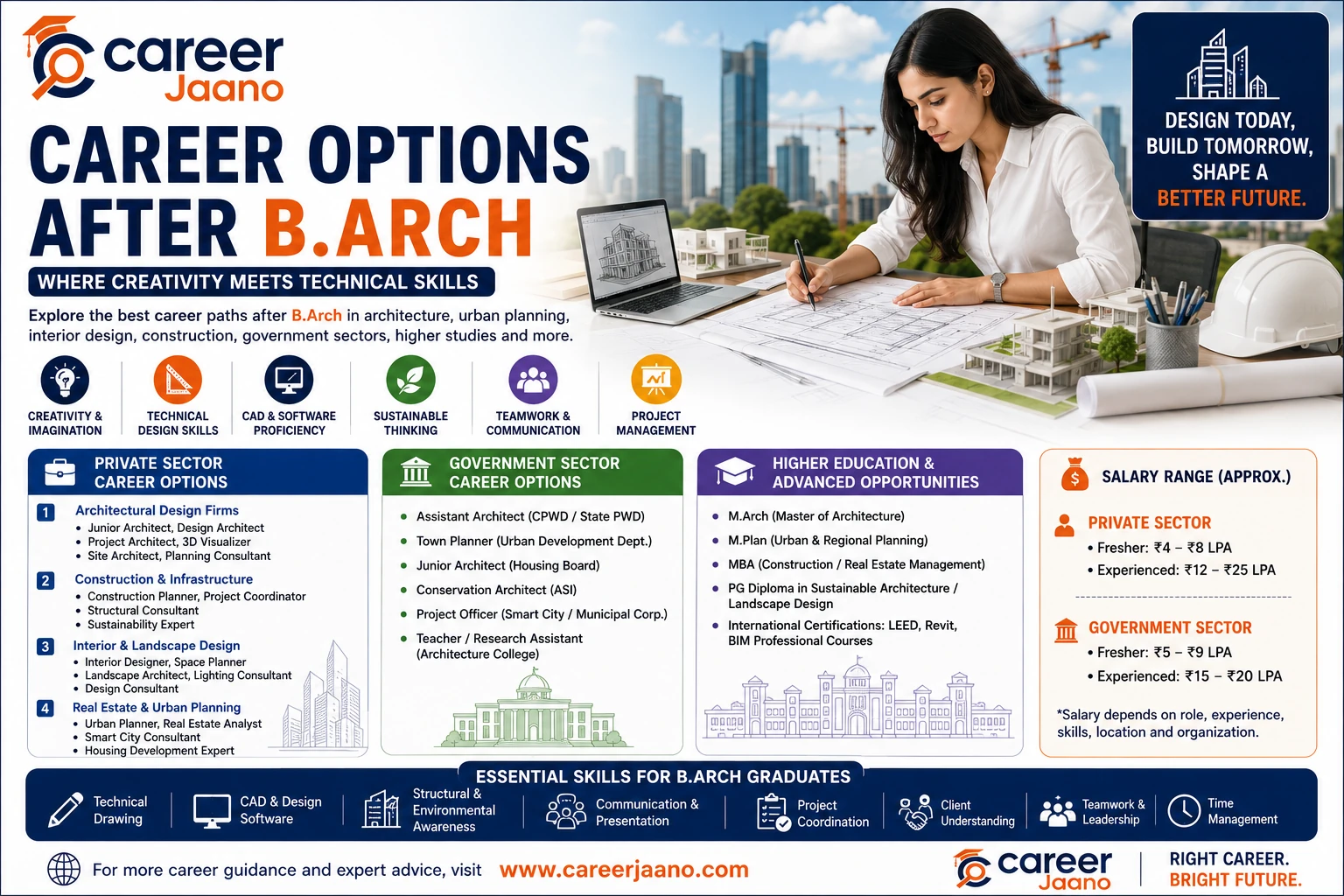
Career Options After B.Arch: Where Creativity Meets Technical SkillsA Bachelor of Architecture (B.Arch) is a five-year undergraduate programme that gives students a strong understanding of building design, construction, urban planning and environmental design.
During the course, students study subjects such as:
Architectural Design
Building Construction
Environmental Studies
Structural Engineering
Interior Design
Landscape Architecture
Computer-Aided Design (CAD)
The aim of B.Arch is not only to teach drawing and designing. It also helps students understand sustainable development, innovative building design and responsible planning.
Students can also build expertise in areas such as:
Urban Design
Green Architecture
Smart City Planning
Sustainable Infrastructure
Digital Design
Major Specialisations in Architecture
Architecture offers many specialisation options. Students can choose an area based on their interest, creativity and career goals.
1. Architectural Design
This area focuses on designing buildings and spaces that are functional, safe and visually attractive.
2. Urban and Regional Planning
Urban planners work on the development of cities, towns and regions.
They may be involved in:
City planning
Transportation planning
Housing projects
Smart city development
3. Landscape Architecture
Landscape architects design outdoor spaces such as:
Parks
Gardens
Public spaces
Institutional campuses
Residential landscapes
4. Interior Architecture
This field focuses on designing the inside of buildings.
Professionals work on:
Space planning
Interior layouts
Materials
Lighting
Furniture planning
5. Green and Sustainable Architecture
This is an important and growing area of architecture.
Professionals focus on:
Energy-efficient buildings
Sustainable materials
Water conservation
Environment-friendly design
Green building concepts
6. Heritage and Conservation Architecture
This field is suitable for students interested in protecting and restoring historical buildings and monuments.
7. Construction Project Management
Students interested in the management side of architecture can work in:
Project planning
Construction coordination
Cost management
Site management
Project execution
8. Digital and Computational Design
Modern architects increasingly use advanced software and technology for design.
This area may include:
3D modelling
BIM
Computational design
Digital visualisation
Parametric design
Important Skills Required After B.Arch
A successful architect needs both creative and technical skills.
Creativity and Imagination
Architects should be able to imagine new spaces and create practical design ideas.
Technical Drawing and Design
Students should understand architectural drawings, plans, sections and construction details.
CAD and Design Software
Knowledge of software can improve job opportunities.
Useful tools include:
AutoCAD
Revit
SketchUp
Rhino
BIM tools
3D visualisation software
Structural and Environmental Understanding
Architects should understand how buildings work technically and how design affects the environment.
Communication Skills
Architects regularly communicate with:
Clients
Engineers
Contractors
Designers
Government authorities
Good communication is very important.
Presentation Skills
Architects must be able to clearly present their design ideas through drawings, models and presentations.
Teamwork
Architecture projects involve many professionals, so teamwork is essential.
Client Understanding
A good architect should understand the clients needs, budget and expectations before developing a design.
Private Sector Career Options After B.Arch
B.Arch graduates can find opportunities in:
Architectural firms
Construction companies
Real estate companies
Interior design firms
Infrastructure companies
Urban planning consultancies
Architectural Design Firms
Possible job roles include:
Junior Architect
Design Architect
Project Architect
Site Architect
3D Visualiser
Planning Consultant
Fresh graduates often begin as junior architects and gain experience by working on real projects.
Construction and Infrastructure Companies
Possible roles include:
Construction Planner
Project Coordinator
Design Coordinator
Sustainability Consultant
Architectural Consultant
Interior and Landscape Design
Students interested in interior and outdoor spaces can explore:
Interior Designer
Space Planner
Landscape Architect
Lighting Consultant
Design Consultant
Real Estate and Urban Planning
Possible roles include:
Urban Planning Associate
Real Estate Design Consultant
Smart City Consultant
Housing Development Specialist
Planning Coordinator
Salary in the Private Sector
Salary after B.Arch depends on:
Company
Location
Portfolio
Software skills
Experience
Type of projects
Specialisation
Fresh graduates may start with entry-level packages in architecture, design or construction firms.
With strong experience, a good portfolio and specialised skills in areas such as BIM, sustainable design, urban planning or project management, salary can increase significantly.
Government Sector Career Options
B.Arch graduates can also explore opportunities in government departments and public organisations.
Possible areas include:
Public Works Departments
Housing Boards
Urban Development Authorities
Smart City Projects
Municipal Corporations
Government planning departments
Railways
Heritage and conservation bodies
Common Government Job Roles
Possible positions may include:
Assistant Architect
Junior Architect
Town Planner
Planning Assistant
Conservation Architect
Project Officer
Eligibility depends on the official recruitment notification.
Public Works Departments
Architects may work on government building projects such as:
Schools
Hospitals
Offices
Housing
Public infrastructure
Urban Development Departments
Graduates may work in:
City planning
Housing planning
Land-use planning
Urban development projects
Heritage and Conservation
Students interested in historical architecture may explore opportunities in conservation and heritage-related projects.
Smart City and Municipal Projects
Architects can also work on:
Smart city planning
Public spaces
Urban redevelopment
Infrastructure projects
Higher Education After B.Arch
Students who want to specialise further have several options.
M.Arch
A Master of Architecture (M.Arch) allows students to specialise in areas such as:
Urban Design
Sustainable Architecture
Landscape Architecture
Housing
Architectural Conservation
Digital Architecture
M.Plan
M.Plan is suitable for students interested in:
Urban Planning
Regional Planning
Transport Planning
Housing
Smart Cities
MBA
Students interested in management can pursue an MBA in areas such as:
Construction Management
Real Estate Management
Project Management
Postgraduate Diplomas
Useful options may include:
Sustainable Architecture
Landscape Design
Urban Planning
Construction Management
Professional Certifications
Short-term certifications can also improve career opportunities.
Useful options include:
LEED Certification
Autodesk Revit Certification
BIM Professional Courses
Sustainable Building Certifications
Project Management Courses
These certifications can help students improve technical skills and work on modern design and construction projects.
Career in Sustainable Architecture
Sustainable architecture is becoming more important as cities focus on energy efficiency and climate-friendly construction.
Professionals may work on:
Green buildings
Energy-efficient design
Sustainable materials
Water conservation
Environment-friendly projects
Career in BIM and Digital Architecture
Building Information Modelling (BIM) is changing the architecture and construction industry.
Architects with BIM skills can work in:
Architectural design
Construction planning
Project coordination
Digital modelling
Infrastructure projects
Software knowledge can provide a strong advantage in this field.
Career in Urban Planning
Rapid urban growth is creating demand for professionals who understand cities and infrastructure.
Urban planning professionals may work on:
Housing
Roads
Transportation
Public spaces
Smart cities
Urban redevelopment
Starting Your Own Architecture Practice
Experienced architects may also choose to start their own architecture or design firm.
Independent professionals may work on:
Residential buildings
Commercial spaces
Interiors
Renovation
Landscape projects
Consultancy
Building a strong portfolio and professional network is very important for independent practice.
Conclusion
B.Arch is not just a degree. It is a creative and responsible profession that combines art, science and technology.
Graduates can build careers in architecture, construction, urban planning, interior design, landscape design, sustainability and digital design.
With the right skills, practical experience and a strong portfolio, B.Arch graduates can build successful careers in India and abroad.
Before choosing a career path, students should understand their interests, creativity and technical strengths.
For more career guidance and career options, visit Career Jaano .
Frequently Asked Questions (FAQs)
1. What are the best career options after B.Arch?
Popular options include Architect, Urban Planner, Interior Designer, Landscape Architect, BIM Specialist, Project Coordinator and Sustainability Consultant.
2. Can I get a government job after B.Arch?
Yes. B.Arch graduates can apply for eligible posts in PWD, housing boards, urban development authorities, municipal bodies, smart city projects and other government organisations.
3. Which course is best after B.Arch?
Popular higher-study options include M.Arch, M.Plan, MBA in Construction or Real Estate Management, and specialised courses in BIM, sustainable architecture or urban planning.
4. Is BIM a good career after B.Arch?
Yes. BIM is a growing area in architecture and construction. Strong BIM and Revit skills can improve opportunities in design, coordination and infrastructure projects.
5. Can I become an Urban Planner after B.Arch?
Yes. B.Arch graduates can move into urban planning roles, especially after gaining relevant experience or completing a specialised qualification such as M.Plan.
6. Can B.Arch graduates start their own architecture firm?
Yes. After meeting the applicable professional registration and practice requirements, experienced graduates can start their own architecture or design practice.
7. What skills are most important after B.Arch?
Important skills include creativity, technical drawing, AutoCAD, Revit, BIM, communication, presentation, project coordination and understanding client requirements.
8. Is B.Arch a good career for the future?
Yes. Opportunities are growing in sustainable design, smart cities, BIM, urban planning, green buildings and digital architecture.
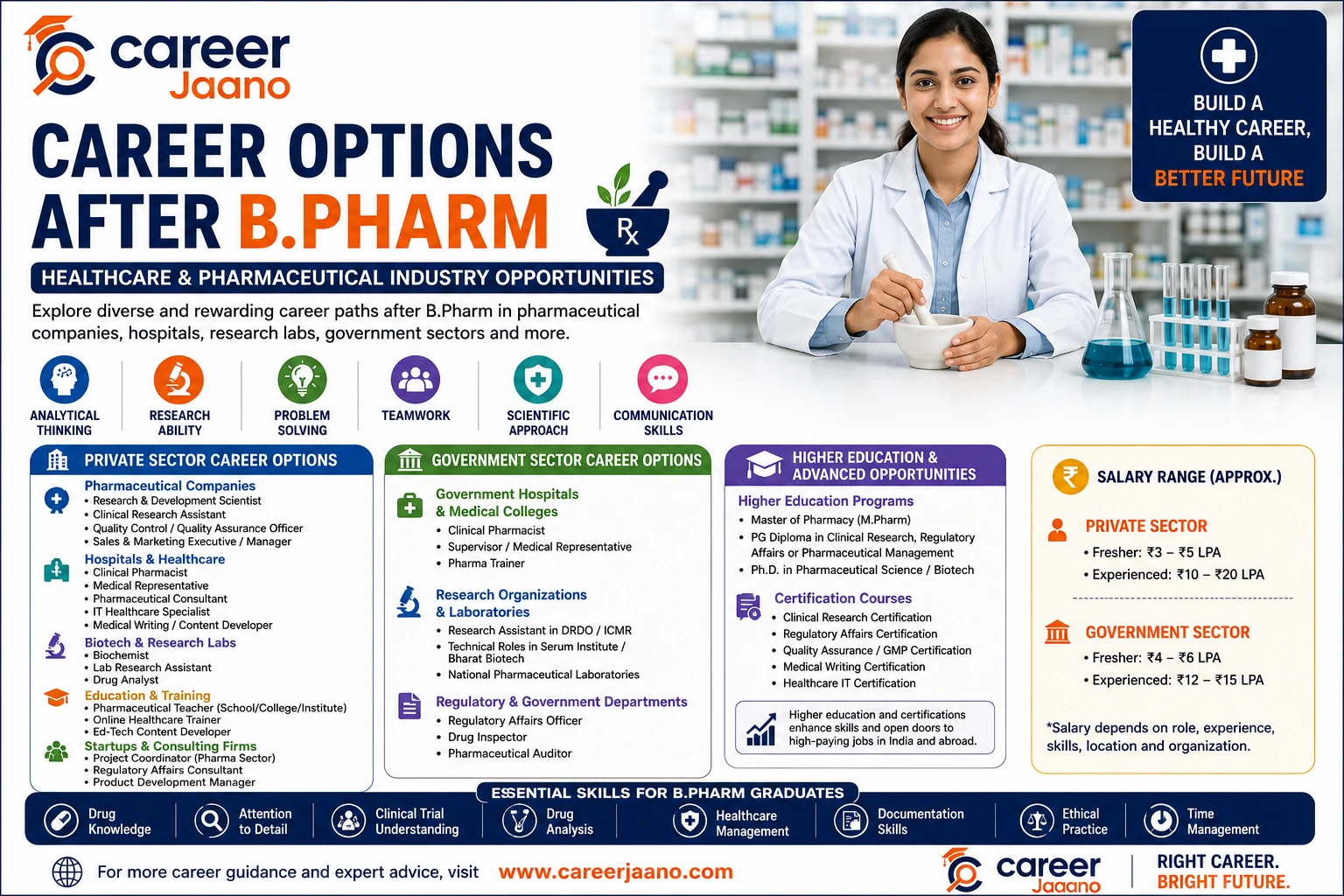
Career Options After B.Pharm: Healthcare and Pharmaceutical Sector OpportunitiesA Bachelor of Pharmacy (B.Pharm) is a four-year undergraduate programme that gives students a strong understanding of pharmaceutical science, drug development and healthcare.
During the course, students study subjects such as:
Pharmaceutical Chemistry
Pharmacology
Formulation Technology
Biochemistry
Pharmaceutical Analysis
Healthcare Management
The aim of B.Pharm is not only to teach students about medicines and drug science, but also to develop ethical thinking, research ability and awareness about patient safety and healthcare.
During B.Pharm, students can also build knowledge in areas such as:
Pharmaceutical Formulation
Clinical Pharmacy
Drug Research and Development
Quality Control
Regulatory Affairs
These areas help students choose a career according to their interests and long-term goals in the pharmaceutical and healthcare sector.
Important Skills Required
For B.Pharm graduates, academic knowledge alone is not enough.
To build a successful career in the pharmaceutical and healthcare industry, students should develop skills such as:
Analytical thinking
Research ability
Problem-solving
Teamwork
Scientific approach
Communication skills
Clinical trial understanding
Drug analysis
Healthcare management
Attention to detail
These skills help students work more confidently in research, production, hospitals, regulatory departments and other healthcare-related areas.
Private Sector Career Options
B.Pharm graduates can find career opportunities in:
Pharmaceutical companies
Hospitals
Research laboratories
Consulting firms
Biotechnology companies
Healthcare organisations
Today, the pharmaceutical and healthcare sectors need trained professionals in drug development, quality control, clinical pharmacy, regulatory affairs, sales, marketing, education and healthcare technology.
Pharmaceutical Companies
Possible job roles include:
Research and Development Scientist
Clinical Research Assistant
Quality Control Officer
Quality Assurance Officer
Sales Executive
Marketing Executive
Product Executive
Hospitals and Healthcare
B.Pharm graduates may work in roles such as:
Clinical Pharmacist
Hospital Pharmacist
Pharmaceutical Consultant
Healthcare Support Professional
Medical Writer
Healthcare Content Developer
Some pharmacy roles may require registration or other professional eligibility depending on the job and applicable rules.
Biotechnology and Research Laboratories
Possible roles include:
Lab Research Assistant
Drug Analyst
Research Associate
Biochemistry-related support roles
Pharmaceutical Research Assistant
Education and Training
Students interested in teaching and training can explore:
Pharmacy Trainer
Academic Content Developer
Online Healthcare Trainer
EdTech Content Developer
Research Assistant
For college-level teaching, higher qualifications may be required.
Startups and Consulting Firms
B.Pharm graduates can also work with healthcare and pharmaceutical startups.
Possible roles include:
Pharma Project Coordinator
Regulatory Affairs Associate
Regulatory Affairs Consultant
Product Development Executive
Healthcare Operations Executive
Salary in the Private Sector
The salary of a B.Pharm graduate depends on:
Company
Location
Job profile
Skills
Experience
Specialisation
Fresh graduates may start with entry-level packages in pharmaceutical companies, hospitals, laboratories or sales roles.
With experience and specialisation in areas such as regulatory affairs, quality assurance, clinical research, drug development or pharmaceutical management, salary can increase significantly.
Government Sector Career Options
B.Pharm graduates can also explore government jobs in pharmaceutical, healthcare and research departments.
They may find opportunities in:
Government hospitals
Medical colleges
Drug control departments
Research institutions
Public health organisations
Government laboratories
Government Hospitals and Medical Colleges
Possible roles may include:
Pharmacist
Hospital Pharmacist
Pharmacy-related technical posts
Research support roles
Training roles
Eligibility depends on the recruitment notification and required registration.
Research Organisations and Laboratories
B.Pharm graduates may explore eligible research and technical opportunities in public research organisations.
Possible roles include:
Research Assistant
Technical Assistant
Laboratory Assistant
Project Assistant
Drug Research Support
Some research positions may require M.Pharm, M.Sc. or other higher qualifications.
Regulatory and Government Departments
B.Pharm graduates may also explore roles such as:
Drug Inspector
Regulatory Officer
Pharmaceutical Auditor
Drug Control Department roles
Quality and compliance-related posts
Eligibility for roles such as Drug Inspector can depend on specific educational, experience and recruitment requirements.
Higher Education and Future Opportunities
Students who want to continue their studies after B.Pharm have several options.
Higher education can help them gain deeper knowledge and access specialised career opportunities.
Master of Pharmacy (M.Pharm)
M.Pharm is one of the most popular options after B.Pharm.
Students can specialise in areas such as:
Pharmaceutics
Pharmacology
Pharmaceutical Chemistry
Quality Assurance
Pharmaceutical Analysis
Regulatory Affairs
Postgraduate Diploma
Students can also pursue postgraduate diploma programmes in areas such as:
Clinical Research
Regulatory Affairs
Pharmaceutical Management
Drug Safety
Healthcare Management
Ph.D.
Students interested in research and academics can pursue a Ph.D. in areas related to:
Pharmaceutical Sciences
Pharmacology
Drug Development
Biotechnology
Pharmaceutical Technology
Special Certification Courses
B.Pharm graduates can also improve their career opportunities through short-term certifications.
Useful options include:
Clinical Research Certification
Regulatory Affairs Certification
Quality Assurance Certification
Good Manufacturing Practices (GMP) Certification
Medical Writing Certification
Healthcare IT Certification
Pharmacovigilance Certification
These certifications can help students gain practical knowledge and improve their chances of getting specialised jobs.
Career in Clinical Research
Clinical research is a growing career option for pharmacy graduates.
Professionals in this field may help with:
Clinical trials
Drug safety
Research documentation
Data collection
Trial coordination
Regulatory documentation
Possible job roles include:
Clinical Research Coordinator
Clinical Research Assistant
Clinical Trial Associate
Drug Safety Associate
Career in Regulatory Affairs
Regulatory Affairs professionals help pharmaceutical companies follow government rules and approval requirements.
Their work may include:
Product documentation
Drug registration
Regulatory submissions
Compliance
Government approvals
This can be a good career for students who are interested in both science and regulations.
Career in Quality Control and Quality Assurance
Quality Control and Quality Assurance are important areas in the pharmaceutical industry.
Professionals help ensure that medicines are:
Safe
Effective
Properly tested
Manufactured according to required standards
Possible roles include:
Quality Control Analyst
Quality Assurance Executive
Documentation Executive
GMP Compliance Associate
Career in Medical Writing
Students with good scientific knowledge and writing skills can explore Medical Writing.
Medical writers may work on:
Scientific articles
Drug information
Clinical research documents
Healthcare content
Regulatory documents
Career in Pharmaceutical Sales and Marketing
Students who have good communication skills may work in pharmaceutical sales and marketing.
Possible roles include:
Medical Representative
Sales Executive
Product Executive
Marketing Executive
With experience, professionals may move into managerial roles.
Conclusion
A Bachelor of Pharmacy offers many career options beyond traditional pharmacy work.
B.Pharm graduates can build careers in pharmaceutical companies, hospitals, research, clinical trials, regulatory affairs, quality control, medical writing, government departments and healthcare technology.
The right skills, higher education and practical experience can help students build strong career opportunities in India and abroad.
Before choosing a career path, it is always helpful to understand your interests, strengths and long-term goals.
For more career guidance and career options, visit Career Jaano .
Frequently Asked Questions (FAQs)
1. What are the best career options after B.Pharm?
Popular career options include Pharmacist, Quality Control Analyst, Clinical Research Associate, Regulatory Affairs Executive, Medical Writer, Drug Safety Associate and Pharmaceutical Sales Executive.
2. Can I get a government job after B.Pharm?
Yes. B.Pharm graduates can apply for eligible government jobs in hospitals, drug control departments, research organisations, public health departments and other government institutions.
3. Can I become a Drug Inspector after B.Pharm?
B.Pharm graduates may be eligible for Drug Inspector recruitment, but the exact eligibility, experience and examination requirements depend on the official recruitment notification.
4. Which course is best after B.Pharm?
M.Pharm is one of the most popular options. Students can also consider MBA, Clinical Research, Regulatory Affairs, Pharmacovigilance, Healthcare Management or other specialised postgraduate courses.
5. Is Clinical Research a good career after B.Pharm?
Yes. Clinical Research can be a good option for students interested in clinical trials, drug development, research documentation and healthcare studies.
6. What is the salary after B.Pharm?
Salary depends on the job role, employer, skills, location and experience. Fresh graduates usually start with entry-level packages, while experienced professionals in specialised pharma roles can earn significantly more.
7. Can B.Pharm graduates work in hospitals?
Yes. B.Pharm graduates may work in hospital pharmacy and other eligible healthcare roles, subject to the registration and qualification requirements of the position.
8. What skills are important for B.Pharm graduates?
Important skills include analytical thinking, research ability, communication, drug knowledge, attention to detail, teamwork and understanding of quality and regulatory standards.
Career Options After LLB: Legal, Private and Government OpportunitiesA Bachelor of Laws (LLB) is a professional law degree that gives students a strong understanding of legal systems, courts, rights, duties and legal procedures.
Students can pursue law in two common ways:
A 3-year LLB after completing graduation
A 5-year integrated law course such as BA LLB, BBA LLB or B.Com LLB after Class 12
During the course, students study subjects such as:
Constitutional Law
Criminal Law
Civil Law
Corporate Law
Contract Law
International Law
Family Law
Human Rights Law
Legal Writing
Court Procedures
Jurisprudence
Law education does not only teach legal rules. It also helps students develop logical thinking, decision-making, communication, research ability and social responsibility.
Popular Specialisations in Law
Students can build expertise in different areas of law depending on their interests.
Corporate Law
Corporate Law deals with companies, business agreements, compliance and commercial matters.
Career opportunities may include:
Corporate Lawyer
Legal Counsel
Compliance Officer
Contract Specialist
Criminal Law
Criminal Law deals with offences, criminal trials and legal defence.
Possible career options include:
Criminal Lawyer
Legal Associate
Litigation Lawyer
Legal Researcher
Civil Law
Civil Law covers disputes related to property, contracts, family matters and other private legal issues.
Constitutional Law
This field focuses on constitutional rights, government powers and public law.
Human Rights Law
Students interested in social justice may work in areas related to:
Human rights
NGOs
Legal aid
Public policy
Social justice
Environmental Law
Environmental lawyers deal with matters related to:
Pollution
Sustainability
Environmental protection
Natural resources
Government regulations
Cyber Law
Cyber Law is becoming more important due to the growth of digital businesses and online services.
It may include:
Data protection
Cybercrime
Digital contracts
Privacy
Technology regulations
Important Skills Required After LLB
Having a law degree is important, but practical skills are equally necessary for a successful legal career.
1. Legal Research
Law professionals should know how to research:
Acts and rules
Court judgments
Legal cases
Government notifications
Regulations
2. Communication Skills
A lawyer must communicate clearly with:
Clients
Judges
Senior lawyers
Government officials
Corporate professionals
3. Logical and Analytical Thinking
Legal professionals need to understand complex situations and build strong arguments based on facts and law.
4. Legal Writing
Good legal writing is important for:
Petitions
Contracts
Notices
Legal opinions
Case summaries
5. Negotiation Skills
Negotiation is useful in:
Business deals
Settlements
Contracts
Dispute resolution
6. Courtroom Presentation
Students planning to enter litigation should learn:
Court etiquette
Argument presentation
Case preparation
Client handling
7. Problem-Solving
Legal professionals often deal with complex disputes and must find practical and lawful solutions.
Private Sector Career Options After LLB
LLB graduates can work in many private-sector organisations.
Law Firms and Litigation
Law firms are one of the most common career options.
Possible roles include:
Junior Advocate
Legal Associate
Litigation Associate
Legal Researcher
Client Coordinator
Fresh graduates usually work under experienced lawyers before handling major cases independently.
Corporate Sector
Companies need legal professionals for contracts, regulations and compliance.
Possible roles include:
Corporate Legal Counsel
Legal Executive
Contract Manager
Compliance Officer
Legal Associate
Banking and Financial Institutions
Banks and financial companies also hire legal professionals.
Possible roles include:
Legal Officer
Recovery Legal Executive
Compliance Executive
Regulatory Legal Associate
Documentation Specialist
Startups
Startups need legal support for:
Business registration
Contracts
Employee agreements
Funding agreements
Data protection
Regulatory compliance
Possible roles include:
Legal Consultant
Legal Executive
Compliance Associate
Contract Specialist
Consulting Firms
Law graduates may also work with consulting firms in areas such as:
Regulatory compliance
Risk management
Corporate governance
Policy advisory
Business law
Government Career Options After LLB
Government careers can provide stable and respected opportunities for law graduates.
Judicial Services
Students interested in becoming judges can prepare for state-level judicial service examinations.
Possible entry-level roles may include:
Civil Judge
Judicial Magistrate
Eligibility and examination rules vary by state, so students should always check the latest official notification.
Government Legal Departments
Law graduates may work in:
Central government departments
State government departments
Public-sector organisations
Legal cells
Regulatory bodies
Possible roles include:
Legal Officer
Law Officer
Legal Assistant
Legal Advisor
Public Prosecutor Career
Experienced advocates may become eligible for roles such as:
Assistant Public Prosecutor
Public Prosecutor
Eligibility usually depends on experience and government recruitment rules.
Banking and Public-Sector Jobs
Public-sector banks may recruit law graduates as:
Legal Officers
Specialist Officers
Compliance Officers
Civil Services
LLB graduates can also prepare for:
UPSC Civil Services
State Public Service Commission examinations
Other graduate-level government recruitment exams
A law background can be useful for subjects related to:
Constitution
Governance
Public administration
Legal issues
Defence Legal Careers
Law graduates may explore legal opportunities in the armed forces through eligible entry routes.
For example, certain legal branches may recruit law graduates based on specific eligibility conditions.
Students should always check the latest official recruitment notification.
Career in Advocacy
Advocacy is one of the most traditional career options after LLB.
To practise law in Indian courts, graduates generally need to complete the required enrolment process with the relevant State Bar Council and meet applicable professional requirements.
An advocate may specialise in:
Criminal cases
Civil matters
Corporate disputes
Family law
Property law
Tax law
Cyber law
Income in litigation may be modest in the beginning, but it can increase significantly with experience, reputation and a strong client base.
Career as a Corporate Lawyer
Corporate lawyers work with businesses and organisations.
Their responsibilities may include:
Drafting contracts
Reviewing agreements
Managing compliance
Advising on business laws
Handling mergers and acquisitions
Supporting corporate transactions
Corporate law can offer strong career growth for students with good legal, business and communication skills.
Career in Legal Compliance
Compliance professionals ensure that companies follow applicable laws and regulations.
Possible industries include:
Banking
Insurance
FinTech
Healthcare
E-commerce
Manufacturing
Technology
This field can be a good option for students who prefer corporate work over courtroom practice.
Salary After LLB
Salary after LLB depends on:
Job profile
Location
College
Skills
Experience
Employer
Area of specialisation
Fresh graduates in law firms or companies may begin with entry-level packages, while experienced lawyers and corporate legal professionals can earn significantly higher salaries.
Top law firms, multinational companies and specialised legal roles may offer higher packages.
Litigation income can vary greatly because it depends on experience, cases and clients.
Higher Study Options After LLB
Students who want to continue their education have several options.
LLM
A Master of Laws (LLM) helps students gain deeper knowledge in a specific area of law.
Popular specialisations include:
Corporate Law
Criminal Law
International Law
Human Rights Law
Constitutional Law
Intellectual Property Law
MBA
An MBA can be useful for students interested in:
Corporate management
Consulting
Business strategy
Compliance
Corporate leadership
A combination of law and management can be valuable in corporate careers.
Postgraduate Diplomas
Students can pursue specialised diplomas in areas such as:
Corporate Law
Cyber Law
Intellectual Property Rights
International Law
Human Rights Law
Taxation Law
Professional Certifications
Useful certifications may include:
Contract Management
Corporate Compliance
Data Protection
Cyber Law
Arbitration
Mediation
Intellectual Property Rights
These certifications can help students build practical knowledge in specialised legal areas.
Emerging Career Options After LLB
The legal industry is also changing with technology.
New career opportunities are developing in:
Legal Technology
Data Privacy
Cyber Law
FinTech Regulation
Intellectual Property
Arbitration
Compliance
ESG and Sustainability Law
Students who understand both law and technology may have better opportunities in the future.
Which Career is Best After LLB?
There is no single best career for every law graduate.
Your choice depends on your interests and working style.
For example:
If you enjoy courtrooms and arguments, litigation may suit you.
If you prefer business and corporate work, Corporate Law can be a good choice.
If you want a stable government career, Judicial Services or government legal jobs may be suitable.
If you enjoy research and teaching, LLM and academics can be useful.
If you are interested in technology, Cyber Law and Data Privacy may offer strong future opportunities.
Conclusion
An LLB degree offers much more than a career in courtroom advocacy.
Law graduates can build careers in litigation, corporate law, government services, judiciary, banking, consulting, compliance, research and emerging legal technologies.
The key to success is to combine legal knowledge with practical skills, internships, communication ability and a clear career goal.
Students should understand their interests before choosing a legal specialisation or career path.
For more career options and professional career guidance, visit Career Jaano
Frequently Asked Questions (FAQs)
1. What are the best career options after LLB?
Popular options include Advocate, Corporate Lawyer, Legal Officer, Legal Consultant, Compliance Officer, Judicial Services and government legal jobs.
2. Can I become a judge after LLB?
Yes. Law graduates can prepare for state judicial service examinations, subject to the eligibility requirements of the concerned state.
3. Can I get a government job after LLB?
Yes. Law graduates may apply for legal officer posts, judicial services, public-sector banks, government departments and various graduate-level competitive examinations.
4. Is corporate law a good career after LLB?
Yes. Corporate law can offer good career growth, especially for students interested in contracts, business laws, compliance and corporate transactions.
5. Can I do MBA after LLB?
Yes. An MBA after LLB can be useful for students interested in management, consulting, compliance and corporate leadership.
6. What skills are most important for law graduates?
Important skills include legal research, communication, legal writing, logical thinking, negotiation, problem-solving and presentation.
7. Is LLB enough to become a practising lawyer?
An LLB is an important academic requirement, but graduates must also complete the applicable professional enrolment and practice requirements before practising law in courts.
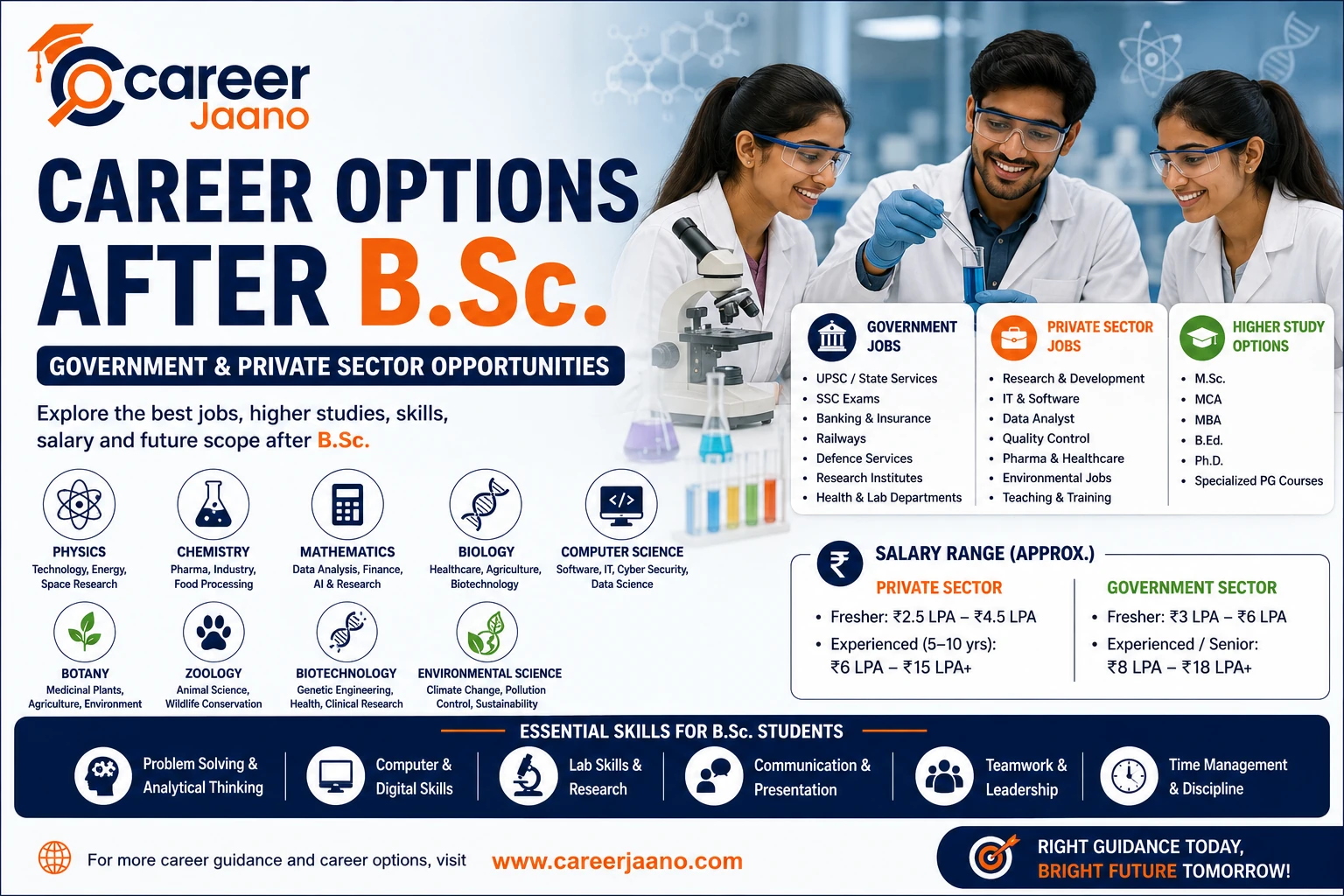
Career Options After B.Sc.: Government and Private Sector OpportunitiesA Bachelor of Science (B.Sc.) is a three-year undergraduate degree that gives students a strong foundation in science, logic, research and analytical thinking.
Students can study subjects such as:
Physics
Chemistry
Mathematics
Biology
Computer Science
Statistics
Environmental Science
Biotechnology
Botany
Zoology
These subjects are directly connected with many real-world industries.
For example:
Physics is useful in technology, electronics, energy and space research.
Chemistry is important in pharmaceuticals, food processing and manufacturing.
Biology is useful in healthcare, agriculture and biotechnology.
Mathematics and Statistics are widely used in data analysis, finance and research.
Computer Science is connected with software, IT, cybersecurity and data science.
Students who choose B.Sc. Honours usually study one subject in greater depth and build stronger subject knowledge for research, higher education and specialised jobs.
Popular B.Sc. Specialisations and Their Career Uses
B.Sc. Physics
Physics is useful in areas such as:
Electronics
Energy
Space research
Technical laboratories
Scientific research
B.Sc. Chemistry
Chemistry graduates can explore:
Pharmaceutical companies
Chemical industries
Quality control
Food testing
Environmental laboratories
B.Sc. Mathematics
Mathematics is useful in:
Data analysis
Finance
Actuarial work
Artificial Intelligence
Research
Statistics
B.Sc. Biology
Biology graduates may explore:
Healthcare support
Biotechnology
Medical research
Agriculture
Life sciences
B.Sc. Botany
Botany can lead to areas such as:
Plant research
Agriculture
Environmental conservation
Medicinal plants
Forestry-related research
B.Sc. Zoology
Zoology students may work in:
Wildlife research
Animal science
Environmental projects
Conservation
Research laboratories
B.Sc. Computer Science
Computer Science graduates can build careers in:
Software development
Web development
IT support
Data analysis
Cybersecurity
Software testing
B.Sc. Biotechnology
Biotechnology is connected with:
Genetic research
Healthcare
Clinical research
Agriculture
Pharmaceuticals
Life sciences
B.Sc. Environmental Science
Environmental Science students may work in:
Pollution control
Sustainability
Climate research
Environmental consulting
Waste management
Importance of Industry Skills After B.Sc.
A B.Sc. degree gives students strong academic knowledge, but practical and technical skills are equally important.
Companies usually prefer candidates who can apply their knowledge in real work situations.
Useful skills include:
Problem-solving
Analytical thinking
Computer knowledge
Programming
Data analysis
Laboratory skills
Research methodology
Communication
Presentation
Teamwork
Time management
Students can improve these skills through internships, online courses, projects and practical training.
Private Sector Career Options After B.Sc.
B.Sc. graduates can work in many private-sector industries.
The available career path mainly depends on the students specialisation and additional skills.
Science and Research Roles
Possible jobs include:
Lab Assistant
Research Assistant
Research Associate
Quality Control Analyst
Laboratory Executive
Pharmaceutical Sales Representative
IT and Computer Science Roles
Students with Computer Science, Mathematics or Statistics backgrounds may explore:
Data Analyst
Software Testing Assistant
IT Support Executive
Network Support Assistant
Web Developer Trainee
Technical Support Executive
Learning programming languages such as Python, SQL, Java or other relevant tools can improve career opportunities.
Mathematics and Statistics Roles
Possible job profiles include:
Data Analyst
Actuarial Assistant
Risk Analyst
MIS Executive
Market Research Analyst
Data Processing Executive
Pharmaceutical and Healthcare Industry
Students from Chemistry, Biology, Biotechnology or Life Science backgrounds may explore:
Quality Control Assistant
Lab Executive
Clinical Research Assistant
Medical Coding roles
Pharmaceutical Sales
Research support roles
The exact qualification requirement may vary for each role.
Environmental and Sustainability Careers
Environmental Science graduates may find opportunities in:
Environmental consulting
Sustainability projects
Pollution monitoring
Waste management
Environmental research
General Private-Sector Jobs
B.Sc. graduates can also apply for many graduate-level jobs that do not require a specific science specialisation.
These may include:
Digital Marketing Trainee
Customer Service Executive
HR Assistant
Administrative Assistant
Business Development Executive
Operations Executive
Education Counsellor
Subject Matter Expert
Salary After B.Sc. in the Private Sector
Salary depends on:
Specialisation
Skills
Job role
Company
Location
Experience
Additional certifications
Fresh graduates usually begin with entry-level packages.
Candidates with strong technical skills in areas such as data analysis, programming, research, laboratory technology or specialised scientific work may get better opportunities.
With experience and additional qualifications, salary can grow significantly.
Government Jobs After B.Sc.
B.Sc. graduates can also apply for a wide range of government jobs.
Depending on the recruitment rules, they may be eligible for opportunities in:
Banking
SSC
UPSC
State government departments
Railways
Defence
Research organisations
Health departments
Scientific institutions
Banking and Insurance Jobs
B.Sc. graduates can apply for many graduate-level banking examinations.
Possible roles include:
Probationary Officer
Clerk
Office Assistant
Assistant
Administrative roles
UPSC and State Civil Services
B.Sc. graduates can appear for the UPSC Civil Services Examination and eligible state-level civil services examinations.
Possible services include:
IAS
IPS
IRS
Other central and state services
Eligibility depends on the latest official recruitment rules.
SSC Jobs
B.Sc. graduates may be eligible for different SSC posts such as:
Assistant
Tax Assistant
Statistical roles
Scientific Assistant
Auditor
Accountant
Some specialist posts may require specific subjects such as Mathematics, Statistics or Science.
Scientific and Research Organisations
Science graduates may also find opportunities in government research institutions.
Depending on their qualification and specialisation, they can explore roles in areas such as:
Scientific research
Laboratories
Technical support
Data analysis
Environmental research
Space and defence research
Higher qualifications such as M.Sc. may be required for many research positions.
Indian Railways
B.Sc. graduates may apply for eligible graduate-level and technical posts in Indian Railways.
Opportunities depend on the recruitment notification and required qualification.
Defence Services
B.Sc. graduates may explore suitable officer-level or technical opportunities through eligible entry routes.
Possible areas may include:
Administration
Logistics
Education
Technical support
Scientific roles
Territorial Army
The exact eligibility varies by branch and recruitment process.
Health and Laboratory Departments
Science graduates may also explore jobs in:
Government laboratories
Research centres
Public health projects
Healthcare support services
Some technical roles may require specific professional qualifications or certifications.
Best Higher Study Options After B.Sc.
Higher education can help students gain specialisation and access better career opportunities.
Course
Career Benefit
M.Sc.
Advanced study, research and specialised science careers
MCA
Computer applications, software and IT careers
MBA
Management and corporate leadership roles
B.Ed.
Teaching careers
Ph.D.
Research and university-level academic careers
Specialised PG Courses
Data science, biotechnology, analytics and other professional fields
M.Sc.
M.Sc. is one of the most common options after B.Sc.
Students can specialise in areas such as:
Physics
Chemistry
Mathematics
Zoology
Botany
Biotechnology
Environmental Science
Statistics
Computer Science
It is useful for research, teaching and specialised technical careers.
MCA
Students interested in IT and software careers can consider MCA, subject to the eligibility criteria of the institution.
It can help build careers in:
Software development
Data systems
IT
Web technologies
Application development
MBA
B.Sc. graduates can also pursue an MBA.
Popular specialisations include:
Business Analytics
Marketing
Human Resources
Finance
Operations
Healthcare Management
B.Ed.
Students who want to become teachers can explore B.Ed. after meeting the required eligibility conditions.
Ph.D.
Students interested in advanced research and academics can pursue a Ph.D. after completing the required postgraduate qualification.
Other Professional Courses
Depending on their interests, B.Sc. students can also explore:
Data Science
Artificial Intelligence
Clinical Research
Bioinformatics
Environmental Management
GIS
Cybersecurity
Actuarial Science
Which Career is Best After B.Sc.?
There is no single best career for every B.Sc. graduate.
The right choice depends on your:
Specialisation
Skills
Interests
Career goals
Higher education plans
For example:
If you like research, M.Sc. and research careers may suit you.
If you enjoy technology, IT, data science or programming may be a good option.
If you want a government job, you can prepare for UPSC, SSC, banking or other competitive exams.
If you enjoy teaching, higher studies and B.Ed. can be useful.
If you want management roles, MBA can open a different career path.
Future Scope After B.Sc.
The future scope of B.Sc. is strong because science graduates can move into both traditional and emerging industries.
Some fast-growing areas include:
Data Science
Artificial Intelligence
Biotechnology
Environmental Science
Renewable Energy
Cybersecurity
Healthcare Research
Climate Science
Scientific Computing
Students who combine science knowledge with modern technical skills may have wider career opportunities in the future.
Conclusion
B.Sc. is more than just a science degree. It gives students a strong foundation in scientific thinking, research, analysis and problem-solving.
Graduates can explore careers in the private sector, government organisations, research institutions, technology companies, education and higher studies.
The key to building a successful career after B.Sc. is to combine academic knowledge with practical skills and choose a career path that matches your interests.
Before making a final career decision, guidance from a qualified career counsellor can also help you understand your strengths and select the right direction.
For more career options and career guidance, visit Career Jaano .
Frequently Asked Questions (FAQs)
1. What are the best career options after B.Sc.?
Popular options include research, data analysis, IT, laboratory jobs, pharmaceutical careers, government jobs, teaching and higher studies such as M.Sc., MCA or MBA.
2. Can I get a government job after B.Sc.?
Yes. B.Sc. graduates can apply for many government exams and jobs through UPSC, SSC, banking, railways, state government departments and research organisations.
3. Which course is best after B.Sc.?
M.Sc. is a strong option for students who want to continue in science. MCA, MBA, B.Ed. and specialised courses in Data Science, AI or Biotechnology are also popular choices.
4. Can I go into IT after B.Sc.?
Yes. Students with Computer Science, Mathematics, Statistics or strong programming skills can explore careers in IT, software, data analysis and technical support.
5. Is B.Sc. good for government exams?
Yes. A recognised B.Sc. degree makes students eligible for many graduate-level government examinations, depending on the specific recruitment rules.
6. What skills should B.Sc. students learn for better jobs?
Useful skills include data analysis, programming, laboratory techniques, research methodology, MS Excel, communication and problem-solving.
7. Is B.Sc. enough to get a good job?
B.Sc. can help you get entry-level opportunities, but practical skills, internships, certifications and higher education can significantly improve your job prospects and salary.
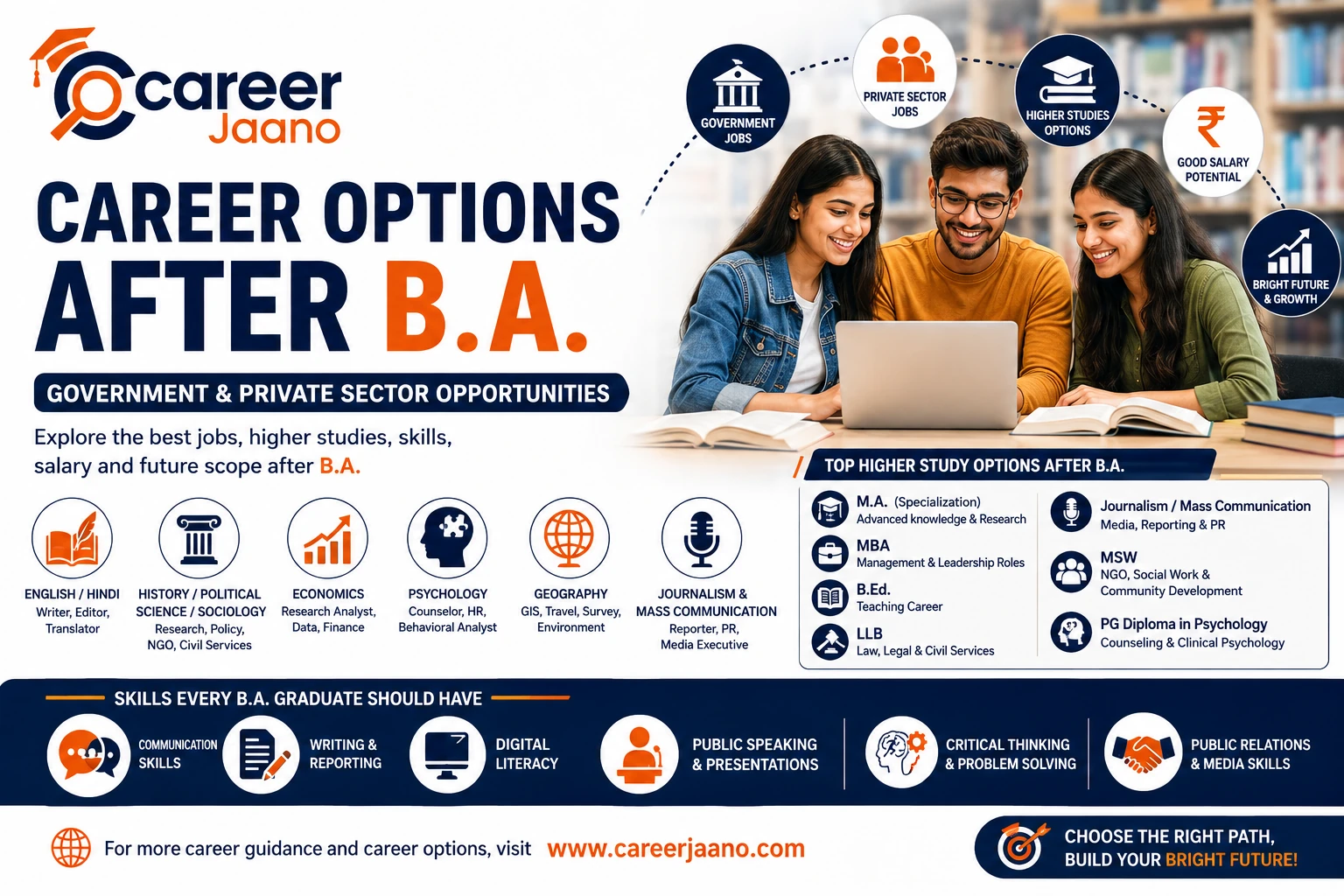
Career Options After B.A.: Government and Private Sector OpportunitiesA Bachelor of Arts (B.A.) is a three-year undergraduate degree that gives students a strong understanding of humanities, social sciences and languages.
Students can study subjects such as:
English
Hindi
History
Geography
Political Science
Economics
Sociology
Psychology
Philosophy
Journalism and Mass Communication
Students who choose B.A. Honours usually study one subject in greater depth. For example, a student may specialise in English Literature, History, Political Science, Economics, Psychology or Sociology.
Because B.A. offers many subject combinations, students can explore careers in government services, media, education, research, counselling, administration, corporate jobs and social development.
Importance of Industry Skills After B.A.
A B.A. degree helps students develop communication, critical thinking and analytical skills.
However, in todays job market, only having a degree may not be enough. Employers also look for practical skills that can be used in the workplace.
Whether you want to work in media, teaching, HR, public relations or a corporate office, practical skills can improve your job opportunities.
Important Skills for B.A. Graduates
Students should try to develop the following skills:
Communication skills
Writing skills
MS Office
Content management tools
Research skills
Report writing
Public speaking
Presentation skills
Critical thinking
Problem-solving
Public relations skills
Social media handling
Basic data analysis
These skills can be learned through internships, online courses, workshops and practical projects.
Private Sector Career Options After B.A.
B.A. graduates can work in many private-sector industries.
Some common areas include:
Media
Education
Public Relations
Content Writing
Human Resources
Social Media
Digital Marketing
Counselling
EdTech
Travel and Tourism
Research
Media and Mass Communication
Students interested in media can explore roles such as:
Reporter
Journalist
News Writer
News Editor
Public Relations Executive
Media Coordinator
Students with a background in Journalism, English, Political Science or Mass Communication may find these roles especially suitable.
Content and Digital Sector
The digital industry has created many career opportunities for Arts graduates.
Possible roles include:
Content Writer
Copywriter
Copy Editor
Social Media Executive
SEO Executive
Content Coordinator
Digital Marketing Executive
Strong writing and digital skills can help students grow in this sector.
Education and Training
Students interested in education can explore jobs such as:
Teaching Assistant
Online Tutor
Academic Coordinator
Education Counsellor
Content Developer
For school teaching roles, students generally need additional qualifications such as B.Ed., depending on the position and applicable rules.
Corporate and Human Resources
B.A. graduates can also work in corporate offices.
Common roles include:
HR Assistant
Recruitment Coordinator
Training Coordinator
Admin Executive
Operations Executive
Customer Relationship Executive
Good communication and organisational skills are especially useful in these roles.
Tourism and Hospitality
Students interested in travel and tourism can work as:
Tour Coordinator
Travel Consultant
Guest Relations Executive
Hospitality Executive
Travel Content Executive
Knowledge of languages and communication skills can be an advantage.
Career Options Based on B.A. Specialisation
Your B.A. subject can also influence your career opportunities.
B.A. English or Hindi
Students with a language or literature background can explore:
Content Writing
Editing
Translation
Publishing
Journalism
Teaching
Copywriting
B.A. History, Political Science or Sociology
Possible career options include:
Research Assistant
Public Policy Assistant
NGO Coordinator
Social Researcher
Political Research Assistant
Content Researcher
Civil Services Preparation
These subjects are also popular among students preparing for government examinations.
B.A. Economics
Economics graduates can explore roles such as:
Research Analyst
Market Research Executive
MIS Executive
Business Research Assistant
Financial Research Assistant
Data Support Executive
Additional skills in Excel, statistics and data analysis can improve career opportunities.
B.A. Psychology
Students with Psychology can explore areas such as:
Counselling support
HR
Training
Behavioural research
Career counselling support
Education services
For professional or regulated psychology roles, students may need additional postgraduate qualifications, supervised training or other credentials depending on the type of practice.
B.A. Geography
Geography students may explore opportunities in:
GIS
Mapping
Travel and Tourism
Survey Research
Environmental Research
Disaster Management
Learning GIS software can improve job prospects.
B.A. Philosophy
Possible career areas include:
Research
Education
Ethics-related work
Writing
Policy research
Academic support
B.A. Journalism and Mass Communication
Students can explore roles such as:
Reporter
Journalist
PR Executive
Digital Media Executive
Video Content Coordinator
Media Researcher
Government Jobs After B.A.
A B.A. degree also makes students eligible for many graduate-level government examinations.
Depending on the recruitment rules, students may apply for opportunities in:
UPSC
SSC
Banking
Railways
State Public Service Commissions
Defence services
Postal services
Government departments
Public-sector organisations
Civil Services
B.A. graduates can appear for the UPSC Civil Services Examination if they meet the eligibility requirements.
Successful candidates can enter services such as:
IAS
IPS
IRS
Other Group A and Group B services
Subjects such as History, Political Science, Sociology and Geography can also help students build a strong foundation for civil services preparation.
SSC Jobs
Through SSC examinations, graduates may become eligible for roles such as:
Assistant
Auditor
Inspector
Tax Assistant
Accountant
Administrative posts
Eligibility depends on the specific recruitment notification.
Banking Jobs
B.A. graduates can also apply for graduate-level banking recruitment processes.
Popular roles include:
Probationary Officer
Clerk
Office Assistant
Customer Service Associate
Railway Jobs
Possible railway roles may include:
Commercial posts
Administrative roles
Clerk-level posts
Graduate-level non-technical posts
Recruitment depends on the latest official notification.
Defence Careers
Eligible graduates can also explore officer-level opportunities in defence services through appropriate entry routes.
Depending on qualification and recruitment rules, possible areas may include:
Administration
Logistics
Education
Territorial Army
Other officer-level roles
Government Opportunities Based on Specialisation
History, Political Science and Sociology
Students may explore:
Civil Services
State Government Services
Rural Development
Research Projects
Policy Research
Legislative Research
Economics
Possible opportunities include:
Economic research
Banking examinations
Government statistical and research departments
Policy support roles
Some specialist economics or statistics posts may require specific subject combinations or postgraduate qualifications.
Psychology
Students may explore eligible roles in:
Social welfare departments
Educational institutions
Rehabilitation services
Training and research
Professional psychologist posts usually require additional qualifications.
Geography
Possible areas include:
GIS and mapping
Disaster management
Environmental projects
Survey-related work
Urban and rural planning support
Mass Communication
Students may explore opportunities in:
Government communication departments
Public relations
Information services
Public broadcasters
Media and communication projects
Best Higher Study Options After B.A.
B.A. graduates have several good options for higher education.
Course
Career Benefit
M.A.
Advanced knowledge, research and academic careers
MBA
Management and corporate careers
B.Ed.
Teaching careers
LLB
Law, legal services and corporate law
Journalism / Mass Communication
Media, reporting, PR and digital communication
MSW
NGOs, development sector and social services
PG in Psychology
Counselling, psychology and behavioural careers
M.A.
Students can pursue a master's degree in the same or related subject.
Popular options include:
M.A. English
M.A. History
M.A. Political Science
M.A. Economics
M.A. Sociology
M.A. Psychology
M.A. Geography
An M.A. can be useful for teaching, research and specialised careers.
MBA
B.A. graduates can also pursue an MBA.
Popular specialisations include:
Human Resources
Marketing
Finance
International Business
Operations
Business Analytics
An MBA can help students move into management and corporate roles.
B.Ed.
Students interested in school teaching can pursue B.Ed. after graduation, subject to applicable eligibility requirements.
LLB
LLB can be a good option for students interested in:
Law
Judiciary
Corporate legal roles
Civil services
Legal research
Journalism and Mass Communication
Students who want to build a career in media can pursue postgraduate courses in:
Journalism
Mass Communication
Digital Media
Public Relations
Master of Social Work (MSW)
MSW is suitable for students interested in:
NGOs
Social development
Community work
Public health programmes
Corporate social responsibility
Salary After B.A.
Salary after B.A. depends on many factors, including:
Job role
Skills
Specialisation
Location
Company
Experience
Additional qualifications
Fresh graduates may start with entry-level salary packages in private organisations.
Students with strong communication, digital, research, data or specialised skills may get better opportunities.
Government salaries depend on the post, pay level and recruitment rules.
Instead of focusing only on starting salary, students should also focus on gaining practical experience and building strong professional skills.
Which Career is Best After B.A.?
There is no single best career after B.A.
The right career depends on your:
Subject specialisation
Interests
Skills
Career goals
Personality
Higher education plans
For example:
If you enjoy writing, you can explore content, media or publishing.
If you are interested in government service, you can prepare for UPSC, SSC, banking or state-level exams.
If you enjoy teaching, you can consider B.Ed. and higher education.
If you are interested in business, MBA can be a good option.
If you are interested in law, LLB can open new career paths.
If you like psychology and human behaviour, you can pursue higher studies in Psychology.
Conclusion
A B.A. is not just a general graduation degree. It can open the door to many different career paths in government, private companies, education, media, research, law, management and social development.
The key is to combine your degree with practical skills and choose a career according to your interests and strengths.
Students should also consider internships, certifications and higher education to improve their career opportunities.
Before choosing a career, getting guidance from a qualified career counsellor can help you understand your strengths and make a better decision.
For more career guidance and career options, visit Career Jaano
Frequently Asked Questions (FAQs)
1. What are the best career options after B.A.?
Popular options include government jobs, teaching, content writing, journalism, HR, public relations, law, MBA, social work and research.
2. Can I get a government job after B.A.?
Yes. B.A. graduates can apply for many graduate-level government exams such as UPSC, SSC, banking, railways and state government recruitment exams.
3. Which course is best after B.A.?
Popular courses include M.A., MBA, B.Ed., LLB, Journalism, Mass Communication and MSW. The best choice depends on your career goal.
4. Can I do MBA after B.A.?
Yes. B.A. graduates can pursue an MBA after meeting the admission requirements of the institution.
5. Is B.A. good for UPSC preparation?
Yes. Subjects such as History, Political Science, Sociology, Economics and Geography can be useful for building knowledge relevant to civil services preparation.
6. What private jobs can I get after B.A.?
B.A. graduates can work in content writing, media, HR, public relations, customer service, research, digital marketing, education and administration.
7. Is B.A. enough to get a good job?
A B.A. can help you enter many fields, but practical skills, internships, certifications and higher education can significantly improve your career opportunities.
Career Options After B.Com: Government and Private Sector OpportunitiesA Bachelor of Commerce (B.Com) is a three-year undergraduate degree that gives students a strong understanding of business, finance, accounting and the corporate world.
During the course, students usually study subjects such as:
Financial Accounting
Cost Accounting
Management Accounting
Income Tax
GST
Banking and Insurance
Business Law
Company Law
Economics
Statistics
Auditing
E-commerce
Computer Applications
Business Communication
Students who choose B.Com Honours usually study these subjects in more detail and may specialise in areas such as Finance, Taxation, Banking or Accounting.
Because of its broad academic structure, B.Com can open doors to private jobs, government jobs, professional courses and higher education.
Importance of Industry Skills After B.Com
A B.Com degree gives students a good academic foundation, but practical skills are equally important in todays job market.
Companies usually prefer candidates who understand both theory and workplace requirements.
Whether you want to work in an accounting firm, bank, corporate office or startup, practical knowledge can improve your chances of getting a good job.
Important Skills for B.Com Graduates
Students should try to develop the following skills:
Communication skills
MS Excel
Tally
QuickBooks
Data analysis
MIS reporting
Time management
Planning and organisation
Professional email writing
Business etiquette
Customer service
Basic business ethics
Many of these skills can be learned through online courses and practical training.
Career Options in the Private Sector
B.Com graduates can work in many private-sector industries.
Some common areas include:
Accounting
Taxation
Banking
Insurance
Retail
E-commerce
Digital marketing
Human resources
Finance
BPO and KPO
Startups
Accounting Firms
Possible job roles include:
GST Assistant
Tax Assistant
Junior Accountant
Accounts Executive
Billing Executive
Corporate Sector
B.Com graduates can work as:
MIS Executive
Accounts Assistant
Finance Executive
Recruitment Coordinator
Operations Executive
Admin Executive
Digital Marketing and E-commerce
Students interested in digital careers can explore roles such as:
Digital Marketing Trainee
Social Media Executive
SEO Executive
E-commerce Executive
Content Operations Assistant
Additional training in digital marketing can improve job opportunities in this field.
Banking and Financial Services
Possible job roles include:
Relationship Executive
Loan Processing Officer
Credit Assistant
Sales Executive
Financial Services Associate
BPO and KPO
B.Com graduates can also work as:
Data Analyst Trainee
Back Office Executive
Customer Service Executive
Finance Process Associate
Operations Associate
Startups
Startups often hire graduates for multiple roles, including:
Business Development Executive
Accounts Operator
Operations Executive
Admin Assistant
Sales Coordinator
Salary After B.Com in the Private Sector
Salary depends on skills, company, location and job profile.
Fresh B.Com graduates may commonly start with entry-level salary packages. Candidates with strong skills in accounting, Excel, taxation, finance or analytics may get better opportunities.
With experience, professional certifications and strong performance, income can increase significantly.
Instead of looking only at the starting salary, students should focus on building practical skills and gaining relevant experience.
Government Jobs After B.Com
B.Com graduates are also eligible for many government jobs.
Government departments recruit graduates for positions in:
Banking
Insurance
Railways
Staff Selection Commission
State government departments
Central government departments
Defence services
Postal services
Tax departments
Most government jobs require candidates to clear a competitive examination.
Banking and Insurance Jobs
B.Com graduates can apply for exams and recruitment processes conducted by organisations such as:
SBI
IBPS
Regional Rural Banks
LIC
Other public-sector banks and insurance organisations
Popular roles include:
Probationary Officer
Clerk
Office Assistant
Assistant
Administrative Officer
SSC and Government Department Jobs
Graduates can apply for various posts through central and state recruitment examinations.
Possible roles include:
Auditor
Accountant
Tax Assistant
Junior Accountant
Inspector
Assistant
Clerk
Administrative roles
Eligibility depends on the specific recruitment notification.
UPSC Civil Services
B.Com graduates can also appear for the UPSC Civil Services Examination, provided they meet the eligibility requirements.
Successful candidates may enter services such as:
IAS
IPS
IRS
Other Group A and Group B services
The exact service allocation depends on rank, preferences and vacancies.
Railway Jobs
Indian Railways also recruits graduates for different administrative and commercial roles.
Depending on the recruitment notification, B.Com graduates may be eligible for posts in:
Accounts
Commercial departments
Administration
Clerical services
Defence Career Options
Graduates may also explore officer-level opportunities in the armed forces through eligible entry routes.
Possible areas may include:
Administration
Logistics
Accounts
Education-related roles
Territorial Army
Eligibility requirements can differ based on age, physical standards, examination and branch.
Postal Department Jobs
B.Com graduates may also apply for eligible posts in the postal department, depending on recruitment notifications.
Possible roles may include:
Postal Assistant
Sorting Assistant
Administrative positions
Best Higher Study Options After B.Com
B.Com graduates have several strong options for higher education and professional qualifications.
Course
Career Benefit
Chartered Accountancy (CA)
Accounting, taxation, audit and finance
Company Secretary (CS)
Corporate law, compliance and governance
Cost and Management Accountancy (CMA)
Cost management, finance and business strategy
MBA
Management, finance, marketing, HR and leadership roles
M.Com
Higher studies, academics, research and commerce specialisation
LLB
Corporate law, taxation law and legal careers
Chartered Accountancy (CA)
CA is one of the most popular professional courses after B.Com.
It is suitable for students interested in:
Accounting
Taxation
Audit
Finance
Corporate advisory
Company Secretary (CS)
CS can be a good option for students interested in:
Company law
Corporate compliance
Governance
Secretarial practices
Cost and Management Accountancy (CMA)
CMA is suitable for students who are interested in:
Cost control
Financial planning
Management accounting
Business strategy
MBA
An MBA can help B.Com graduates move towards management and leadership roles.
Popular MBA specialisations include:
Finance
Marketing
Human Resources
Business Analytics
Operations
International Business
M.Com
M.Com is suitable for students who want to continue their studies in commerce.
It can be useful for careers in:
Teaching
Research
Accounting
Finance
Academics
LLB
B.Com graduates who are interested in law can pursue LLB.
This combination can be useful for careers related to:
Corporate law
Tax law
Banking law
Business law
Which Career is Best After B.Com?
There is no single best career for every student.
The right option depends on your:
Interests
Skills
Career goals
Academic strengths
Financial expectations
Willingness to prepare for competitive exams or professional courses
For example:
If you like accounting and taxation, CA or accounting jobs may suit you.
If you want a government job, banking, SSC or civil services can be good options.
If you want management roles, MBA can be useful.
If you are interested in law, LLB may be a good choice.
If you want to start working quickly, you can build practical skills and apply for private-sector jobs.
Conclusion
B.Com is not just a degree. It can lead to many different career paths.
Students can choose from private jobs, government jobs, professional courses, higher education or business opportunities.
The most important thing is to combine your academic knowledge with practical skills and choose a career path that matches your interests and long-term goals.
Before making a final career decision, career counselling can also help you understand your strengths and identify suitable options.
For more career guidance and career options, visit Career Jaano
Frequently Asked Questions (FAQs)
1. What are the best career options after B.Com?
Popular options include CA, CS, CMA, MBA, M.Com, banking jobs, government exams, accounting, finance, taxation and corporate jobs.
2. Can I get a government job after B.Com?
Yes. B.Com graduates can apply for many government jobs through banking exams, SSC, UPSC, railways, insurance and state-level recruitment exams.
3. What private jobs can I get after B.Com?
You can work as an Accountant, Accounts Assistant, MIS Executive, Finance Executive, Relationship Executive, Operations Executive, Tax Assistant or Business Development Executive.
4. Which professional course is best after B.Com?
CA, CS and CMA are popular professional courses. The best option depends on whether you are more interested in accounting, corporate law or cost and management finance.
5. Is MBA a good option after B.Com?
Yes. MBA can be a strong option for students who want careers in management, finance, marketing, HR, analytics or business operations.
6. What skills should B.Com students learn for better jobs?
Useful skills include MS Excel, Tally, accounting software, MIS reporting, data analysis, communication, email writing and basic digital skills.
7. Is B.Com enough to get a good job?
B.Com can help you get entry-level jobs, but practical skills, certifications, internships and experience can significantly improve your career opportunities and salary.
Sports Psychologist: Career, Courses, Skills, Jobs and SalaryIn sports, physical fitness is important, but mental strength is just as important. Athletes often face pressure, stress, competition, fear of failure and performance anxiety.
A Sports Psychologist helps athletes become mentally stronger, improve confidence, manage stress and perform better during training and competition.
Sports Psychology is becoming an important career field because professional athletes, sports teams and academies now understand that mental preparation can directly affect performance.
What is Sports Psychology?
Sports Psychology is a branch of psychology that studies the mental and emotional factors that affect sports performance.
It focuses on areas such as:
Confidence
Motivation
Concentration
Stress management
Emotional control
Teamwork
Performance under pressure
Goal setting
Mental recovery after injury
A Sports Psychologist works with athletes to improve their mindset and help them handle challenging situations in a better way.
What Does a Sports Psychologist Do?
A Sports Psychologist may work with individual athletes, teams, coaches and sports organisations.
Their work may include:
Helping athletes manage performance pressure
Improving concentration and focus
Building confidence
Teaching stress-management techniques
Supporting athletes after injury
Helping players deal with fear of failure
Improving team communication
Developing motivation strategies
Helping athletes prepare mentally before competitions
Supporting long-term performance goals
Some Sports Psychologists also work in research, education and performance consulting.
Education and Training
To build a career in Sports Psychology, students usually need a strong foundation in Psychology.
1. Bachelor's Degree
Students can start with:
B.A. in Psychology
B.Sc. in Psychology
B.A. in Applied Psychology
During graduation, students may study subjects such as:
Human behaviour
Cognitive psychology
Social psychology
Developmental psychology
Mental health
Research methods
Statistics
A bachelor's degree helps students understand the basic principles of psychology.
2. Master's Degree
After graduation, students can pursue a master's degree in areas such as:
M.A. in Psychology
M.Sc. in Psychology
M.A. in Applied Psychology
M.Sc. in Sports Psychology
M.A. in Sports and Performance Psychology
A specialised master's programme can help students understand how psychological techniques are used in sports and athletic performance.
3. Doctoral Degree
Students interested in advanced research, teaching or specialised professional work can pursue:
Ph.D. in Psychology
Ph.D. in Sports Psychology
Psy.D. in Psychology
Doctoral-level study usually includes research, practical training and advanced psychological assessment.
Colleges and Institutes in India
Students interested in Sports Psychology can explore recognised universities and institutes offering programmes in Psychology, Sports Science, Applied Psychology and related areas.
Some institutions may offer specialised Sports Psychology courses, while others may provide related Psychology or Sports Science programmes.
Students should always check the latest course name, eligibility criteria, admission process and specialisation directly on the official website of the institution before applying.
Relevant institutions may include universities, sports institutes and colleges offering:
Psychology
Applied Psychology
Sports Science
Physical Education
Performance Psychology
Counselling-related programmes
Important Skills Required
A good Sports Psychologist needs both psychological knowledge and strong people skills.
1. Communication Skills
Sports Psychologists must communicate clearly with athletes, coaches and team members.
They should be able to explain psychological techniques in a simple and practical way.
2. Psychological Understanding
They need a strong understanding of:
Human behaviour
Emotions
Motivation
Stress
Confidence
Performance pressure
3. Problem-Solving Skills
Athletes may face different mental challenges.
A Sports Psychologist should be able to understand the problem and suggest suitable strategies.
4. Patience
Mental improvement does not happen instantly.
A Sports Psychologist needs patience while working with athletes over a long period.
5. Empathy
Understanding an athlete's emotions and challenges is very important.
Empathy helps professionals build trust and create a supportive environment.
6. Observation Skills
A Sports Psychologist should notice changes in behaviour, confidence, communication and performance.
7. Research and Data Skills
Psychologists often use assessments, surveys and performance data to understand athletes better.
Career Opportunities
Sports Psychologists can work in many different areas.
1. Sports Teams and Organisations
They may work with:
Cricket teams
Football clubs
Hockey teams
Kabaddi teams
Athletics teams
Olympic-level athletes
Professional sports organisations
Their role is to support the mental performance of players.
2. Sports Academies
Sports academies may hire psychologists to help young athletes develop confidence, discipline and mental strength.
3. Government Sports Organisations
Career opportunities may also be available in:
Sports authorities
State sports departments
National sports institutes
Athlete development programmes
The exact role and recruitment process depend on the organisation.
4. Universities and Colleges
Experienced professionals may work as:
Lecturer
Professor
Researcher
Sports Psychology Trainer
5. Private Practice
Qualified professionals may work independently and provide performance-related psychological support to athletes and teams, subject to applicable professional and licensing requirements.
6. Performance Consulting
Some Sports Psychologists work as consultants for:
Professional athletes
Coaches
Sports clubs
Fitness organisations
Corporate performance programmes
Popular Job Roles
Depending on their qualification and experience, professionals may work as:
Sports Psychologist
Performance Psychologist
Mental Performance Consultant
Sports Counsellor
Athlete Development Specialist
Psychology Researcher
Sports Psychology Trainer
Performance Coach
Team Psychology Consultant
Salary of a Sports Psychologist in India
Salary can vary greatly depending on:
Qualification
Experience
Employer
Location
Type of sports organisation
Level of athletes
Private consulting work
Professional reputation
Entry-level professionals may start with moderate salary packages, while experienced specialists working with professional teams, elite athletes or private clients may earn significantly more.
Income can also be higher for professionals who combine:
Psychology expertise
Sports experience
Performance coaching
Research knowledge
Strong professional networks
Future Scope of Sports Psychology
The future of Sports Psychology is promising because competitive sports are becoming more professional.
Athletes are now paying more attention to:
Mental health
Performance anxiety
Confidence
Focus
Recovery after injury
Motivation
Team communication
As sports academies, leagues and professional teams continue to grow, the demand for trained Sports Psychology professionals may also increase.
There may also be opportunities in:
Esports
Fitness coaching
Athlete wellness
Rehabilitation
Youth sports
Performance science
Corporate performance training
Advantages of Choosing Sports Psychology
This career can be suitable for students who enjoy both sports and psychology.
Some advantages include:
Opportunity to work with athletes
Growing awareness of mental performance
Career options in sports organisations
Opportunities in research and education
Possibility of private consulting
Work that can directly improve athlete performance
Challenges of This Career
Students should also understand the challenges.
A Sports Psychologist may need to:
Work under pressure
Handle emotionally difficult situations
Maintain confidentiality
Work during competitions and training schedules
Continue learning new techniques
Build experience before working with elite athletes
Who Should Choose This Career?
Sports Psychology may be a good option for students who are interested in:
Sports
Psychology
Human behaviour
Mental health
Motivation
Performance improvement
Coaching
Working with people
Students who enjoy understanding how the mind affects performance may find this field especially interesting.
Conclusion
Sports Psychology is an emerging career that combines psychology, sports and performance improvement.
A Sports Psychologist helps athletes become more confident, focused and mentally prepared for competition.
Students who want to enter this field should build a strong foundation in Psychology, gain practical experience and develop communication, observation and research skills.
Before choosing any career, it is helpful to understand your interests, abilities and long-term goals.
For more career options and expert career guidance, visit Career Jaano
Frequently Asked Questions (FAQs)
1. What is a Sports Psychologist?
A Sports Psychologist is a professional who helps athletes improve their mental strength, confidence, focus and performance.
2. Which degree is required to become a Sports Psychologist?
Students usually begin with a bachelor's degree in Psychology and then pursue a master's degree in Psychology, Applied Psychology or Sports Psychology.
3. Is Sports Psychology a good career in India?
Yes, it is a growing field as professional sports teams, academies and athletes are paying more attention to mental performance and psychological support.
4. Can a Sports Psychologist work with professional athletes?
Yes. Experienced and properly qualified professionals may work with professional athletes, sports teams, academies and national-level players.
5. What skills are needed for Sports Psychology?
Important skills include communication, empathy, patience, psychological understanding, problem-solving, observation and research skills.
6. Where can Sports Psychologists work?
They can work in sports academies, professional teams, universities, research organisations, sports authorities and private practice.
7. What is the future scope of Sports Psychology?
The field has good future potential because athletes are increasingly focusing on mental health, performance pressure, confidence, recovery and long-term well-being.
Futurologist: Career, Courses, Skills, Jobs, Salary and Future ScopeThe world is changing very quickly. New technologies, changing lifestyles, economic developments, climate issues and new business models are continuously shaping the way we live and work.
Because of these changes, organisations need professionals who can study present trends and help them prepare for what may happen in the future. One such professional is a Futurologist, also known as a Futurist or Strategic Foresight Professional.
A Futurologist does not simply predict the future. Instead, they study data, social behaviour, technology, economic trends and global developments to identify possible future scenarios.
They help businesses, governments, research organisations and other institutions understand upcoming opportunities, challenges and changes so that they can make better long-term decisions.
What Does a Futurologist Do?
A Futurologist studies current developments and tries to understand how they may affect the future.
Their work may include:
Studying social and economic trends
Analysing new technologies
Researching consumer behaviour
Identifying future risks and opportunities
Preparing different future scenarios
Helping organisations with long-term planning
Studying climate, population and lifestyle changes
Advising businesses on future products and services
Supporting policy and strategic decision-making
For example, a Futurologist may study how Artificial Intelligence will affect jobs, how cities may change in the next 20 years, or how climate change could influence industries and consumer behaviour.
Education and Training
There is no single compulsory degree that makes someone a Futurologist.
People enter this career from different educational backgrounds.
1. Bachelor's Degree
Students can begin with a bachelor's degree in subjects such as:
Economics
Sociology
Political Science
Psychology
Business Administration
Data Science
Statistics
Technology
Environmental Studies
International Relations
Philosophy
These subjects help students understand society, technology, economics and human behaviour.
2. Master's Degree
After graduation, students can pursue a master's degree in areas such as:
Futures Studies
Strategic Foresight
Public Policy
Economics
Development Studies
Data Analytics
Innovation Management
Business Strategy
Technology Management
International Relations
Specialised programmes in Futures Studies and Strategic Foresight are more common internationally, although Indian students can also build this career through related programmes and professional certifications.
3. Ph.D. and Research
Students interested in advanced research, academics or policy studies can pursue a Ph.D. in areas such as:
Futures Studies
Sociology
Economics
Public Policy
Technology and Innovation
Environmental Studies
Strategic Studies
A Ph.D. can be useful for people who want to work in research institutions, universities or specialised think tanks.
Where Can You Study?
Since Futurology is still a specialised career field, students may not always find a degree titled exactly Futurology or Futures Studies in every university.
Instead, they can study related areas at universities and institutes offering programmes in:
Social Sciences
Economics
Technology
Public Policy
Strategic Studies
Innovation
Management
Data Science
Development Studies
Institutions such as major universities, IITs, management institutes, policy schools and research organisations can provide relevant educational pathways.
Students should always check the latest course name, eligibility and admission requirements on the official website of the institution before applying.
Important Skills Required to Become a Futurologist
A successful Futurologist needs a combination of research, analytical and creative skills.
1. Trend Analysis
Futurologists must be able to identify patterns in areas such as:
Technology
Society
Business
Politics
Environment
Consumer behaviour
Understanding trends helps them identify possible future developments.
2. Creative Thinking
The future is not always predictable.
A Futurologist needs creative thinking to imagine different possibilities and understand how new ideas could change society or business.
3. Data Analysis
Data plays an important role in future research.
Futurologists should be comfortable analysing:
Statistics
Market reports
Consumer data
Economic indicators
Research studies
Technology adoption trends
Basic knowledge of tools such as Excel, data visualisation software and analytics platforms can be useful.
4. Research Skills
Strong research skills are essential because Futurologists need to study information from many different sources before developing future scenarios.
5. Communication Skills
A Futurologist must explain complex future trends in a simple and understandable way.
They may need to prepare:
Reports
Presentations
Strategy documents
Research papers
Future scenarios
6. Critical Thinking
Not every popular trend becomes important in the future.
Futurologists must separate short-term hype from long-term changes.
7. Strategic Thinking
Companies and governments often use future research for long-term planning.
Therefore, Futurologists need to understand how future developments may affect business strategies, public policies and investments.
Career Opportunities for Futurologists
Futurologists can work across many industries.
Private Sector Career Opportunities
Companies increasingly want to understand future consumer behaviour, technologies and market opportunities.
Futurologists may work in:
Management consulting
Technology companies
Market research companies
Financial services
Automotive companies
Consumer brands
Healthcare companies
Energy companies
Innovation teams
Strategy departments
Large consulting firms may also have teams working in strategy, innovation, technology forecasting and future trends.
Government and Public Policy Careers
Government organisations also need professionals who can study future developments.
Futurologists may contribute to areas such as:
Economic planning
Technology policy
Urban development
Climate policy
Disaster management
Education planning
Public health
Infrastructure planning
National security
Environmental planning
Professionals working in government may have job titles such as:
Policy Analyst
Research Analyst
Strategic Planner
Economic Analyst
Technology Analyst
Policy Consultant
Think Tanks and Research Organisations
Think tanks and research organisations are another major career option.
Professionals working here may research:
Global economic changes
Geopolitics
Climate change
Technology
Artificial Intelligence
Population trends
Future jobs
Urbanisation
Popular Job Roles
A person working in this field may have different job titles, including:
Futurologist
Futurist
Strategic Foresight Analyst
Trend Analyst
Research Analyst
Strategy Consultant
Innovation Consultant
Policy Analyst
Technology Forecaster
Scenario Planning Specialist
Market Intelligence Analyst
Consumer Trend Analyst
In many organisations, the job title may not be exactly Futurologist, even though the work involves future forecasting and strategic foresight.
Salary of a Futurologist in India
There is no fixed salary structure for Futurologists because this career includes many different roles and industries.
Salary depends on:
Educational qualification
Experience
Research skills
Industry
Employer
Location
Specialisation
Data and technology skills
Professionals working as research analysts, strategy consultants, trend analysts or policy analysts may start with moderate salary packages.
Experienced professionals working in consulting, corporate strategy, technology forecasting or international organisations can earn significantly higher salaries.
Instead of focusing only on the title Futurologist, students should also search for related jobs such as Strategic Foresight Analyst, Trend Analyst, Strategy Consultant and Research Analyst.
Future Scope of Futurology
The future scope of this career is growing because organisations are facing more uncertainty than before.
Some major areas creating opportunities include:
Artificial Intelligence
Companies want to understand how AI will change businesses, jobs and society.
Climate Change
Governments and businesses need long-term planning to deal with environmental and climate-related challenges.
Future of Work
Automation, remote working and new technologies are changing traditional jobs.
Smart Cities
Urban planners are studying how future cities will use technology, transportation and sustainable infrastructure.
Healthcare
New technologies, ageing populations and changing lifestyles are creating new healthcare needs.
Consumer Behaviour
Businesses want to understand what future customers will buy and how their preferences may change.
Space and Emerging Technologies
New areas such as space technology, robotics, biotechnology and quantum computing are creating new opportunities for future research.
Advantages of Becoming a Futurologist
This career can offer several benefits:
Opportunity to work with emerging technologies
Exposure to different industries
Work involving research and creativity
Opportunities in consulting and strategy
Possibility of working internationally
Growing importance of future planning
Opportunity to influence important business and policy decisions
Challenges of This Career
Futurology is also a challenging profession.
Some challenges include:
The future cannot be predicted with complete accuracy
Strong research skills are required
Continuous learning is necessary
Job titles may vary between organisations
Specialised opportunities may be limited compared with traditional careers
Professionals must understand many different industries and technologies
Who Should Choose This Career?
Futurology can be suitable for students who enjoy:
Research
Technology
Economics
Sociology
Data analysis
Current affairs
Innovation
Strategic thinking
Understanding global trends
If you regularly think about questions such as What will the world look like in 10 or 20 years?, this career may be worth exploring.
Conclusion
A Futurologist is a professional who studies present-day developments to understand possible future changes.
It is an interesting career for people who enjoy research, technology, trends, innovation and strategic thinking.
There is no single fixed path to becoming a Futurologist. Students can start with subjects such as economics, sociology, technology, data science, business or public policy and later specialise in strategic foresight and future studies.
Before choosing any career, it is always helpful to understand your interests, skills and long-term goals.
For more career options and professional career guidance, visit Career Jaano
Frequently Asked Questions (FAQs)
1. What is a Futurologist?
A Futurologist is a professional who studies current trends, technologies, social changes and economic developments to understand possible future scenarios.
2. Does a Futurologist actually predict the future?
Not exactly. Futurologists do not predict the future like fortune tellers. They use research, data, trends and scenario planning to understand what may happen in the future.
3. Which degree is best for becoming a Futurologist?
There is no single compulsory degree. Students can study Economics, Sociology, Political Science, Business, Data Science, Technology, Public Policy or related subjects and later specialise in Futures Studies or Strategic Foresight.
4. Is Futurologist a good career in India?
It is still a specialised career in India, but opportunities are increasing in consulting, research, technology, public policy, market intelligence and corporate strategy.
5. What skills are needed to become a Futurologist?
Important skills include trend analysis, research, data analysis, critical thinking, creativity, communication and strategic thinking.
6. Where can Futurologists work?
They can work in consulting firms, technology companies, research institutions, think tanks, government organisations, market research companies and corporate strategy teams.
7. What is the future scope of Futurology?
The scope is growing because companies and governments need to understand future developments in AI, climate change, future jobs, consumer behaviour, healthcare, smart cities and emerging technologies.
Petroleum Engineer: Career, Courses, Skills, Jobs and SalaryStudents who are good at Mathematics and Physics and have an interest in Earth Science, Geology, Energy and Natural Resources can consider Petroleum Engineering as a career option.
Petroleum Engineering is an important branch of engineering connected with the oil, gas and energy industry. Petroleum engineers help companies find, extract and produce oil and natural gas safely and efficiently. They also work on improving drilling methods, production systems and technologies used in the energy sector.
This career requires strong technical knowledge, analytical thinking, problem-solving ability and an understanding of natural resources. Petroleum engineers often work with geologists, drilling engineers, scientists and other technical professionals.
What Does a Petroleum Engineer Do?
A Petroleum Engineer works on different stages of oil and gas exploration and production. Their major responsibilities may include:
Studying underground oil and gas reserves
Planning drilling and extraction methods
Improving oil and gas production
Analysing geological and production data
Designing equipment and production systems
Monitoring drilling operations
Improving safety and efficiency
Finding cost-effective methods of extracting natural resources
Working with geologists and other engineers
Depending on their role, petroleum engineers may work in offices, research centres, refineries, drilling sites or offshore locations.
Education and Training
To become a Petroleum Engineer, students need a strong academic background, especially in Mathematics and Science.
1. Bachelor's Degree
After Class 12, students can pursue courses such as:
B.Tech in Petroleum Engineering
B.E. in Petroleum Engineering
B.Tech in Petroleum Technology
B.Tech in related Oil and Gas Engineering fields
Students generally need Physics, Chemistry and Mathematics (PCM) in Class 12 for admission to engineering programmes.
During the course, students may study subjects related to:
Petroleum geology
Reservoir engineering
Drilling engineering
Production engineering
Fluid mechanics
Thermodynamics
Oil and gas exploration
Well testing
Energy technology
Safety and environmental management
2. Master's Degree
Students who want advanced knowledge or specialised career opportunities can pursue:
M.Tech in Petroleum Engineering
M.Tech in Petroleum Technology
Master's programmes in Oil and Gas Engineering
Related postgraduate programmes in Energy Engineering
A master's degree can help students move towards specialised technical, research and senior engineering roles.
3. Ph.D.
Students interested in research, innovation or teaching can pursue a Ph.D. in Petroleum Engineering or a related field.
Research areas may include:
Advanced drilling technologies
Reservoir modelling
Enhanced oil recovery
Energy efficiency
Sustainable energy systems
Carbon management
New exploration technologies
Colleges and Institutes for Petroleum Engineering in India
Students interested in this career should look for recognised universities and engineering institutes offering programmes in petroleum, energy, chemical or related engineering fields.
Some well-known institutions associated with petroleum and energy education in India include:
Indian Institute of Technology (IIT) institutions offering relevant energy, petroleum or geological programmes
University of Petroleum and Energy Studies (UPES), Dehradun
Rajiv Gandhi Institute of Petroleum Technology (RGIPT)
Pandit Deendayal Energy University (PDEU), Gujarat
Other recognised engineering universities offering petroleum, chemical or energy-related programmes
Before applying, students should always check the latest course availability, eligibility requirements, entrance examination and admission process on the official college website, because courses can change over time.
Important Skills for a Petroleum Engineer
1. Technical Knowledge
Petroleum engineers should understand drilling, reservoirs, oil and gas production, geology and energy systems.
2. Problem-Solving Skills
Oil and gas projects can involve complex technical challenges. Engineers must be able to analyse a problem and find practical solutions.
3. Analytical Skills
Engineers work with large amounts of geological, drilling and production data. Good analytical skills help them make accurate decisions.
4. Mathematics and Physics
A strong understanding of Mathematics and Physics is important because petroleum engineering involves calculations related to pressure, flow, drilling and underground formations.
5. Communication Skills
Petroleum engineers often work with multidisciplinary teams. Good communication helps them explain technical information clearly.
6. Computer and Data Skills
Modern petroleum engineering uses computer software for:
Reservoir simulation
Geological modelling
Production analysis
Drilling planning
Data interpretation
Students who are comfortable working with technology and data may have an advantage.
7. Safety Awareness
Oil and gas operations can involve heavy machinery, high pressure and challenging working environments. Understanding and following safety procedures is extremely important.
Career Opportunities for Petroleum Engineers
Petroleum engineers can find career opportunities in several areas of the energy industry.
Oil and Gas Exploration
Engineers help companies identify and evaluate potential oil and natural gas reserves.
Drilling Engineering
Drilling engineers plan and manage the process of drilling wells safely and efficiently.
Reservoir Engineering
Reservoir engineers study underground reservoirs and determine the most effective way to recover oil and gas.
Production Engineering
Production engineers work on improving the flow and production of oil and gas from wells.
Oilfield Services
Petroleum engineers can work with companies providing drilling equipment, technical services and specialised technologies to the energy industry.
Research and Development
Experienced professionals can work on new technologies for drilling, reservoir management, energy efficiency and resource recovery.
Government Sector Career Opportunities
Petroleum engineers may find opportunities in public sector energy organisations such as:
ONGC
Oil India Limited
Indian Oil Corporation Limited (IOCL)
Bharat Petroleum Corporation Limited (BPCL)
Hindustan Petroleum Corporation Limited (HPCL)
Other energy and petroleum organisations
Recruitment requirements vary between organisations and may involve GATE scores, written examinations, interviews or direct recruitment processes.
Private Sector Career Opportunities
Petroleum engineers can also work with private companies involved in:
Oil and gas exploration
Drilling services
Refining
Energy consulting
Petrochemicals
Equipment manufacturing
Engineering services
Job opportunities can be available both in India and overseas.
Popular Job Roles
After completing Petroleum Engineering, students may work as:
Petroleum Engineer
Reservoir Engineer
Drilling Engineer
Production Engineer
Well Engineer
Oil and Gas Analyst
Field Engineer
Operations Engineer
Energy Consultant
Research Engineer
The exact job role depends on the student's qualification, skills, experience and the organisation.
Salary of a Petroleum Engineer in India
The salary of a Petroleum Engineer depends on several factors, including:
Educational qualification
College or university
Technical skills
Job role
Employer
Work location
Industry experience
Offshore or field responsibilities
Fresh graduates may receive attractive starting packages, particularly when hired by major energy companies. Professionals with specialised knowledge and several years of experience can earn significantly higher salaries.
Instead of selecting this career only because of the salary, students should also consider their interest in engineering, energy, fieldwork, technology and problem-solving.
Future Scope of Petroleum Engineering
The global energy sector is changing quickly. Traditional oil and gas continue to play an important role, while companies are also investing in cleaner and more efficient energy technologies.
Because of this transition, future petroleum engineers may also work in areas such as:
Natural gas
Carbon capture and storage
Geothermal energy
Hydrogen projects
Energy transition technologies
Environmental management
Reservoir modelling
Sustainable resource management
Students who combine petroleum engineering knowledge with data science, automation, environmental technology and renewable energy skills may have wider career opportunities in the future.
Advantages of Choosing Petroleum Engineering
Some major advantages include:
Opportunities in the global energy industry
Strong technical career options
Possibility of high-paying specialised roles
Opportunities to work internationally
Exposure to advanced engineering technologies
Career options in research and energy management
Challenges of Petroleum Engineering
Students should also understand the challenges before choosing this career.
Some jobs may require:
Working at remote locations
Offshore assignments
Long working hours during important operations
Following strict safety procedures
Adapting to changes in global energy demand
Continuous learning of new technologies
Therefore, students should carefully understand the nature of the profession before making their final decision.
Conclusion
Petroleum Engineering can be an exciting career for students who enjoy Mathematics, Physics, engineering, geology and the energy sector. It provides opportunities to work on large technical projects involving oil, natural gas, drilling and energy production.
However, choosing a career should not depend only on salary or job opportunities. Students should consider their interests, abilities, working preferences and long-term career goals.
If you are unsure whether Petroleum Engineering is suitable for you, career counselling can help you understand your strengths and explore the right options.
To explore more career opportunities and get career guidance, visit Career Jaano .
Frequently Asked Questions (FAQs)
1. What is Petroleum Engineering?
Petroleum Engineering is a branch of engineering that deals with the exploration, extraction and production of oil and natural gas from underground reserves.
2. Which subjects are required to become a Petroleum Engineer?
Students generally need Physics, Chemistry and Mathematics (PCM) in Class 12 to pursue a B.Tech or B.E. programme in Petroleum Engineering.
3. Is Petroleum Engineering a good career in India?
It can be a good career for students interested in energy, engineering and geology. Opportunities are available in oil and gas companies, public sector organisations, engineering firms and energy-related industries.
4. What is the salary of a Petroleum Engineer?
Salary depends on the company, job profile, experience, qualification and location. Specialised and experienced petroleum engineers can receive attractive salary packages.
5. Can Petroleum Engineers get government jobs?
Yes. Petroleum engineers may find opportunities in organisations such as ONGC, Oil India, IOCL, BPCL and HPCL, depending on available vacancies and recruitment requirements.
6. Is Petroleum Engineering difficult?
The course can be challenging because it includes Mathematics, Physics, geology, fluid mechanics, drilling and other technical subjects. However, students with a genuine interest in engineering and science can perform well with regular study and practical training.
7. What is the future scope of Petroleum Engineering?
Petroleum engineers will continue to have opportunities in oil and natural gas, while new opportunities are also developing in areas such as carbon capture, geothermal energy, hydrogen, energy transition and sustainable resource management.
Sustainability Consultant: Career, Education, Skills, Jobs & Future ScopeWith growing awareness about climate change, environmental protection, and responsible business practices, the demand for Sustainability Consultants is increasing. Today, many companies, organisations, and government bodies are looking for professionals who can help them reduce their environmental impact while continuing to grow their business.
A Sustainability Consultant is a professional who advises organisations on how to make their operations more environmentally responsible, resource-efficient, and sustainable. They may work on areas such as energy use, waste reduction, carbon emissions, environmental policies, sustainable supply chains, and long-term business planning.
If you are interested in environmental protection and also want to understand how businesses work, a career as a Sustainability Consultant can be a good option for you.
What Does a Sustainability Consultant Do?
A Sustainability Consultant studies the environmental impact of a company or organisation and suggests practical ways to improve its sustainability performance.
Their work may include:
Studying energy and resource consumption
Identifying ways to reduce waste
Supporting carbon-emission reduction plans
Helping organisations develop sustainability strategies
Conducting environmental assessments
Preparing sustainability and ESG-related reports
Advising businesses on sustainable practices
Analysing environmental data
Supporting compliance with environmental regulations
Helping organisations balance environmental and business goals
The exact responsibilities may vary depending on the organisation and industry.
Education Required to Become a Sustainability Consultant
There is no single educational route to becoming a Sustainability Consultant. Students can enter this profession through environmental science, engineering, economics, business, public policy, or related fields.
1. Bachelor's Degree
After Class 12, students can consider bachelor's programmes in areas such as:
Environmental Science
Environmental Engineering
Ecology
Sustainability Studies
Economics
Business Administration
Geography
Energy and Environmental Studies
A bachelor's degree helps students understand the basic concepts of environmental management, climate change, business operations, and sustainable development.
2. Master's Degree
A postgraduate degree can help you develop specialised knowledge and may improve your career opportunities.
Relevant programmes may include:
Master's in Sustainability
Environmental Management
Sustainable Development
Climate Change Studies
Environmental Science
Energy Management
MBA with Sustainability or ESG-related specialisation
A master's degree can be especially useful for students who want to work in consulting firms, multinational companies, research organisations, or senior sustainability roles.
3. PhD and Research
Students interested in advanced research, academics, environmental policy, climate science, or sustainability innovation can also pursue a PhD.
A doctorate is usually not necessary for regular consulting roles, but it can be valuable for research-intensive or highly specialised careers.
Courses and Institutions in India
Students interested in this field can explore sustainability, environmental science, environmental engineering, climate studies, sustainable development, and related programmes offered by universities and institutes across India.
Some well-known institutions working in environmental, sustainability, management, or related areas include:
Indian Institutes of Technology (IITs)
TERI School of Advanced Studies
Tata Institute of Social Sciences (TISS)
University of Delhi
Savitribai Phule Pune University
Symbiosis International University
National Environmental Engineering Research Institute (NEERI)
Other universities offering Environmental Science, Sustainability, Energy, Climate Change, or Environmental Management programmes
Before applying, students should always check the latest course name, eligibility criteria, curriculum, fees, and admission process on the official website of the institution, as programmes may change over time.
Internship and Practical Experience
Academic knowledge alone is not enough in sustainability consulting. Practical experience can make a major difference when you start looking for jobs.
Students can look for internships with:
Sustainability consulting firms
Environmental consulting companies
NGOs
Research organisations
Renewable energy companies
Corporate sustainability departments
Government environmental bodies
Climate-tech companies
During an internship, you may learn how environmental audits are conducted, how sustainability data is collected, how reports are created, and how organisations develop environmental strategies.
Certifications
Professional certifications can also help you strengthen your profile.
Depending on your career direction, you can explore certifications related to:
ESG
Carbon accounting
Sustainability reporting
Environmental management
Energy management
Life Cycle Assessment
Climate risk
Green buildings
Corporate sustainability
Certifications are especially useful when combined with a relevant degree and practical experience.
Important Skills for a Sustainability Consultant
Environmental Knowledge
You should understand topics such as climate change, pollution, natural resources, energy use, carbon emissions, waste management, and sustainable development.
Business Understanding
Sustainability solutions should not only be environmentally responsible but also practical for an organisation. Understanding business strategy, costs, operations, and management can therefore be very useful.
Problem-Solving Skills
Every organisation has different sustainability challenges. A good consultant should be able to study a problem and develop practical solutions.
Data Analysis
Sustainability professionals often work with large amounts of data related to emissions, energy, waste, water consumption, and other performance indicators.
Knowledge of tools such as Excel, data visualisation software, and analytics platforms can be helpful.
Report Writing
Companies increasingly need structured sustainability, ESG, environmental, and impact reports. Strong report-writing skills can therefore improve your career prospects.
Communication Skills
A Sustainability Consultant may need to explain complex environmental issues to senior management, clients, employees, and other stakeholders.
Clear communication and presentation skills are extremely important.
Research Skills
Environmental regulations, sustainability standards, technologies, and reporting requirements continue to evolve. Professionals in this field need strong research and learning abilities.
Career Opportunities in the Private Sector
The private sector offers many opportunities for sustainability professionals.
You may find roles in:
Consulting firms
IT companies
Manufacturing companies
Renewable energy companies
Infrastructure firms
Real estate companies
Financial institutions
FMCG companies
Automotive companies
Climate-tech startups
Large consulting and professional-services firms such as Deloitte, PwC, EY and KPMG have sustainability, ESG, climate, risk, or related advisory practices.
Depending on your qualifications and experience, you may work as:
Sustainability Consultant
ESG Analyst
Sustainability Analyst
Environmental Consultant
Climate Change Consultant
Carbon Analyst
Sustainability Manager
ESG Consultant
Environmental Manager
Sustainable Supply Chain Analyst
Career Opportunities in the Government Sector
Sustainability professionals can also work with government departments, public-sector organisations, research institutes, pollution-control bodies, and environmental projects.
Opportunities may be available in areas such as:
Environmental policy
Climate-action programmes
Pollution control
Renewable energy
Waste management
Urban sustainability
Water-resource management
Environmental research
Sustainable development projects
Students interested in government careers should regularly check vacancies released by relevant ministries, departments, research institutes, and public-sector organisations.
Salary of a Sustainability Consultant in India
The salary of a Sustainability Consultant depends on several factors, including:
Educational qualification
Work experience
Job role
Employer
Location
Technical skills
ESG or sustainability expertise
Industry
Entry-level professionals may begin with analyst, associate, or junior consulting roles. With experience and specialised knowledge in areas such as ESG, carbon accounting, climate strategy, sustainability reporting, or environmental management, earning potential can increase significantly.
Instead of choosing this career only on the basis of salary, students should also consider the type of work, required skills, future growth opportunities, and their personal interest in environmental and business issues.
Future Scope of Sustainability Consulting
The future scope of sustainability consulting is promising because businesses are facing increasing pressure to reduce emissions, manage climate risks, improve resource efficiency, and communicate their environmental performance.
New career opportunities are also developing in areas such as:
ESG consulting
Carbon accounting
Net-zero strategy
Climate-risk assessment
Sustainable finance
Green buildings
Renewable energy
Circular economy
Sustainable supply chains
Environmental reporting
Professionals who combine environmental knowledge with business, technology, finance, and data-analysis skills can have strong opportunities in this field.
Is Sustainability Consulting the Right Career for You?
This career may suit you if:
You care about environmental issues
You enjoy research and analysis
You like solving practical problems
You are interested in both business and sustainability
You can work with data and reports
You have good communication skills
You want your work to create a positive environmental impact
Conclusion
Sustainability Consulting is an emerging career that brings together environmental responsibility, business strategy, data analysis, and problem-solving.
If you want to contribute towards environmental protection while helping organisations make smarter and more responsible business decisions, this profession can offer an interesting career path.
However, every student's interests, abilities, academic background, and career goals are different. Before choosing a career, it is helpful to understand your strengths and explore different career options carefully.
For career guidance and information about different career paths, you can explore Career Jaano
Frequently Asked Questions (FAQs)
1. What is a Sustainability Consultant?
A Sustainability Consultant is a professional who helps companies and organisations reduce their environmental impact and develop more sustainable business practices.
2. Which degree is best for becoming a Sustainability Consultant?
Degrees in Environmental Science, Environmental Engineering, Sustainability, Ecology, Economics, Business Administration, Energy Studies, or related fields can provide a good foundation.
3. Can a commerce or management student become a Sustainability Consultant?
Yes. Students from business, economics, finance, and management backgrounds can enter sustainability consulting, especially in areas such as ESG, sustainable finance, corporate sustainability, and sustainability strategy.
4. Is an MBA necessary to become a Sustainability Consultant?
No. An MBA is not compulsory. However, an MBA with exposure to sustainability, ESG, strategy, or environmental management can be useful for business-focused consulting roles.
5. What skills are required for Sustainability Consulting?
Important skills include environmental knowledge, data analysis, research, communication, report writing, business understanding, and problem-solving.
6. Where can Sustainability Consultants work?
They can work in consulting firms, multinational companies, environmental organisations, renewable energy companies, government bodies, NGOs, research institutions, manufacturing companies, and climate-tech startups.
7. Is Sustainability Consulting a good career in India?
It can be a promising career because more organisations are focusing on ESG, climate action, resource efficiency, environmental compliance, and sustainable business strategies.
8. Can I become a Sustainability Consultant after B.Tech?
Yes. Students with degrees in Environmental, Civil, Chemical, Mechanical, Energy, or other engineering disciplines can move into sustainability through specialised courses, internships, or postgraduate programmes.
9. What is the difference between an Environmental Consultant and a Sustainability Consultant?
An Environmental Consultant may focus more on environmental assessments, compliance, pollution, and environmental regulations. A Sustainability Consultant generally works across a broader range of environmental, social, operational, and business sustainability issues.
10. Does Sustainability Consulting have a future?
Yes. Areas such as ESG, carbon management, climate-risk assessment, net-zero planning, sustainable finance, and corporate sustainability are creating new career opportunities for qualified professionals.
Art Conservator: Build a Career in Art and Heritage PreservationIf you are interested in art, history, science, museums, and cultural heritage, then a career as an Art Conservator can be a very meaningful option for you.
An Art Conservator is a professional who protects and preserves paintings, sculptures, textiles, historical documents, manuscripts, artefacts, and other valuable cultural objects.
Their work is not only about repairing damaged art. They also study the scientific, chemical, physical, and historical condition of an object before deciding how it should be treated.
This career is a good choice for students who enjoy both creative work and scientific analysis.
Who is an Art Conservator?
An Art Conservator is a specialist who takes care of valuable artworks and cultural objects.
They may work with:
Paintings
Sculptures
Textiles
Manuscripts
Historical documents
Archaeological objects
Museum collections
Decorative art
Old photographs
Cultural artefacts
The main goal is to make sure these objects stay safe for future generations.
What Does an Art Conservator Do?
The work of an Art Conservator can include many different tasks.
1. Examine the Condition of Art
They carefully study an artwork or object to find damage, cracks, fading, moisture problems, chemical changes, or other issues.
2. Clean and Repair Objects
They use special methods to clean and repair damaged items without changing their original value.
3. Protect from Future Damage
Art Conservators also help protect objects from:
Humidity
Heat
Light
Dust
Insects
Pollution
Poor storage conditions
4. Scientific Testing
They may use scientific tools and methods to understand the materials used in an artwork.
5. Documentation
They maintain detailed records of the condition, treatment, and history of each object.
Education and Training
To build a career in Art Conservation, proper education and practical training are very important.
Bachelor's Degree
Students can start with subjects such as:
Art History
Chemistry
Archaeology
Fine Arts
History
Museum Studies
Heritage Studies
A background in Chemistry can be especially useful because conservation often involves understanding materials and chemical reactions.
Master's Degree
For specialised work, students can continue with postgraduate programmes in areas such as:
Art Conservation
Heritage Conservation
Museology
Archaeology
Conservation Science
Art History
Ph.D. and Research
Students interested in advanced research, teaching, or specialised conservation work can also choose a Ph.D.
Institutes and Training Options
Students can explore institutes and organisations connected with museums, archaeology, art history, and heritage conservation.
Some well-known names in India include:
National Museum Institute
INTACH
Archaeological Survey of India
Universities offering Museology, Archaeology, Heritage Studies, or Art History
Museums and conservation laboratories
International institutions also offer advanced programmes in conservation and heritage management.
Before joining any programme, always check the latest information about:
Eligibility
Course duration
Fees
Admission process
Practical training
Specialisation
from the official website of the institute.
Online Courses
Online courses can be useful for learning the basics of:
Art History
Museum Studies
Heritage Management
Conservation Science
Documentation
However, practical conservation work usually requires hands-on training.
Skills Required to Become an Art Conservator
A successful Art Conservator needs a mix of scientific knowledge, patience, creativity, and attention to detail.
1. Scientific Knowledge
Knowledge of chemistry and physical processes can help you understand how different materials react over time.
2. Knowledge of Art Materials
You should understand materials such as:
Paint
Canvas
Paper
Wood
Metal
Stone
Textile
Ceramics
3. Problem-Solving Skills
Every damaged artwork is different.
You need to decide the safest way to treat each object.
4. Attention to Detail
Conservation work often involves very small and delicate tasks.
Even a minor mistake can damage an important object.
5. Patience
Some conservation projects can take weeks or months.
You need patience and focus to work carefully.
6. Research Skills
You may need to study the history, material, artist, and earlier treatments of an object.
7. Communication Skills
Art Conservators often work with:
Historians
Museum professionals
Scientists
Archaeologists
Curators
Researchers
Good communication and teamwork are very important.
Career Opportunities in the Private Sector
Art Conservators can work in many private organisations.
Possible work areas include:
Private museums
Art galleries
Auction houses
Art restoration companies
Heritage organisations
Private collections
Conservation studios
Art dealers
Cultural foundations
Possible job roles include:
Art Conservator
Painting Conservator
Paper Conservator
Textile Conservator
Museum Conservator
Heritage Conservator
Restoration Specialist
Conservation Assistant
Collection Care Specialist
Freelance and Independent Work
Experienced Art Conservators can also work independently.
They may provide services to:
Private collectors
Art galleries
Museums
Heritage organisations
Auction houses
Historical institutions
Freelancing can give more flexibility, but strong skills and a good professional reputation are important.
Career Opportunities in the Government Sector
Government organisations also provide career opportunities in heritage protection, museums, archives, and archaeology.
Possible areas include:
Archaeological departments
National museums
State museums
Archives
Heritage departments
Cultural departments
Research institutions
Universities
Possible roles include:
Conservator
Conservation Assistant
Museum Professional
Heritage Specialist
Research Assistant
Restoration Expert
Documentation Specialist
Government recruitment rules and eligibility can be different for every post.
Students should always check official recruitment notifications.
Salary and Career Growth
The salary of an Art Conservator depends on experience, specialisation, employer, location, and type of work.
At the starting level, professionals may earn around ₹3 lakh to ₹6 lakh per year.
With experience and advanced skills, Art Conservators may earn around ₹8 lakh to ₹10 lakh per year or more.
Senior professionals, consultants, and specialised experts may earn even higher income depending on their projects and organisation.
Government salaries are usually based on the official pay structure of the department.
These figures are general estimates and actual income can vary.
Is Art Conservation a Good Career?
Yes, Art Conservation can be a very meaningful career if you are interested in:
Art
History
Science
Culture
Museums
Heritage
Research
It gives you the opportunity to protect valuable objects and help preserve history for future generations.
Who Should Choose This Career?
You may enjoy this career if:
You love art and history
You enjoy detailed work
You are patient
You are interested in science
You enjoy research
You like working with museums and heritage
You want to protect cultural objects
Before choosing any career, it is always better to understand your interests, skills, personality, and long-term goals.
If you are confused about your career direction, you can also take guidance from a professional career counsellor.
You can explore more career options on Career Jaano .
FAQs About Art Conservator Career
1. What does an Art Conservator do?
An Art Conservator protects, repairs, studies, and preserves paintings, sculptures, documents, textiles, and other valuable cultural objects.
2. Which course is best for becoming an Art Conservator?
Courses in Art Conservation, Art History, Chemistry, Archaeology, Museology, Heritage Studies, or Fine Arts can be useful.
3. Is Chemistry important for Art Conservation?
Yes. Chemistry can be very useful because Art Conservators often need to understand materials, pigments, ageing, and chemical changes.
4. Can I become an Art Conservator after Class 12?
Yes. After Class 12, you can choose a relevant bachelor's degree and later specialise in Art Conservation or Heritage Conservation.
5. Where can Art Conservators work?
They can work in museums, galleries, archives, archaeology departments, auction houses, restoration studios, heritage organisations, and private collections.
6. What is the salary of an Art Conservator in India?
A beginner may earn around ₹3 lakh to ₹6 lakh per year. Experienced professionals may earn ₹8 lakh to ₹10 lakh per year or more depending on their role and specialisation.
7. Is Art Conservation a good career in India?
Yes. It can be a good career for students who are interested in art, history, science, museums, and cultural heritage.
Voice Actor: Build a Creative Career with Your VoiceIf you have a good voice, enjoy acting, and can express different emotions through your voice, then a career as a Voice Actor can be a very exciting option for you.
A Voice Actor is a professional who gives voice to characters, advertisements, documentaries, audiobooks, games, cartoons, podcasts, and many other types of digital content.
Unlike normal acting, a Voice Actor does not always appear on screen. Their main tool is their voice.
Today, Voice Actors are needed in many industries such as:
Films
Television
Animation
Cartoons
Advertisements
Video games
Audiobooks
Podcasts
Documentaries
Dubbing
Digital media
If you can change your tone, pitch, accent, and emotions according to a character or situation, then Voice Acting can become a strong career option for you.
Who is a Voice Actor?
A Voice Actor is someone who uses their voice to bring a character, story, or message to life.
They may give voice to:
Cartoon characters
Film characters
Game characters
Advertisements
Audiobooks
Documentaries
Podcasts
Radio shows
Corporate videos
E-learning content
A good Voice Actor knows how to control tone, emotion, speed, pronunciation, and expression.
What Does a Voice Actor Do?
A Voice Actor may perform different types of work depending on the project.
1. Character Voice
They give voice to animated characters, cartoon characters, game characters, and fictional roles.
2. Dubbing
Voice Actors dub films, TV shows, and web series from one language to another.
3. Advertising Voice-Over
They record voice for TV ads, radio commercials, YouTube ads, and digital campaigns.
4. Audiobooks
Voice Actors also narrate books and stories for audiobook platforms.
5. Podcasts and Digital Content
They may work as hosts, narrators, or voice-over artists for podcasts, documentaries, explainers, and online videos.
Education and Training
There is no fixed degree required to become a Voice Actor.
However, proper training can improve your acting and voice control.
Useful courses may include:
Theatre Arts
Acting
Media Studies
Mass Communication
Performing Arts
Voice and Speech Training
Students can also join workshops in:
Voice Acting
Dubbing
Voice Modulation
Pronunciation
Acting
Public Speaking
Institutes related to acting, theatre, film, and media can also help you develop useful skills.
Before joining any course, always check the latest details about eligibility, fees, duration, and training structure from the official website.
Practical Training is Very Important
Voice Acting is a practical skill.
You improve mainly through regular practice and real projects.
You can start with:
Short voice-over samples
YouTube videos
Student films
Podcasts
Audiobooks
Local advertisements
Dubbing practice
Animation projects
With time, you can build a strong voice demo or portfolio.
Skills Required to Become a Voice Actor
A successful Voice Actor needs several important skills.
1. Voice Control
You should be able to control:
Tone
Pitch
Speed
Volume
Emotion
This helps you perform different characters and situations.
2. Acting Skills
Voice Acting is still acting.
You need to understand the emotions and personality of a character and express them only through your voice.
3. Good Pronunciation
Clear pronunciation is very important.
Good command of Hindi, English, or regional languages can increase your opportunities.
4. Accent and Language Skills
Knowing different accents and languages can help you work on more projects.
5. Recording Skills
You should know the basics of:
Microphones
Audio recording
Noise control
Basic editing
Recording software
6. Patience
Sometimes one line may need to be recorded many times.
Patience and consistency are important.
7. Creativity
A Voice Actor should be able to create different voices and expressions.
8. Listening Skills
Good listening skills help you understand direction and improve your performance.
Career Opportunities in the Private Sector
Voice Actors can work in many private industries.
Some major areas include:
Animation studios
Film studios
Dubbing studios
Advertising agencies
Gaming companies
Podcast companies
Audiobook platforms
Radio stations
Digital media companies
YouTube production houses
E-learning companies
Possible job roles include:
Voice Actor
Voice-Over Artist
Dubbing Artist
Narrator
Audiobook Artist
Podcast Voice Artist
Character Voice Artist
Radio Presenter
Commercial Voice Artist
Many Voice Actors also work as freelancers.
Career Opportunities in the Government Sector
Government media organisations may also offer opportunities for voice-based work.
Possible areas include:
All India Radio
Doordarshan
Government documentaries
Educational content
Public awareness campaigns
Cultural programmes
Government media productions
Opportunities may include roles such as:
Narrator
Voice-Over Artist
Presenter
Dubbing Artist
Announcer
Selection rules and requirements may vary from project to project.
Freelancing Opportunities
Freelancing is a very common option in Voice Acting.
You can work from your own home studio and record voice for clients.
Freelancers may work on:
Ads
YouTube videos
Audiobooks
Podcasts
Mobile apps
Games
Corporate videos
E-learning courses
A good microphone, quiet room, basic recording setup, and strong portfolio can help you get freelance work.
Salary and Income
Voice Actor income depends on:
Experience
Type of project
Language
Client
Popularity
Recording duration
Platform
A fresher may earn around ₹3 lakh to ₹6 lakh per year through regular work or projects.
Experienced Voice Actors may earn around ₹10 lakh to ₹15 lakh per year or more, depending on the number and quality of projects.
Freelancers may earn differently because payment is often project-based.
Some projects may pay per hour, per script, per episode, or per recording.
These are only general estimates. Actual income can vary a lot.
Is Voice Acting a Good Career?
Yes, Voice Acting can be a good career if you enjoy:
Acting
Speaking
Storytelling
Languages
Audio
Creative work
It is especially suitable for people who can express emotions strongly through their voice.
However, success requires regular practice, patience, good voice control, and a strong portfolio.
Who Should Choose Voice Acting?
You may enjoy this career if:
You have a clear and expressive voice
You enjoy acting
You can change your tone easily
You enjoy storytelling
You are comfortable with microphones
You can practice regularly
You are interested in media and entertainment
Before choosing any career, it is always better to understand your interests, skills, personality, and long-term goals.
If you are confused about the right career path, you can also take guidance from a professional career counsellor.
You can explore more career options on Career Jaano.
FAQs About Voice Actor Career
1. What does a Voice Actor do?
A Voice Actor gives voice to characters, advertisements, audiobooks, documentaries, podcasts, games, and other media content.
2. Do I need a degree to become a Voice Actor?
No. A special degree is not compulsory. However, training in acting, theatre, media, voice modulation, and speech can be very useful.
3. Can I become a Voice Actor after Class 12?
Yes. After Class 12, you can start voice training, acting workshops, dubbing practice, and build your voice portfolio.
4. What skills are important for Voice Acting?
Important skills include voice control, acting, pronunciation, language skills, creativity, patience, and recording knowledge.
5. Can I work as a freelance Voice Actor?
Yes. Many Voice Actors work as freelancers and record from home for ads, audiobooks, podcasts, games, and digital content.
6. What is the salary of a Voice Actor in India?
A fresher may earn around ₹3 lakh to ₹6 lakh per year, while experienced professionals may earn ₹10 lakh to ₹15 lakh per year or more depending on projects.
7. Is Voice Acting a good career in India?
Yes. It can be a good career for people who are interested in acting, storytelling, languages, and digital media. A strong voice demo and regular practice are very important.
Spacecraft Designer: Build a Career in Space TechnologyIf you are interested in space, engineering, mathematics, satellites, rockets, and new technology, then a career as a Spacecraft Designer can be a very exciting option for you.
A Spacecraft Designer is a professional who works on the design and development of spacecraft, satellites, space vehicles, and other systems used for space missions.
Their main job is to make sure that a spacecraft is safe, efficient, strong, and capable of working in the difficult conditions of space.
This career combines engineering, science, creativity, and problem-solving.
Who is a Spacecraft Designer?
A Spacecraft Designer works on different parts of a spacecraft such as:
Structure
Aerodynamics
Propulsion
Electrical systems
Communication systems
Navigation systems
Thermal control
Satellite components
Safety systems
They may work with engineers, scientists, researchers, and mission planners to develop spacecraft for different types of missions.
What Does a Spacecraft Designer Do?
A Spacecraft Designer may work on many different tasks.
1. Spacecraft Design
They help create the basic design and structure of spacecraft and satellites.
2. Testing and Simulation
Before a spacecraft is launched, its design is tested using computer models and simulations.
This helps engineers understand whether the design can handle extreme temperature, pressure, vibration, and other space conditions.
3. Material Selection
Spacecraft need special materials that are lightweight, strong, and able to survive difficult conditions.
Spacecraft Designers help select the right materials for different parts.
4. System Integration
A spacecraft has many systems such as communication, navigation, power, propulsion, and electronics.
Designers work with different teams to make sure all systems work properly together.
5. Improving Existing Designs
Spacecraft technology keeps changing.
Designers regularly improve older systems and work on new ideas to make spacecraft safer and more efficient.
Education and Training
To become a Spacecraft Designer, you usually need a strong background in engineering and science.
Step 1: Complete Class 12
Students should preferably complete Class 12 with:
Physics
Chemistry
Mathematics
Step 2: Complete a Bachelor's Degree
Useful bachelor's degree options include:
B.Tech Aerospace Engineering
B.Tech Aeronautical Engineering
B.Tech Mechanical Engineering
B.Tech Electrical Engineering
B.Tech Electronics Engineering
B.Tech Avionics
Related engineering programmes
Aerospace Engineering is one of the most direct paths for students interested in spacecraft design.
Step 3: Higher Studies
For advanced roles, students can continue with courses such as:
M.Tech Aerospace Engineering
M.Tech Aerodynamics
M.Tech Avionics
M.Tech Space Technology
M.S. Aerospace Engineering
M.S. Space Science
M.S. Aeronautical Engineering
Step 4: Ph.D. and Research
Students who are interested in advanced research, spacecraft technology, propulsion, or space systems can also complete a Ph.D.
This can be useful for research and senior technical positions.
Institutes for Aerospace and Space Technology
Several institutions in India offer programmes related to aerospace engineering, avionics, space science, and space technology.
Students can explore institutions such as:
Indian Institutes of Technology
Indian Institute of Science
Indian Institute of Space Science and Technology
Anna University
Selected NITs and engineering universities
Universities offering Aerospace or Aeronautical Engineering
Before applying, always check the latest details about:
Eligibility
Entrance exams
Course duration
Fees
Specialisation
Admission process
from the official website of the institute.
Internship and Practical Experience
Practical experience is very important in this career.
Students should try to gain experience through:
Internships
Research projects
Aerospace labs
Satellite projects
Robotics projects
Engineering competitions
University space clubs
Design projects
Working on real projects helps you understand how spacecraft systems are designed and tested.
Skills Required to Become a Spacecraft Designer
A good Spacecraft Designer needs strong technical and creative skills.
1. Engineering Knowledge
You should have a good understanding of:
Mechanics
Aerodynamics
Thermodynamics
Electronics
Structures
Propulsion
2. CAD and Design Software
Spacecraft Designers often use software for 3D modelling and design.
Useful tools may include:
CATIA
SolidWorks
MATLAB
ANSYS
CAD software
Simulation tools
3. Problem-Solving Skills
Spacecraft design is complex.
You need to find solutions to problems related to weight, safety, energy, structure, and performance.
4. Creativity
Space technology is based on innovation.
Creative thinking helps engineers develop new designs and better systems.
5. Analytical Skills
Every design decision can affect the complete spacecraft.
You should be able to analyse data and understand the impact of different design changes.
6. Mathematics and Physics
Strong knowledge of mathematics and physics is very important.
These subjects are used in almost every part of spacecraft design.
7. Teamwork
A spacecraft is never designed by one person.
You may work with:
Engineers
Scientists
Programmers
Researchers
Mission planners
Technicians
Good teamwork is essential.
8. Communication Skills
You should be able to explain technical ideas clearly to other team members.
Career Opportunities in the Private Sector
The private space industry is growing and creating new opportunities in areas such as:
Satellite design
Rocket development
Space technology
Launch systems
Navigation
Communication systems
Space research
Aerospace manufacturing
Possible job roles include:
Spacecraft Design Engineer
Aerospace Engineer
Satellite Design Engineer
Structural Engineer
Avionics Engineer
Propulsion Engineer
Systems Engineer
Space Systems Engineer
CAD Design Engineer
Research and Development Engineer
Private aerospace and space technology companies may offer opportunities depending on your skills and experience.
Career Opportunities in the Government Sector
Government organisations also offer career opportunities in space technology, defence research, satellite systems, and aerospace engineering.
In India, possible areas include organisations connected with:
ISRO
DRDO
Space research centres
Satellite development
Propulsion research
Defence technology
Research laboratories
Government engineering institutions
Possible job profiles include:
Scientist
Engineer
Research Engineer
Space Systems Engineer
Aerospace Engineer
Design Engineer
Technical Officer
Avionics Engineer
The recruitment process and eligibility can be different for every organisation and post.
Always check official recruitment notifications before applying.
Salary and Career Growth
The salary of a Spacecraft Designer depends on education, skills, experience, organisation, and job role.
A fresher working in an aerospace or space-related design role in India may earn around ₹6 lakh to ₹12 lakh per year.
With experience, strong technical skills, and advanced qualifications, professionals may earn around ₹15 lakh to ₹30 lakh per year or more.
Senior professionals working in specialised roles may earn even higher packages.
These figures are general estimates. Actual salary can vary widely depending on the company, location, role, and level of experience.
Is Spacecraft Designing a Good Career?
Yes, it can be a very exciting career for students who are interested in:
Space
Engineering
Mathematics
Physics
Satellites
Rockets
Technology
Innovation
However, this is a technical and challenging field.
Students need strong subject knowledge, regular practice, practical experience, and patience.
Who Should Choose This Career?
You may enjoy this career if:
You love learning about space
You enjoy mathematics and physics
You like engineering and design
You enjoy solving complex problems
You are interested in technology
You like working on innovative projects
Before choosing any course or career, it is always better to understand your interests, skills, personality, and long-term goals.
If you are confused about the right career option, you can also take guidance from a professional career counsellor.
You can explore more career options on Career Jaano .
FAQs About Spacecraft Designer Career
1. What does a Spacecraft Designer do?
A Spacecraft Designer works on the design, development, testing, and improvement of spacecraft, satellites, and space systems.
2. Which course is best for becoming a Spacecraft Designer?
Aerospace Engineering is one of the best options. Mechanical, Electrical, Electronics, Avionics, and related engineering courses can also be useful.
3. Can I become a Spacecraft Designer after Class 12?
Yes. After Class 12 with Physics, Chemistry, and Mathematics, you can choose a relevant engineering degree and later specialise in aerospace or space technology.
4. Is mathematics important for Spacecraft Designing?
Yes. Mathematics is very important because spacecraft design involves calculations, modelling, structures, aerodynamics, and system analysis.
5. Where can Spacecraft Designers work?
They can work in space agencies, aerospace companies, satellite companies, defence organisations, research centres, and private space-tech companies.
6. What is the salary of a Spacecraft Designer in India?
A fresher may earn around ₹6 lakh to ₹12 lakh per year, while experienced professionals may earn ₹15 lakh to ₹30 lakh per year or more depending on the role.
7. Is Spacecraft Designing a good career in India?
Yes. It can be a strong career option for students who are interested in space, engineering, technology, and research. Practical skills and advanced technical knowledge are very important.
Actuary: A Smart Career for Students Who Love Maths and FinanceIf you are good at mathematics, statistics, logical thinking, and financial analysis, then a career as an Actuary can be a very interesting option for you.
An Actuary is a professional who studies financial risks and tries to predict what may happen in the future. They mainly work in areas such as insurance, pensions, investments, finance, and risk management.
Their job is to use maths, statistics, probability, and financial knowledge to help companies make better decisions.
In simple words, an Actuary helps an organisation understand:
What financial risks may come in the future
How much money should be kept for future claims
How insurance prices should be decided
Whether a pension plan is financially safe
How future financial losses can be reduced
Who is an Actuary?
An Actuary is a financial risk expert.
They study data and calculate the chances of future events such as:
Insurance claims
Accidents
Illness
Death
Retirement payments
Investment losses
Natural disasters
Business risks
After analysing these risks, Actuaries help companies plan their finances properly.
Actuary vs Chartered Accountant
Many students think that an Actuary and a Chartered Accountant do almost the same work, but their roles are different.
A Chartered Accountant mainly works with:
Accounting
Taxation
Auditing
Financial statements
Compliance
An Actuary, on the other hand, mainly works with:
Risk calculation
Future financial predictions
Insurance
Pension plans
Probability
Statistical models
So, a CA mainly checks and manages financial records, while an Actuary focuses more on future financial risk.
Actuary vs Financial Analyst
A Financial Analyst usually studies:
Company performance
Investments
Profit
Market trends
Returns
An Actuary mainly studies future risk.
For example, an Actuary may calculate whether an insurance company has enough money to pay future claims.
This makes the Actuary profession more specialised in risk and long-term financial planning.
Education and Training
There is no single fixed graduation degree required to become an Actuary, but a strong background in mathematics, statistics, economics, or finance can be very useful.
Some popular courses are:
B.Sc. Actuarial Science
B.Sc. Mathematics
B.Sc. Statistics
B.Stat
B.Com
BBA in Finance or Insurance
Economics-related courses
Students should choose a course that helps them build strong knowledge of maths, probability, statistics, and finance.
Professional Actuarial Qualification
To build a professional career as an Actuary in India, students usually need to clear actuarial examinations.
The Institute of Actuaries of India (IAI) is an important professional body for actuarial education and qualification in India.
Students have to clear different actuarial papers and gain relevant practical experience to move towards professional actuarial membership.
The full qualification process may take several years because the exams are detailed and challenging.
Students should always check the latest syllabus, eligibility, exam structure, and membership rules from the official website of the professional body.
International Actuarial Qualifications
Students who want to work internationally may also explore professional actuarial pathways through recognised global actuarial organisations.
However, the best option depends on where you want to work and what type of actuarial career you want to build.
Always compare the latest exam structure, recognition, cost, and career opportunities before choosing a qualification.
Practical Experience
Practical experience is very important in this field.
Students can gain experience through internships in:
Insurance companies
Pension companies
Actuarial consulting firms
Banks
Investment firms
Risk management companies
Analytics firms
Internships help students understand how actuarial concepts are used in real business situations.
Skills Required to Become an Actuary
A successful Actuary needs strong technical as well as communication skills.
1. Mathematics and Statistics
A strong understanding of:
Mathematics
Statistics
Probability
Calculations
Financial mathematics
is very important.
2. Financial Knowledge
Actuaries should understand:
Insurance
Investments
Pension plans
Financial markets
Risk management
3. Analytical Thinking
An Actuary should be able to study a complex problem and break it into smaller parts.
Good analytical thinking helps in making better financial decisions.
4. Problem-Solving Skills
Actuaries often deal with uncertain future situations.
They need to use data and logic to find practical solutions.
5. Data Analysis Skills
Knowledge of tools such as:
Excel
Python
R
SAS
can be useful for analysing large amounts of data.
6. Communication Skills
Actuaries often need to explain complex calculations to people who may not have a technical background.
So, clear communication is very important.
7. Decision-Making Skills
Actuaries help organisations make important financial decisions.
They need to understand both risk and reward before giving advice.
8. Time Management
Actuaries may work on multiple projects at the same time.
Good planning and time management can make their work easier.
9. Knowledge of Rules and Regulations
Insurance and financial industries follow many legal and regulatory rules.
Actuaries should stay updated with important rules related to their work.
Career Opportunities in the Private Sector
There are many career options for Actuaries in the private sector.
Possible job roles include:
Insurance Actuary
Life Insurance Actuary
General Insurance Actuary
Pension Actuary
Retirement Benefits Specialist
Consulting Actuary
Risk Analyst
Financial Risk Specialist
Investment Analyst
Actuarial Analyst
Data Analyst
Data Scientist
Reserving Analyst
Claims Risk Analyst
Actuaries may find opportunities in:
Insurance companies
Consulting companies
Banks
Investment companies
Financial service firms
Analytics companies
Fintech companies
Pension and retirement firms
Career Opportunities in the Government Sector
Actuarial professionals may also find opportunities in government-linked organisations, regulators, public insurance companies, pension-related organisations, banks, and financial institutions.
Possible roles may be available in areas such as:
Insurance
Pension management
Risk management
Financial regulation
Investment analysis
Social security planning
Recruitment rules and eligibility depend on the post.
Students should always check the official recruitment notification before applying.
Salary and Career Growth
Actuary is considered a specialised financial profession.
At the starting level, an Actuarial Analyst may earn around ₹40,000 to ₹70,000 per month, depending on education, exams cleared, company, and location.
With more experience and more actuarial exams completed, salary may increase to around ₹70,000 to ₹1 lakh per month or more.
Experienced and fully qualified Actuaries may earn ₹1 lakh to ₹1.5 lakh per month or much more, depending on their role, company, and level of responsibility.
These are only general estimates. Actual salary can vary widely.
Is Actuary a Good Career?
Actuary can be a very good career if you enjoy:
Mathematics
Statistics
Finance
Data
Risk analysis
Problem-solving
Long-term financial planning
This career is not easy because actuarial exams require regular study and patience.
But for students who enjoy numbers and analytical work, it can offer strong career growth.
Who Should Choose an Actuarial Career?
You may enjoy this career if:
You are strong in maths
You enjoy solving problems
You like working with data
You are interested in finance and insurance
You can study consistently for professional exams
You are comfortable with long-term learning
Before choosing any career, it is always better to understand your interests, skills, personality, and long-term goals.
If you are confused about the right career path, you can also take guidance from a professional career counsellor.
You can explore more career options on Career Jaano .
FAQs About Actuary Career
1. What does an Actuary do?
An Actuary studies financial risks using mathematics, statistics, probability, and financial data. They mainly work in insurance, pensions, investments, and risk management.
2. Is Actuary a good career in India?
Yes, it can be a strong career option for students who are good at mathematics, statistics, finance, and analytical thinking.
3. Which course is best for becoming an Actuary?
Courses such as B.Sc. Actuarial Science, B.Sc. Mathematics, B.Sc. Statistics, B.Stat, B.Com, Economics, or Finance can be useful.
4. Do I need to clear exams to become an Actuary?
Yes. Students usually need to clear professional actuarial examinations and gain relevant practical experience to progress in this field.
5. Is Actuary difficult?
The actuarial qualification process can be challenging because it requires strong mathematical skills, regular study, and multiple professional exams.
6. What is the salary of an Actuary in India?
A beginner may earn around ₹40,000 to ₹70,000 per month, while experienced and qualified professionals can earn much more depending on their role and company.
7. Where can an Actuary work?
Actuaries can work in insurance companies, pension firms, consulting companies, banks, investment firms, fintech companies, analytics firms, and risk management organisations.
Meteorologist: Build a Career in Weather and Climate ScienceIf you are interested in weather, temperature, rainfall, storms, clouds, wind, humidity, and climate, then a career as a Meteorologist can be a good option for you.
Meteorology is different from careers like medicine, law, or engineering. It is a science-based field where professionals study the atmosphere and try to understand how weather changes.
A Meteorologist studies weather conditions and uses scientific data to predict future weather. Their work is useful in many areas such as agriculture, aviation, shipping, disaster management, renewable energy, and climate research.
What is Meteorology?
Meteorology is the study of the atmosphere, weather, and climate.
It includes the study of:
Temperature
Air pressure
Wind
Humidity
Rainfall
Snowfall
Storms
Cyclones
Clouds
Climate patterns
The main purpose of meteorology is to understand weather conditions and make useful forecasts.
Weather forecasts also help authorities prepare for natural events such as heavy rainfall, cyclones, floods, heatwaves, and droughts.
Who is a Meteorologist?
A Meteorologist is a scientist who studies weather and atmospheric conditions.
Meteorologists use different tools and technologies such as:
Satellites
Weather radar
Weather stations
Computer models
Climate data
Forecasting software
They analyse this information to understand current weather and predict what may happen in the coming hours or days.
Some Meteorologists also work in climate research and study long-term changes in weather patterns.
Education and Training
To become a Meteorologist in India, students usually need a strong background in science.
Step 1: Complete Class 12
It is useful to complete Class 12 with subjects such as:
Physics
Chemistry
Mathematics
Step 2: Complete a Bachelor's Degree
After Class 12, students can choose courses such as:
B.Sc. Physics
B.Sc. Mathematics
B.Sc. Geology
B.Sc. Environmental Science
B.Sc. Atmospheric Science
B.Tech in a relevant engineering field
Step 3: Choose a Master's Degree
For specialised roles in meteorology, students can continue with courses such as:
M.Sc. Meteorology
M.Sc. Atmospheric Science
M.Sc. Climate Science
M.Sc. Ocean and Atmospheric Science
M.Tech in Atmospheric Science
Step 4: Higher Studies
Students interested in research, teaching, or advanced scientific work can also complete a Ph.D. in Meteorology, Atmospheric Science, Climate Science, or a related field.
Institutes for Meteorology and Atmospheric Science
Many institutions in India offer courses related to atmospheric science, earth science, climate science, ocean science, and meteorology.
Some well-known institutions include:
Indian Institutes of Technology (IITs)
Indian Institute of Science (IISc), Bengaluru
Savitribai Phule Pune University
Banaras Hindu University
Andhra University
Cochin University of Science and Technology
Selected National Institutes of Technology
Aligarh Muslim University
Institutions and training centres connected with the India Meteorological Department
Course names, eligibility, fees, and admission requirements may change from one institute to another.
Students should always check the latest information on the official website of the institute before applying.
Skills Required to Become a Meteorologist
A good Meteorologist needs scientific knowledge along with strong analytical skills.
1. Mathematics and Physics
Meteorology involves a lot of mathematics and physics.
You should be comfortable with formulas, calculations, scientific concepts, and data interpretation.
2. Data Analysis
Meteorologists work with large amounts of weather and climate data.
You should be able to study the data and find useful patterns.
3. Computer Skills
Modern weather forecasting depends heavily on computers.
Knowledge of tools and programming languages such as:
Python
R
MATLAB
can be useful.
4. Weather Modelling
Meteorologists use computer models to understand and predict changes in weather.
Basic knowledge of simulation and modelling can be helpful.
5. Satellite and Radar Data
Meteorologists should understand how to read satellite images, radar data, and other weather information.
6. Problem-Solving Skills
Weather conditions can change quickly.
Meteorologists need to understand complex situations and make careful decisions.
7. Communication Skills
Weather information should be easy for people to understand.
Meteorologists may need to explain forecasts to:
Government agencies
Media
Airlines
Farmers
Emergency teams
General public
8. Observation Skills
Small changes in clouds, wind, temperature, or air pressure can be important.
Good observation skills are therefore very useful.
9. Teamwork
Meteorologists often work with scientists, researchers, engineers, disaster-management teams, and government departments.
Being able to work well with others is important.
Career Opportunities in the Private Sector
Meteorologists can find opportunities in many private industries.
Some possible job roles include:
Weather Forecaster
Applied Meteorologist
Climatologist
Aviation Meteorologist
Environmental Consultant
Renewable Energy Analyst
Weather Data Analyst
Climate Data Analyst
Marine Meteorologist
GIS and Weather Data Specialist
Risk Analyst
Climate Technology Professional
Private companies use weather information for planning, safety, business decisions, energy production, agriculture, logistics, and insurance.
Possible industries include:
Private weather companies
Renewable energy companies
Aviation companies
Agriculture technology companies
Insurance companies
Logistics companies
Climate-tech startups
Environmental consulting firms
Data analytics companies
Career Opportunities in the Government Sector
Government organisations also offer career opportunities in meteorology, climate science, atmospheric research, disaster management, and environmental science.
Possible job profiles include:
Meteorologist
Scientist
Weather Forecaster
Research Scientist
Scientific Assistant
Technical Officer
Climate Researcher
Weather Data Analyst
Atmospheric Scientist
Disaster Management Specialist
Possible organisations and sectors include:
India Meteorological Department
Research institutions
Government universities
Disaster management organisations
Defence organisations
Space and atmospheric research organisations
Environmental departments
Agriculture departments
Recruitment rules, examinations, and eligibility depend on the post.
Students should always check official recruitment notifications for accurate information.
Salary and Career Growth
The salary of a Meteorologist depends on education, experience, organisation, job profile, and location.
At the beginning of a career, professionals may earn around ₹25,000 to ₹50,000 per month depending on the role and organisation.
With experience and specialised skills, salary may increase to around ₹50,000 to ₹1 lakh per month or more.
Senior scientists, researchers, consultants, and experienced specialists may earn higher salaries depending on their role and organisation.
These are only general estimates. Actual salary can be different for every employer and job profile.
Is Meteorology a Good Career?
Meteorology can be a good career if you are interested in:
Weather
Climate
Science
Mathematics
Data
Environment
Technology
This field is especially suitable for students who enjoy studying natural events and want to understand how the atmosphere works.
It also gives you a chance to work in areas that directly affect agriculture, aviation, disaster management, climate research, and public safety.
Before choosing any course or profession, it is always better to understand your interests, skills, personality, and long-term goals.
If you are confused about the right career path, you can take guidance from a professional career counsellor.
You can also explore different career options on Career Jaano
FAQs About Meteorologist Career
1. What does a Meteorologist do?
A Meteorologist studies weather and atmospheric conditions. They analyse data and use satellites, radar, and computer models to forecast weather.
2. Can I become a Meteorologist after Class 12?
Yes. After Class 12 with a science background, you can study Physics, Mathematics, Atmospheric Science, Environmental Science, Geology, or a related subject and later specialise in Meteorology.
3. Is Mathematics important for Meteorology?
Yes. Mathematics is very important because Meteorologists use calculations, statistics, data analysis, and computer models in their work.
4. Which degree is best for becoming a Meteorologist?
Degrees in Physics, Mathematics, Atmospheric Science, Environmental Science, Earth Science, or related subjects can be useful. A master's degree in Meteorology or Atmospheric Science can help you specialise.
5. Where can Meteorologists work?
Meteorologists can work in government weather departments, research institutes, airlines, renewable energy companies, private weather companies, agriculture, climate-tech firms, and disaster-management organisations.
6. What is the salary of a Meteorologist in India?
A beginner may earn around ₹25,000 to ₹50,000 per month. Salary can increase with education, experience, specialisation, and the type of organisation.
7. Is Meteorology a good career in India?
Yes, it can be a good career for students who are interested in weather, climate, science, mathematics, and data. The field offers opportunities in research, government services, aviation, renewable energy, agriculture, and climate technology.
Sound Engineer: A Creative Career in the World of AudioIf you enjoy listening to different sounds and can notice small details in tone, pitch, frequency, and sound quality, then a career in Sound Engineering can be a very interesting option for you.
Sound Engineering is different from a normal office job. It is a technical as well as a creative field where sound is recorded, edited, mixed, and improved.
Sound Engineers work in many industries such as music, films, television, radio, gaming, live events, podcasts, and digital media.
The main goal of a Sound Engineer is to make sure that the sound we hear is clear, balanced, and of high quality.
Who is a Sound Engineer?
A Sound Engineer is a professional who handles the technical side of sound.
They work with microphones, recording systems, mixing consoles, software, speakers, amplifiers, and other audio equipment.
A Sound Engineer may work in a studio, at a live concert, on a film set, in a radio station, or even in the gaming industry.
What Does a Sound Engineer Do?
A Sound Engineer performs different types of work depending on the industry.
1. Recording
A Sound Engineer records voices, music, instruments, and other sounds using microphones and recording equipment.
2. Mixing
Different audio tracks are mixed together so that vocals, music, effects, and background sound remain balanced.
3. Editing
Recorded sound may contain unwanted noise or mistakes. A Sound Engineer edits the recording and improves its overall quality.
4. Live Sound Management
At concerts, seminars, events, and stage shows, Sound Engineers manage microphones, speakers, mixers, and other equipment to give the audience a good listening experience.
5. Sound Design
Sound Engineers and Sound Designers may also create special sounds for films, games, advertisements, and digital content.
Education and Training
There are different ways to enter the field of Sound Engineering.
Students can choose diploma, certificate, undergraduate, or postgraduate programmes in areas such as:
Sound Engineering
Sound Recording
Audio Engineering
Music Production
Sound Design
Audio Technology
Some institutions in India offer courses related to sound recording and sound design.
Examples may include film institutes, private audio academies, music institutes, and media schools.
Before applying to any institute, students should always check the latest information about:
Eligibility
Course duration
Fees
Admission process
Practical training
Placement support
It is better to verify all details from the official website of the institute.
Important Skills Required for Sound Engineering
To become a successful Sound Engineer, you need both technical knowledge and creativity.
1. Technical Knowledge
You should understand how to use equipment such as:
Microphones
Mixing consoles
Amplifiers
Speakers
Audio interfaces
Digital Audio Workstations or DAWs
2. Audio Software Skills
Sound Engineers often use software such as:
Pro Tools
Logic Pro
Ableton Live
FL Studio
Adobe Audition
You do not need to learn every software at the beginning. Start with one or two and improve through practice.
3. Understanding of Tone and Frequency
A good Sound Engineer should be able to notice differences in frequency, pitch, tone, and loudness.
This helps in improving clarity and balance.
4. Creativity
Sound Engineering is not only technical.
You also need creativity to make music, background effects, film sound, and game audio more interesting.
5. Attention to Detail
Even a small mistake in sound can affect the final output.
That is why focus and accuracy are very important.
6. Communication Skills
Sound Engineers often work with:
Producers
Directors
Singers
Musicians
Editors
Event teams
Good communication helps everyone achieve the right result.
7. Practical Training
Practical experience is very important in Sound Engineering.
Students should try to gain experience through:
Internships
Workshops
Studio practice
Live events
College projects
Short films
Music projects
Podcasts
8. Problem-Solving Skills
During live events or recordings, technical problems can happen at any time.
A Sound Engineer should be able to identify and solve them quickly.
9. Knowledge of New Technology
Audio technology keeps changing.
Sound Engineers should stay updated with new software, equipment, plugins, and recording methods.
Career Opportunities in the Private Sector
There are many career options in the private sector for Sound Engineers.
They can work in:
Music studios
Film production houses
Television
Radio
OTT platforms
Gaming companies
Advertising agencies
Live event companies
Podcast studios
Digital media companies
Some popular job profiles include:
Sound Recordist
Sound Designer
Music Producer
Audio Mixing Engineer
Mastering Engineer
Foley Artist
Live Sound Engineer
Post-Production Sound Engineer
Broadcast Engineer
Gaming Audio Engineer
Podcast Producer
With experience, a Sound Engineer can also work independently as a freelancer.
Career Opportunities in the Government Sector
Government organisations may also offer technical and audio-related jobs from time to time.
Possible areas include:
Broadcasting
Government media organisations
Film institutes
Cultural departments
Research institutions
Public events
Audio-visual departments
Possible job roles may include:
Sound Technician
Recording Engineer
Audio-Visual Engineer
Technical Officer
Broadcast Engineer
Audio Quality Control Professional
Research or Technical Assistant
The eligibility and recruitment process can be different for every post.
Students should regularly check official recruitment notifications for accurate information.
Salary and Career Growth
The salary of a Sound Engineer depends on experience, city, company, skills, and industry.
At the starting level, a Sound Engineer may earn around ₹20,000 to ₹50,000 per month.
With a few years of experience, the salary may increase to around ₹50,000 to ₹80,000 per month or more.
Senior Sound Engineers with strong experience may earn around ₹80,000 to ₹1.5 lakh per month or even more, depending on the type of work and organisation.
Freelancers may earn differently depending on their projects, clients, reputation, and experience.
These figures are only general estimates. Actual salary can vary from one job to another.
Can a Sound Engineer Work as a Freelancer?
Yes.
Freelancing is a common option in Sound Engineering.
You can work on:
Songs
Podcasts
Short films
YouTube videos
Advertisements
Events
Music albums
Voice recordings
Game audio
With experience, you can even start your own recording studio or audio production business.
Is Sound Engineering the Right Career for You?
Sound Engineering can be a good career option if you are interested in music, technology, sound, editing, recording, and creative work.
However, interest alone is not enough.
You need regular practice, technical training, patience, and strong listening skills.
Before choosing any course or career, it is always better to understand your interests, skills, personality, and future goals.
If you are confused about your career direction, you can also take guidance from a professional career counsellor.
You can explore different career options on Career Jaano .
FAQs About Sound Engineering Career
1. What is Sound Engineering?
Sound Engineering is the process of recording, editing, mixing, and improving sound for music, films, television, radio, gaming, and live events.
2. Who can become a Sound Engineer?
Students who are interested in sound, music, technology, and audio equipment can consider this career. Good listening skills and technical interest are very useful.
3. Can I become a Sound Engineer after Class 12?
Yes. After Class 12, you can join a diploma, certificate, or degree course in Sound Engineering, Audio Engineering, Music Production, or a related field.
4. Which software should a Sound Engineer learn?
Popular software includes Pro Tools, Logic Pro, Ableton Live, FL Studio, and Adobe Audition. Beginners can start with one software and improve step by step.
5. What is the salary of a Sound Engineer in India?
A beginner may earn around ₹20,000 to ₹50,000 per month. Salary can increase with experience, skills, company, and type of work.
6. Can a Sound Engineer work in films and music?
Yes. Sound Engineers can work in films, music studios, television, radio, gaming, live events, podcasts, and many other areas.
7. Is Sound Engineering a good career in India?
Yes, it can be a good career for students who are interested in sound, music, technology, and creative work. Good training and practical experience are very important for long-term growth.
Tea Taster: Build a Unique Career with the Taste of TeaIf you love tea and can easily notice the difference between different tastes and aromas, a career as a Tea Taster can be an interesting option for you.
This career is different from a normal office job. It can be a good choice for students who are interested in tea, food, flavours, and the beverage industry.
A Tea Taster is also known as a Tea Expert or Tea Sommelier. Their main job is to check the quality, taste, aroma, colour, and overall feel of tea.
An experienced Tea Taster can identify different types of tea and can often understand where the tea comes from by checking its taste and aroma. Tea Tasters also learn about tea farming, processing, production, and different tea varieties.
What Does a Tea Taster Do?
Tea tasting is not just about drinking tea. A professional Tea Taster needs training, practice, and good knowledge of tea.
Some important parts of the job are:
1. Check Taste and Aroma
A Tea Taster checks the sweetness, bitterness, freshness, strength, and aroma of different teas.
2. Check Colour and Appearance
They study the colour and appearance of dry tea leaves as well as the colour of the prepared tea.
3. Identify Tea from Different Regions
Experienced Tea Tasters can understand the differences between teas from places such as Assam, Darjeeling, and Nilgiri.
4. Quality Control
Tea Tasters help companies make sure that the quality of tea is good before it reaches the market.
5. Help in Tea Selection
They may also help tea companies, buyers, and customers choose the right type of tea according to quality, taste, and requirements.
Education and Training for a Tea Taster
There is no single fixed degree required to become a Tea Taster. However, proper training and practical experience are very important.
Different tea industry organisations, research centres, agriculture institutes, and training centres may offer programmes related to tea production, quality control, tea processing, and tea tasting.
Before joining any course, students should always check the latest details about eligibility, fees, course duration, and admission process on the official website of the institute.
Some courses that can also give you a good base for this career are:
B.Sc. Agriculture
B.Sc. Forestry
Bachelor of Hotel Management (BHM)
Food Technology
Plantation Management
Agriculture-related courses
These courses can help you understand plants, food quality, production, and management.
Skills Required to Become a Tea Taster
A successful Tea Taster needs some special skills.
Good Sense of Taste
You should be able to understand small differences between different tea flavours.
Good Sense of Smell
Tea aroma is very important. A Tea Taster should be able to notice different types of smells and fragrances.
Attention to Detail
Tea tasting requires a lot of concentration because even a small difference in taste or aroma can be important.
Comparison Skills
You should be able to compare different tea samples and understand the differences between them.
Sensitivity to Taste and Aroma
A strong sense of taste and smell can be very useful in this profession.
Technical Knowledge
Basic knowledge of tea farming, processing, production, storage, and quality control is also helpful.
Communication Skills
A Tea Taster should be able to clearly explain the quality and characteristics of a tea to other people.
Career Opportunities in the Private Sector
Tea Tasters can find career opportunities in tea companies, tea gardens, beverage companies, food companies, and tea trading businesses.
Some possible job roles are:
Tea Taster
Tea Quality Controller
Tea Production Controller
Tea Buyer
Tea Trader
Tea Garden Professional
Tea Research and Development Professional
Tea Marketing Executive
Tea Sales Executive
Tea Brand Specialist
With experience, you can move into senior positions in quality control, buying, production, or management.
Career Opportunities in the Government Sector
There can also be career opportunities in government organisations, agriculture institutions, research centres, food quality organisations, and departments connected with the tea industry.
Some possible job profiles may include:
Quality Control Officer
Research Assistant
Research Scientist
Technical Officer
Field Officer
Project Officer
Agriculture Research Officer
Trainer
The eligibility and selection process for government jobs may be different for every post. Candidates should always check the official recruitment notification before applying.
Tea Taster Salary in India
The salary of a Tea Taster depends on experience, company, location, skills, and job profile.
At the starting level, a Tea Taster may earn around ₹20,000 to ₹30,000 per month.
With a few years of experience, the salary may increase to around ₹30,000 to ₹50,000 per month or more.
Experienced and senior Tea Tasters working with large companies or in specialised roles may earn around ₹50,000 to ₹1 lakh per month or even more.
These salary figures are only general estimates. Actual salary can be different depending on the company and job role.
Is Tea Tasting a Good Career for You?
Tea tasting can be a good career option if you are truly interested in tea, flavours, aroma, food, and the beverage industry.
However, simply enjoying tea is not enough. You need regular practice, training, patience, and strong observation skills to become successful in this field.
Before choosing any career, it is always better to understand your interests, skills, personality, and future goals.
If you are confused about the right career option, you can also take guidance from a professional career counsellor. You can explore different career options on Career Jaano .
FAQs About Tea Taster Career
1. Who is a Tea Taster?
A Tea Taster is a professional who checks the taste, aroma, colour, and quality of different types of tea.
2. Which course is best to become a Tea Taster?
There is no single compulsory course. Courses in Agriculture, Forestry, Food Technology, Hotel Management, or Plantation Management can be helpful. Practical tea tasting training is also very important.
3. Can I become a Tea Taster after Class 12?
Yes. After Class 12, you can join a suitable agriculture, food, hospitality, or tea-related training programme and start building experience in the tea industry.
4. What is the starting salary of a Tea Taster?
A beginner may earn around ₹20,000 to ₹30,000 per month. Salary depends on the company, location, training, and experience.
5. Are government jobs available for Tea Tasters?
There can be opportunities in tea-related government organisations, agriculture departments, research institutes, and quality control organisations. Eligibility depends on the particular job.
6. What is the most important skill for a Tea Taster?
A strong sense of taste and smell is very important. Good concentration, observation, communication, and technical knowledge are also useful.
7. Is Tea Tasting a good career in India?
Yes, it can be a good career for people who are genuinely interested in tea and the beverage industry. With the right training and experience, you can build a career in quality control, tea buying, production, research, or trading.
Toy Designer: A Creative Career in the World of ToysToday, we have experts who design cars, aeroplanes, ships, buildings and many other products. But when it comes to designing toys, there are still fewer trained professionals compared to many other design fields.
For students who are creative, enjoy making new things and want to work in a less conventional career, Toy Designing can be an interesting option. It combines creativity, product design, technology and an understanding of how children learn and play.
Let us first understand who a Toy Designer is and what they actually do.
Who is a Toy Designer?
A Toy Designer is a professional who creates, develops and improves toys for children of different age groups. Their work may include developing a new toy idea, making sketches, creating 3D models, selecting suitable materials, preparing prototypes and working with manufacturing teams.
A Toy Designer also needs to think about a child's age, interests and safety while developing a product. A good toy should not only entertain children but can also support creativity, learning, problem-solving and mental development.
Toy Designers may work on:
Educational toys
Dolls and action figures
Board games
Electronic toys
Building and construction toys
DIY and craft kits
Learning games
Outdoor toys
Soft toys
Technology-based and interactive toys
Education and Training to Become a Toy Designer
There is no single fixed route to becoming a Toy Designer. Students can enter this profession through different design and product-development courses.
1. Educational Qualification
After completing Class 12, students can consider courses such as:
Bachelor of Design (B.Des)
Product Design
Industrial Design
Toy and Game Design
Graphic Design
Applied Arts
Knowledge of subjects such as mechanical engineering, material science and child psychology can also be useful because Toy Designers need to understand how products work, which materials are suitable and how children interact with toys.
Students who want to specialise further can also pursue a Master's degree in Design or a related field.
2. Training and Practical Experience
Internship
Internships with toy companies, product-design studios or children's product companies can provide valuable practical experience.
During an internship, students can understand how toys move from an initial idea to a final product. They may also get opportunities to work on real projects and develop their professional portfolio.
Workshops and Short Courses
Workshops related to the following subjects can also be useful:
Toy safety
Product design
3D modelling
Materials and manufacturing
Child development
Prototype development
Portfolio Development
A strong portfolio is one of the most important parts of a design career.
Students should include their best work such as:
Toy sketches
Product concepts
3D models
Prototypes
College projects
Creative design projects
A good portfolio helps employers understand a candidate's creativity, technical skills and design thinking.
3. Additional Qualifications
Toy Designers can also improve their profile by learning professional design software and understanding product-safety requirements.
Knowledge of software such as AutoCAD, Rhino, SolidWorks and other 3D modelling tools can be helpful.
Attending design exhibitions, industry events and trade shows can also help students understand new trends and build professional connections.
Important Skills for a Toy Designer
Creativity and Imagination
A Toy Designer needs to think differently and create products that are interesting, useful and attractive for children.
Drawing and Sketching
Sketching helps designers convert an idea in their mind into a visual concept.
3D Modelling
Knowledge of 3D design software helps in creating detailed digital models before a toy is manufactured.
Knowledge of Manufacturing
Toy Designers should understand basic manufacturing processes, materials, moulding techniques and production limitations.
Understanding of Child Development
Different age groups have different learning abilities, interests and safety requirements. Understanding child behaviour helps designers create age-appropriate toys.
Problem-Solving Skills
A design may need several changes before it becomes practical and safe. Toy Designers should be able to identify problems and find creative solutions.
Communication and Teamwork
Toy Designers often work with engineers, manufacturers, marketers, researchers and other designers. Good communication and teamwork are therefore very important.
Where Can You Study Toy or Product Design in India?
Students interested in Toy Designing can explore design and related programmes offered by different institutes in India.
Some well-known institutions include:
1. National Institute of Design (NID), Ahmedabad
Students can explore undergraduate and postgraduate programmes in different areas of design.
2. Symbiosis Institute of Design (SID), Pune
The institute offers design programmes, including areas related to product design.
3. Amity University, Noida
Students can explore Bachelor's and Master's programmes in design and product-related specialisations.
4. IIT Bombay IDC School of Design
Students interested in advanced design education can explore postgraduate design programmes in industrial and product-related design areas.
5. Sir J.J. School of Art, Mumbai
Students interested in art and design-related careers can explore suitable programmes in applied arts and related fields.
6. DJ Academy of Design, Coimbatore
The institute offers programmes in different areas of design, including product-related disciplines.
Course names, eligibility requirements, admission processes and programme structures may change. Students should always check the latest details on the official website of the institution before applying.
Admission to many design colleges may involve an entrance examination, interview, studio test or portfolio assessment.
Career Opportunities in the Private Sector
The private sector can provide many career opportunities for skilled Toy Designers.
A Toy Designer may work with:
Toy manufacturing companies
Product design studios
Educational toy companies
Children's product brands
Technology-based toy companies
DIY and craft brands
Animation and media companies
Retail companies
E-commerce businesses
Toy-export companies
Depending on their skills and experience, professionals may work as Toy Designers, Product Designers, Concept Designers, Prototype Developers or Design Researchers.
Career Opportunities in the Government Sector
Direct government jobs specifically titled Toy Designer may be limited, but professionals with product-design and toy-development skills can explore opportunities connected with design, education, research, skill development and children's learning.
Relevant opportunities may sometimes be available through:
Design institutes
Educational organisations
Research and development institutions
Government-supported toy clusters
Skill-development programmes
Innovation programmes
Design competitions and government projects
Government departments and organisations associated with education, MSMEs, textiles, commerce, skill development and innovation may also support projects connected with India's toy industry.
Students should always check the official recruitment notification before applying for any government position.
Salary of a Toy Designer
The income of a Toy Designer depends on several factors such as:
Qualification
Portfolio
Skills
Experience
Company
Job location
Type of projects
A fresher may start in a junior design or product-development role. With experience, a Toy Designer can move into senior design, product development, consulting or leadership positions.
Professionals with strong skills and experience may also increase their income through freelance projects, consulting and entrepreneurship.
Freelancing and Entrepreneurship
Toy Designing is not limited to regular jobs.
A professional can work independently with toy companies and product brands or create their own products.
For example, a Toy Designer can develop:
Educational toys
STEM toys
Eco-friendly toys
Traditional Indian toys
Board games
Activity kits
DIY products
Learning toys
This makes Toy Designing an interesting career option for students who want to combine creativity with entrepreneurship.
Is Toy Designing a Good Career?
Toy Designing can be a good career for students who enjoy creativity, sketching, product development and solving problems.
However, success in this field depends strongly on practical skills and the quality of your portfolio. Students should focus not only on completing a degree but also on developing real projects, learning design software and understanding how products are manufactured.
Frequently Asked Questions (FAQs)
1. What does a Toy Designer do?
A Toy Designer creates and develops toys for children. Their work can include sketching ideas, creating 3D models, selecting materials, making prototypes and working with manufacturing teams to turn an idea into a finished product.
2. What qualification is required to become a Toy Designer?
After Class 12, students can pursue courses such as B.Des in Product Design, Industrial Design, Toy and Game Design or related design fields. A Master's degree can also be useful for further specialisation.
3. Which skills are important for a Toy Designer?
Important skills include creativity, sketching, 3D modelling, problem-solving, communication, understanding of materials and manufacturing, and knowledge of child behaviour and toy safety.
4. Where can a Toy Designer work?
Toy Designers can work in toy manufacturing companies, product-design studios, educational toy companies, children's product brands, technology-based toy companies, retail businesses and e-commerce companies. They can also work as freelancers.
5. Is Toy Designing a good career in India?
Toy Designing can be a good career option for creative students interested in product development and innovation. Career growth depends on practical skills, industry experience, a strong portfolio and the ability to create useful, attractive and safe products.
Conclusion
Toy Designing is a unique career that combines creativity, technology, product development and an understanding of children.
Students who enjoy creating new products and want to work in an innovative design field can explore this career. With proper education, practical training, a strong portfolio and continuous skill development, a student can build a successful career in the toy and product-design industry.
Before selecting any course or career, students should understand their interests, abilities and long-term goals. Professional career guidance can also help students compare different career options and make a more informed decision.
For career guidance and to explore different career options, visit Career Jaano .
How to Become a Marine Biologist: Courses, Skills, Jobs and SalaryIf you are interested in oceans, marine animals and environmental conservation, a career as a Marine Biologist may be a suitable choice.
Marine Biology is not limited to working with dolphins or diving near coral reefs. It involves scientific research, laboratory work, data analysis, field surveys, conservation and the study of complex marine ecosystems.
The career can be exciting, but it may also involve long working hours, difficult field conditions, remote locations and highly competitive research positions.
What Is Marine Biology?
Marine Biology is the scientific study of organisms that live in oceans, seas and coastal environments.
The field examines:
Marine plants
Fish
Coral reefs
Marine mammals
Shellfish
Plankton
Microorganisms
Coastal habitats
Deep-sea ecosystems
Relationships between marine organisms and their environment
Marine biologists also study how pollution, fishing, coastal development and climate change affect marine life.
Who Is a Marine Biologist?
A Marine Biologist is a scientist or trained professional who studies marine organisms and ecosystems.
Depending on their specialisation, Marine Biologists may:
Study marine animals and plants
Collect water, soil or biological samples
Monitor coral reefs
Study the effect of pollution
Analyse marine data
Conduct laboratory experiments
Support conservation projects
Study fisheries and aquatic resources
Prepare environmental-impact reports
Develop marine-management recommendations
Write research papers
Educate communities about ocean conservation
Not every Marine Biologist works underwater. Many professionals spend a large part of their time in laboratories, offices, classrooms or data-analysis environments.
Marine Biologist vs Oceanographer
Marine Biology and Oceanography are related but different fields.
Marine Biologist
A Marine Biologist primarily studies living organisms and their relationships with marine environments.
Oceanographer
An Oceanographer studies the ocean itself, including its physical, chemical, geological or biological processes.
Some professionals work across both areas, particularly in research projects.
Major Areas of Marine Biology
1. Marine Ecology
Marine ecologists study how organisms interact with each other and their environment.
They may research food chains, biodiversity, habitats and environmental changes.
2. Marine Conservation
Marine conservation professionals work to protect:
Coral reefs
Mangroves
Sea turtles
Marine mammals
Coastal habitats
Endangered species
Marine biodiversity
They may work in research, policy, community education or protected-area management.
3. Fisheries Biology
Fisheries biologists study fish populations, breeding, aquatic habitats and the sustainable use of fisheries resources.
4. Marine Microbiology
Marine microbiologists study bacteria, viruses, algae and other microorganisms found in marine environments.
This work may contribute to ecology, biotechnology and environmental research.
5. Marine Biotechnology
Marine biotechnology studies how marine organisms or biological processes may be used in areas such as:
Medicine
Food
Industrial materials
Environmental management
Biological research
Advanced laboratory qualifications are generally required for this field.
6. Coral-Reef Biology
Coral-reef biologists study reef ecosystems, coral health, bleaching, biodiversity and conservation.
7. Marine Mammal Science
Professionals in this area study whales, dolphins and other marine mammals.
Dedicated positions can be highly competitive and may require postgraduate research experience.
8. Aquaculture
Aquaculture involves the controlled breeding and production of fish, shellfish and aquatic plants.
Marine Biology graduates may work in research, environmental monitoring, farm management or aquatic-health support according to their qualifications.
Education Required to Become a Marine Biologist
Step 1: Complete Class 12
Students should generally study science subjects in Class 12.
Biology is particularly useful and may be compulsory for certain undergraduate programmes. Eligibility requirements vary between institutions.
Step 2: Complete a Bachelors Degree
Relevant undergraduate options include:
B.Sc. Marine Biology
B.Sc. Zoology
B.Sc. Biology
B.Sc. Environmental Science
B.Sc. Fisheries Science
B.Sc. Aquaculture
B.Sc. Life Sciences
B.Sc. Biotechnology
Students should select a recognised programme that provides laboratory work, field exposure and a strong science foundation.
Step 3: Pursue a Masters Degree
A postgraduate degree may be required for specialised research, consulting and advanced scientific roles.
Suitable programmes may include:
M.Sc. Marine Biology
M.Sc. Oceanography
M.Sc. Marine Science
M.Sc. Aquatic Biology
M.Sc. Zoology
M.Sc. Fisheries Science
M.Sc. Environmental Science
M.Sc. Marine Ecology
M.Sc. Coastal and Marine Management
Eligibility differs between universities. A particular bachelors subject may be required.
Step 4: Consider a PhD
A PhD may be necessary for:
Independent research
University teaching
Senior scientific roles
Research leadership
Specialised academic careers
PhD programmes generally require strong academic performance, research ability and a suitable research proposal.
Practical Training and Experience
Practical experience is important for building a career in Marine Biology.
Students can gain experience through:
Internships
University research projects
Coastal field surveys
Laboratory work
Conservation programmes
Fisheries projects
Environmental organisations
Aquariums
Research institutes
Wildlife organisations
Citizen-science projects
Field activities should be completed under qualified supervision and with all required permissions.
Certifications and Additional Training
A specific professional licence is not required for every Marine Biology job. However, certain additional qualifications may be useful.
Options may include:
Scientific diving or recognised scuba training
First aid and CPR
GIS and remote sensing
Environmental Impact Assessment
Research ethics
Boat safety
Statistical analysis
Laboratory safety
Wildlife-handling training
A recreational scuba certificate alone does not qualify someone to conduct scientific diving or handle marine animals.
Diving is also not compulsory for every Marine Biology career.
Institutions and Research Organisations to Explore
Students may explore relevant programmes or research opportunities at recognised universities, fisheries institutions and marine-research organisations.
Examples of organisations to research include:
Universities offering Marine Biology, Marine Science, Oceanography or Fisheries programmes
Central and state universities in coastal regions
Fisheries universities
CSIRNational Institute of Oceanography
National Centre for Coastal Research
National Centre for Polar and Ocean Research
ICAR fisheries-research institutions
Wildlife and marine-conservation organisations
Research institutions may not always offer regular degree programmes. Some primarily provide internships, research projects, fellowships or employment.
Course names and availability can change. Students must verify eligibility, curriculum, recognition, fees and admissions on the institutions official website.
Important Skills for a Marine Biologist
1. Scientific Research
Marine Biologists should know how to:
Develop research questions
Collect samples
Record observations
Conduct experiments
Analyse results
Prepare scientific reports
2. Fieldwork
Fieldwork may involve:
Coastal surveys
Boat travel
Sample collection
Wildlife observation
Difficult weather
Early or irregular working hours
Professionals must follow safety, ethical and legal requirements.
3. Laboratory Skills
Useful laboratory skills may include:
Microscopy
Water-quality testing
Sample preservation
Species identification
Molecular techniques
Safe equipment handling
The required skills depend on the research area.
4. Data Analysis
Modern Marine Biology uses a large amount of data.
Useful tools may include:
Microsoft Excel
R
Python
MATLAB
Statistical software
Data-visualisation tools
5. GIS and Remote Sensing
Geographic Information Systems and remote sensing can help professionals study:
Marine habitats
Coastal changes
Species distribution
Pollution
Coral reefs
Fishing activity
6. Environmental Knowledge
Marine Biologists need an understanding of ecology, biodiversity, climate change, pollution and conservation.
7. Communication
Professionals must communicate research through:
Reports
Scientific papers
Presentations
Community programmes
Policy recommendations
8. Teamwork
Marine projects may involve biologists, oceanographers, fisheries experts, divers, boat crews, engineers, government departments and local communities.
9. Adaptability
Field conditions can change because of tides, weather, equipment failure or access restrictions.
10. Ethical Responsibility
Marine research must respect animal welfare, environmental laws, protected areas and community rights.
Career Options in the Private Sector
Marine Biology graduates may find opportunities in:
Environmental consultancies
Aquaculture companies
Fisheries businesses
Marine biotechnology
Coastal-development projects
Environmental testing laboratories
Marine tourism
Aquariums
Conservation organisations
Data and mapping companies
Educational organisations
Possible job roles include:
Marine Biology Research Assistant
Marine Ecologist
Environmental Consultant
Coastal Survey Assistant
Fisheries Research Assistant
Aquaculture Executive
Marine Conservation Officer
Laboratory Analyst
Environmental Impact Assessment Assistant
GIS Analyst
Marine Data Analyst
Aquarium Education Officer
Field Project Coordinator
Some positions require a masters degree, technical certification or previous field experience.
Government-Sector Career Options
Government opportunities may be available in marine research, fisheries, environmental management and coastal conservation.
Relevant organisations and departments may include:
Marine and ocean-research institutions
Fisheries departments
Environment departments
Coastal-zone management authorities
Biodiversity boards
Universities
Government research laboratories
Wildlife and protected-area programmes
ICAR and CSIR institutions
Possible roles may include:
Research Assistant
Project Associate
Junior Research Fellow
Technical Assistant
Fisheries Officer
Laboratory Assistant
Marine Conservation Project Assistant
Environmental Scientist
Scientific Officer
GIS or Data Analyst
A Marine Biology degree does not automatically make a candidate eligible for every scientific or administrative position. Eligibility depends on the official recruitment notification.
Indian Forest Service and other civil-service roles follow separate competitive examinations and eligibility requirements.
Career in Research and Academics
Students interested in research may work on topics such as:
Coral bleaching
Marine pollution
Microplastics
Fisheries management
Mangrove conservation
Marine mammals
Ocean acidification
Climate change
Coastal ecosystems
Marine biotechnology
Deep-sea biodiversity
Senior research and university-teaching positions may require a postgraduate degree, NET, PhD, publications or other qualifications specified by the institution.
Freelancing and Consulting
Experienced professionals may work independently in areas such as:
Environmental surveys
Marine-data analysis
GIS mapping
Scientific writing
Conservation education
Research support
Documentary consultation
Environmental Impact Assessment
Freelancers must follow applicable laws, permits and professional standards. Wildlife handling, sample collection and protected-area research may require official permission.
Salary of a Marine Biologist in India
Salary varies according to qualifications, role, location, employer, specialisation and experience.
Approximate annual salary ranges may be:
Entry-level roles: ₹3 lakh to ₹6 lakh per year
Experienced professionals: ₹6 lakh to ₹12 lakh per year
Senior or specialised professionals: ₹12 lakh to ₹20 lakh or more per year
Research fellowships and project-based positions may follow fixed institutional rates rather than private-sector salary structures.
Very high salaries are not standard for all Marine Biologists. These figures are approximate and should not be treated as guaranteed income.
Future Scope of Marine Biology
Marine ecosystems are affected by climate change, pollution, overfishing, habitat loss and coastal development.
This creates a need for trained professionals in:
Marine conservation
Fisheries management
Coastal planning
Climate research
Aquaculture
Environmental monitoring
Marine biotechnology
Data analysis
Ocean policy
Public education
Career growth may require postgraduate education, technical skills and research experience.
Challenges of This Career
Students should understand the challenges before choosing Marine Biology:
Limited entry-level vacancies
Competitive research positions
Remote field locations
Project-based employment
Irregular working hours
Physically demanding fieldwork
Need for postgraduate education
Exposure to difficult weather
Continuing training requirements
Strict research and wildlife regulations
The career should be selected because of genuine interest in science and marine ecosystems, not only because it appears adventurous.
How to Build a Successful Career
Develop a strong foundation in biology and ecology.
Select a recognised degree programme.
Learn statistics and data analysis.
Gain laboratory and field experience.
Complete relevant internships.
Learn GIS or remote sensing.
Build research and scientific-writing skills.
Work under qualified supervision.
Follow research ethics and environmental laws.
Consider postgraduate education for specialised roles.
Frequently Asked Questions
1. What does a Marine Biologist do?
A Marine Biologist studies organisms living in oceans and coastal environments. They may conduct research, collect samples, analyse data or work in conservation.
2. Which degree is best for becoming a Marine Biologist?
A bachelors degree in Marine Biology, Zoology, Biology, Environmental Science, Fisheries Science or a related subject can provide a suitable foundation.
3. Is NEET required for Marine Biology?
NEET is generally not required for regular B.Sc. Marine Biology programmes. Admission requirements vary, so students should check the universitys official criteria.
4. Is scuba diving compulsory for Marine Biologists?
No. Many Marine Biologists work in laboratories, data analysis, policy or conservation. Diving is useful only for certain field roles.
5. Can I become a Marine Biologist after a B.Sc. in Zoology?
Yes. Depending on university eligibility, a B.Sc. Zoology graduate may pursue an M.Sc. in Marine Biology or a related field.
6. Are government jobs available in Marine Biology?
Yes, related opportunities may be available in research institutions, fisheries departments, universities and environmental organisations. Eligibility differs for each vacancy.
7. What is the salary of a Marine Biologist in India?
Entry-level professionals may earn approximately ₹3 lakh to ₹6 lakh per year. Salary depends on qualifications, job role, employer and experience.
8. Is Marine Biology a good career in India?
It can be a rewarding career for students interested in science, oceans and conservation. However, specialised positions can be competitive and may require postgraduate education.
9. Can Marine Biologists work abroad?
Yes. Opportunities may be available in research, conservation, aquaculture and environmental consulting. Candidates must meet the academic, visa and professional requirements of the destination country.
10. Does Marine Biology involve working only with marine animals?
No. The field also includes marine plants, microorganisms, ecosystems, environmental data, pollution, fisheries and coastal management.
Conclusion
Marine Biology is an important scientific field that helps us understand and protect oceans, marine organisms and coastal ecosystems.
It offers opportunities in research, conservation, fisheries, aquaculture, environmental consulting and education. However, success requires scientific knowledge, practical experience, data skills and, for many specialised roles, postgraduate education.
Before choosing this career, understand the difference between the adventurous image of Marine Biology and its real scientific responsibilities.
You may also consult a qualified career counsellor and visit Career Jaano for additional career guidance.
How to Build a Career in Gerontology: Courses, Skills, Jobs and SalaryAs people live longer, families, healthcare systems and communities need trained professionals who understand the different needs of older adults. This has increased interest in Gerontology, the study of ageing and older people.
A career in gerontology may be suitable for students interested in psychology, social work, healthcare, public policy, research or community service.
Gerontology is a broad field. It is not limited to treating illnesses. Professionals may study the ageing process, develop programmes for senior citizens, conduct research, provide social support or work on policies that improve the quality of life of older adults.
What Is Gerontology?
Gerontology is the scientific and multidisciplinary study of ageing.
It examines how ageing affects people in different ways, including:
Biological changes
Physical health
Mental and emotional wellbeing
Family relationships
Social participation
Financial security
Housing
Independence
Public policy
Access to healthcare
Gerontology brings together knowledge from psychology, sociology, public health, social work, biology, economics and policy studies.
Who Is a Gerontologist?
A Gerontologist is a professional who studies ageing or works to improve the wellbeing and quality of life of older people.
Depending on their education and role, a Gerontologist may:
Conduct research on ageing
Develop programmes for senior citizens
Work with families and caregivers
Support community-care projects
Study the social effects of ageing
Develop ageing-related policies
Manage elder-care services
Provide non-medical guidance and support
Train caregivers
Work in advocacy and public awareness
A Gerontologist is not automatically a medical doctor.
Gerontologist vs Geriatrician
This difference is extremely important.
Gerontologist
A Gerontologist studies ageing and may work in research, social services, counselling support, policy, programme management or elder-care administration.
The professionals role depends on their qualifications.
Geriatrician
A Geriatrician is a qualified medical doctor who specialises in the healthcare of older adults.
A person must first complete the required medical degree, registration and postgraduate medical training before practising geriatric medicine.
A non-medical Gerontologist cannot diagnose diseases, prescribe medicines or provide medical treatment unless separately qualified and legally authorised to do so.
What Does a Gerontologist Do?
The responsibilities of a Gerontologist vary according to the workplace and educational background.
Common responsibilities may include:
Assessing the social and support needs of older people
Studying physical, psychological and social aspects of ageing
Conducting surveys and research
Developing senior-care programmes
Coordinating community services
Supporting families and caregivers
Managing elder-care facilities
Designing active-ageing programmes
Working on public policy
Providing ageing-related education
Advocating for the rights of older people
Training staff and caregivers
Evaluating the quality of elder-care services
Promoting social participation among senior citizens
Clinical tasks can only be performed by professionals with the required healthcare qualifications and licences.
Major Areas of Gerontology
1. Social Gerontology
Social Gerontology studies how ageing affects relationships, family life, employment, retirement, community participation and society.
Professionals may work in research, social services, nonprofit organisations and policy development.
2. Psychological Gerontology
This area focuses on emotional wellbeing, memory, behaviour, adjustment, loneliness and other psychological aspects of ageing.
Psychological assessment or therapy requires the qualifications and registration applicable to the profession.
3. Biological Gerontology
Biological Gerontology studies changes in the body during the ageing process.
It may involve laboratory research, public health or academic work. Research positions generally require advanced science qualifications.
4. Public Health and Ageing
Professionals study health trends among older populations and help develop programmes related to:
Preventive health
Nutrition
Physical activity
Community care
Health education
Access to services
5. Elder-Care Management
Professionals may manage senior-living communities, day-care centres, assisted-living facilities or home-care services.
6. Ageing Policy and Advocacy
This field focuses on laws, welfare programmes, pensions, accessibility, elder rights and the prevention of neglect or abuse.
Education Required to Become a Gerontologist
There is no single compulsory degree for every gerontology career.
Students may begin with a bachelors degree in:
Social Work
Psychology
Sociology
Public Health
Nursing
Occupational Therapy
Physiotherapy
Healthcare Management
Human Development
Life Sciences
Economics
Public Administration
After graduation, students may pursue further education in:
Gerontology
Geriatric Care
Ageing Studies
Social Work
Public Health
Psychology
Healthcare Management
Elder-Care Management
Population Studies
Public Policy
The right course depends on whether the student wants to work in research, social care, healthcare, counselling, administration or policy.
Courses and Training Options
Students can explore programmes such as:
Masters degree in Gerontology or Ageing Studies
Postgraduate diploma in Gerontology
Certificate in Geriatric Care
Master of Social Work
Master of Public Health
Masters degree in Psychology
Diploma in Elder-Care Management
Certificate in Dementia Care
Certificate in Palliative Care
Caregiver training
Research programmes related to ageing
Course titles and availability can change. Students should check the institutions official website for current information about:
Recognition
Eligibility
Duration
Fees
Curriculum
Internship opportunities
Admission process
Placement support
A course containing the word geriatric does not necessarily qualify someone to practise geriatric medicine.
Institutions to Explore in India
Students may explore relevant programmes and research opportunities at:
Recognised universities
Medical institutions
Social-work institutes
Public-health institutions
Psychology departments
Nursing colleges
Open and distance-learning universities
Institutions working in population and ageing research
Not every institution offers a dedicated Gerontology degree every year. Students should verify the latest programme directly through the official website or admission office.
Practical Training and Experience
Practical experience is important because gerontology involves working with people who may have complex physical, social and emotional needs.
Students may gain experience through:
Internships
Supervised fieldwork
Volunteer programmes
Senior-care organisations
Community health projects
Hospitals
Nursing homes
Assisted-living facilities
Day-care centres for senior citizens
Research projects
Helplines
Nonprofit organisations
Students must work within the limits of their training and should not perform clinical tasks without the required qualifications and supervision.
Important Skills for a Gerontologist
1. Empathy
Professionals should understand the experiences of older people without making assumptions about their abilities or choices.
2. Communication
Some older adults may experience hearing, vision, memory or speech-related difficulties. Gerontologists should communicate clearly and respectfully.
3. Patience
Supporting older adults and their families may require time, careful listening and repeated explanations.
4. Understanding of Ageing
Professionals should understand the biological, psychological and social changes associated with ageing.
5. Research Skills
Research roles require the ability to:
Collect information
Conduct interviews
Analyse data
Review academic studies
Prepare reports
6. Problem-Solving
Older adults may face several connected challenges involving health, housing, money, mobility, family support and social isolation.
Gerontologists may help identify suitable support services while remaining within their professional role.
7. Teamwork
Gerontology professionals often work with:
Doctors
Nurses
Psychologists
Social workers
Physiotherapists
Occupational therapists
Nutritionists
Caregivers
Administrators
Legal professionals
8. Organisation
Professionals may need to coordinate appointments, services, records, programmes and family communication.
9. Digital Skills
Useful digital skills may include:
Record management
Online research
Data analysis
Telehealth coordination
Digital communication
Presentation tools
10. Ethics and Confidentiality
Professionals must respect privacy, dignity, independence and informed choice.
They should also understand how to identify and report suspected abuse or neglect according to applicable rules.
Career Options in the Private Sector
Gerontology graduates may explore opportunities in:
Private hospitals
Senior-living communities
Assisted-living facilities
Nursing homes
Home healthcare
Rehabilitation centres
Wellness organisations
Health-insurance companies
Healthcare technology companies
Research organisations
Consulting firms
Nonprofit organisations
Possible job roles include:
Gerontology Programme Assistant
Elder-Care Coordinator
Senior-Care Manager
Community Programme Coordinator
Research Assistant
Ageing Researcher
Policy Research Assistant
Senior-Living Operations Executive
Caregiver Training Coordinator
Activity and Wellness Coordinator
Patient-Support Executive
Home-Care Coordinator
Dementia-Care Programme Assistant
Elder-Rights Programme Officer
Eligibility depends on the responsibilities of the position.
Career Options in the Government Sector
Government opportunities may be available through health, welfare, research and social-development programmes.
Relevant areas may include:
Government hospitals
Community health centres
National and state health programmes
Social-welfare departments
Public-health projects
Medical colleges
Universities
Research institutions
Senior-citizen welfare programmes
Public-policy organisations
Possible job categories may include:
Research Assistant
Project Coordinator
Programme Officer
Social Worker
Public-Health Assistant
Community Outreach Worker
Policy Researcher
Welfare Officer
Training Coordinator
There may not always be a government post titled Gerontologist. Relevant work may be advertised under social work, public health, research or programme-management job titles.
Candidates should check the official recruitment notification for the required degree, experience and selection process.
Career in Research and Academics
Students interested in research may study:
Healthy ageing
Dementia
Loneliness and social isolation
Elder abuse
Retirement
Senior housing
Caregiving
Digital inclusion
Public health
Long-term care
Age-friendly cities
Academic and senior research roles may require a postgraduate degree, NET, PhD or other qualifications specified by the institution.
Freelancing and Entrepreneurship
Experienced professionals may start services related to:
Elder-care coordination
Caregiver training
Senior activity programmes
Age-friendly home consultation
Senior-living management
Family-support education
Research and policy consulting
Technology training for older adults
Medical, psychological, nursing, legal or rehabilitation services can only be provided by appropriately qualified and authorised professionals.
Starting an elder-care service may also require business registration, trained staff, safety procedures and compliance with local rules.
Salary of a Gerontologist in India
Salary varies because gerontology includes social work, research, healthcare management, community programmes and policy roles.
Approximate annual salary ranges may be:
Entry-level roles: ₹3 lakh to ₹6 lakh per year
Experienced professionals: ₹6 lakh to ₹12 lakh per year
Senior, specialised or management roles: ₹12 lakh to ₹20 lakh or more per year
Doctors specialising in geriatric medicine follow a different education and salary path. Their earnings should not be used as the standard salary for non-medical Gerontologists.
Salary depends on qualifications, role, organisation, location and experience. These figures are approximate and should not be treated as guaranteed income.
Future Scope of Gerontology
The need for ageing-related services is expected to grow as the older population increases.
Possible growth areas include:
Senior living
Home-based care
Community health
Dementia support
Caregiver training
Ageing research
Public policy
Assistive technology
Rehabilitation
Active-ageing programmes
Financial and legal awareness
Age-friendly urban planning
Professionals with appropriate qualifications, practical experience and a multidisciplinary understanding of ageing may find opportunities across different sectors.
Challenges of This Career
Students should also understand the challenges:
Emotional pressure
Complex family situations
Limited awareness of the profession
Different qualification requirements
Risk of burnout
Need for continuous learning
Responsibility to protect vulnerable adults
Limited dedicated job titles
Confusion between medical and non-medical roles
Clear professional boundaries and proper supervision are essential.
How to Build a Successful Career in Gerontology
Select the area of ageing that interests you.
Complete a recognised degree or relevant training.
Gain supervised experience with older adults.
Learn about elder rights, ethics and confidentiality.
Develop communication and research skills.
Work with multidisciplinary teams.
Attend relevant workshops and conferences.
Keep your knowledge updated.
Build a professional network.
Apply for related roles, not only jobs titled Gerontologist.
Frequently Asked Questions
1. What is Gerontology?
Gerontology is the scientific and multidisciplinary study of ageing and older people. It examines biological, psychological, social and policy-related aspects of ageing.
2. What does a Gerontologist do?
A Gerontologist may conduct research, manage senior-care programmes, support families, develop policies or work in elder-care services. The exact role depends on their qualifications.
3. Is a Gerontologist a doctor?
Not necessarily. A Gerontologist may come from social work, psychology, public health, research or another field. A Geriatrician is a qualified medical doctor specialising in the care of older adults.
4. Can a Gerontologist prescribe medicine?
A non-medical Gerontologist cannot prescribe medicine. Only an appropriately qualified and registered medical professional can diagnose illnesses and prescribe treatment.
5. Which degree is best for a career in Gerontology?
Relevant degrees include social work, psychology, sociology, public health, nursing, healthcare management and human development. The right choice depends on the intended career path.
6. Are government jobs available in Gerontology?
Relevant opportunities may be available in government health, welfare, research and community programmes. However, the job title may not always be Gerontologist.
7. What is the salary of a Gerontologist in India?
Entry-level professionals may earn approximately ₹3 lakh to ₹6 lakh per year. Salary varies according to qualifications, job role, location and experience.
8. Can I study Gerontology after a bachelors degree?
Yes. Depending on institutional eligibility, graduates may pursue a masters degree, postgraduate diploma or certificate related to Gerontology or Ageing Studies.
9. Where can a Gerontologist work?
Gerontologists may work in hospitals, senior-living facilities, research organisations, universities, nonprofit organisations, community programmes and government projects.
10. Is Gerontology a good career in India?
It can be a meaningful career for people interested in ageing, social care, research or public health. Career prospects depend on qualifications, practical experience and the chosen specialisation.
Conclusion
Gerontology is a meaningful and multidisciplinary career field focused on understanding ageing and improving the quality of life of older adults.
It offers opportunities in research, social work, public health, elder-care management, policy and community services.
Students must understand that a Gerontologist and a Geriatrician are not the same. Medical treatment requires a recognised medical qualification and professional registration.
To build a successful career, select the right educational pathway, gain supervised practical experience and work within your professional limits.
Before choosing this career, consider your interests, skills and long-term goals. You may also consult a qualified career counsellor and visit Career Jaano for additional career guidance.
How to Become an Expedition Expert: Courses, Skills, Jobs and Career ScopeIf you enjoy adventure, outdoor travel, teamwork and challenging environments, a career as an Expedition Expert may interest you.
An Expedition Expert plans and manages adventure journeys such as trekking, mountaineering, wildlife exploration, rafting and other outdoor expeditions. The role involves much more than travelling to exciting places. It requires careful planning, physical fitness, technical training, risk assessment and the ability to lead people safely.
This career can provide opportunities in adventure tourism, outdoor education, environmental projects, research and media. However, it is a physically demanding and potentially dangerous profession. Employment may also be seasonal or project-based, especially at the beginning.
Who Is an Expedition Expert?
An Expedition Expert is a trained professional who helps plan, organise and lead adventure or exploration activities.
Depending on their training, they may work on:
Trekking expeditions
Mountaineering trips
Wildlife expeditions
River-rafting programmes
Diving expeditions
Research journeys
Environmental field projects
Outdoor education camps
Documentary and film projects
Survival and leadership programmes
An Expedition Expert must understand the destination, weather, terrain, equipment, participant abilities and possible risks.
The professional may also coordinate permits, transportation, accommodation, emergency communication and local support.
What Does an Expedition Expert Do?
The responsibilities of an Expedition Expert depend on the type and location of the journey.
Common responsibilities include:
Researching the destination
Designing a safe itinerary
Checking weather and terrain conditions
Studying local laws and permit requirements
Assessing participant fitness and experience
Selecting suitable equipment
Preparing safety and emergency plans
Coordinating transportation and accommodation
Working with local guides and support teams
Briefing participants
Monitoring health and weather during the journey
Making decisions during emergencies
Protecting the natural environment
Preparing reports after the expedition
No expedition can be made completely risk-free. A professionals responsibility is to identify foreseeable risks, follow accepted safety standards and avoid unnecessary danger.
Types of Expedition Careers
1. Trekking and Mountaineering
These professionals lead or support journeys in mountain regions. They may work as trekking guides, expedition coordinators, climbing instructors or outdoor leaders.
Technical mountaineering roles require recognised practical training and substantial field experience.
2. River and Water Expeditions
Professionals in this area may work in rafting, kayaking, sailing or other water-based activities.
They require activity-specific training, rescue skills and knowledge of water conditions.
3. Diving Expeditions
Diving professionals may support recreational, scientific, environmental or underwater-documentation projects.
Recognised diving qualifications, medical fitness and activity-specific experience are generally required.
4. Wildlife and Jungle Expeditions
These expeditions may involve wildlife observation, conservation, photography or research.
Professionals need knowledge of:
Wildlife behaviour
Local regulations
Environmental ethics
First aid
Navigation
Emergency procedures
Wildlife activities should always follow legal requirements and avoid disturbing animals or damaging their habitats.
5. Scientific and Research Expeditions
Research organisations and universities may organise expeditions for environmental, geological, biological or climate-related studies.
These roles may require a relevant academic qualification in addition to field skills.
6. Media and Documentary Expeditions
Film crews, photographers and content-production teams may require expedition coordinators to manage location access, safety, local logistics and outdoor operations.
7. Outdoor Education
Schools, colleges, camps and training organisations may hire professionals to conduct:
Adventure camps
Leadership programmes
Nature education
Team-building activities
Basic outdoor-skills training
Education Required to Become an Expedition Expert
There is no single compulsory degree for every expedition career. Educational requirements depend on the type of expedition and job.
Useful areas of study include:
Geography
Environmental Science
Wildlife Science
Forestry
Tourism Management
Adventure Tourism
Physical Education
Geology
Disaster Management
Travel and Hospitality
Sports Science
A relevant bachelors degree can be useful for research, conservation, tourism-management or specialised organisational roles.
For technical field positions, practical training and experience are often as important as academic qualifications.
Professional Training and Certifications
Students should select training according to the activity in which they want to specialise.
Useful training may include:
Basic and advanced mountaineering
Trekking leadership
Wilderness first aid
CPR and first aid
Search and rescue
Navigation
Rope and climbing techniques
River rescue
Rafting instruction
Diving
Paragliding
Avalanche awareness
Outdoor leadership
Disaster management
One short course cannot qualify a person to lead every type of adventure activity. Mountaineering, rafting, diving and paragliding require different skills, experience and certification systems.
Training Organisations to Explore
Depending on the chosen specialisation, students may explore recognised training offered by organisations such as:
Nehru Institute of Mountaineering
Himalayan Mountaineering Institute
Indian Mountaineering Foundation
Other recognised mountaineering and outdoor-training institutes
Approved first-aid and CPR training providers
Recognised diving-training organisations
Recognised rafting and river-rescue organisations
State tourism and adventure-training institutes
Training availability, fees, duration, age limits, medical requirements and certification conditions can change.
Students must check the latest information on the official website of the relevant institution. They should also confirm whether a certificate is recognised by the employer, activity regulator or destination authority.
Course Duration and Fees
Course duration and fees depend on the activity and training level.
A short introductory programme may last a few days, while advanced mountaineering, rescue or instructor-level programmes may require several weeks, previous qualifications and substantial field experience.
Costs may include:
Course fees
Travel
Accommodation
Equipment
Medical examination
Insurance
Permit charges
Assessment fees
Online courses may help students learn theory, but practical outdoor, rescue and technical skills must be learned through supervised, in-person training.
Physical and Medical Fitness
Expedition work can involve:
Long hours of walking
Carrying equipment
High altitude
Heat or cold
Limited sleep
Difficult terrain
Unpredictable weather
Emergency situations
Professionals should develop fitness gradually through appropriate training.
Useful areas of fitness include:
Cardiovascular endurance
Strength
Flexibility
Balance
Mobility
Recovery
Mental resilience
People with medical conditions should consult an appropriate healthcare professional before beginning demanding training or high-altitude activities.
Important Skills for an Expedition Expert
1. Planning and Organisation
Expedition Experts must coordinate routes, schedules, equipment, permits, transport, food, accommodation and emergency support.
2. Leadership
A leader must remain calm and make responsible decisions, particularly when weather or participant health changes.
Good leadership does not mean taking unnecessary risks. It includes knowing when to change the route or cancel an activity.
3. Communication
Professionals must communicate clearly with participants, local guides, rescue teams, government authorities and support staff.
4. Navigation
Useful navigation skills include:
Map reading
Compass use
GPS use
Route planning
Terrain interpretation
Backup navigation methods
Electronic devices can fail, so professionals should not depend entirely on a phone or GPS device.
5. First Aid
First-aid training is essential for outdoor work. Depending on the role, professionals may need wilderness first aid, CPR or activity-specific emergency training.
First-aid certification does not replace professional medical care. Emergency evacuation should be arranged whenever required.
6. Risk Assessment
Professionals must understand and manage risks related to:
Weather
Altitude
Terrain
Water conditions
Wildlife
Equipment
Participant health
Transport
Communication failure
7. Survival and Outdoor Skills
Depending on the environment, useful skills may include:
Shelter management
Water safety
Food planning
Weather awareness
Campcraft
Fire safety
Waste management
Emergency signalling
8. Environmental Responsibility
Expedition professionals should follow responsible outdoor practices, including:
Avoiding litter
Respecting wildlife
Following local rules
Protecting water sources
Reducing damage to trails
Respecting local communities
9. Teamwork
Expeditions involve guides, porters, drivers, instructors, medical support, researchers and participants. Effective teamwork is essential for safety and success.
How to Gain Practical Experience
Begin with Supervised Activities
Join beginner-level treks or outdoor programmes led by trained professionals.
Complete Relevant Training
Choose recognised training that matches your preferred activity.
Volunteer
Volunteering with suitable environmental, adventure or community programmes may help you gain experience and build professional connections.
Do not perform technical or rescue duties without the required training and supervision.
Work as an Assistant
Starting as a trainee, camp assistant or guide assistant can help you understand real field responsibilities.
Keep an Experience Record
Maintain a record of:
Routes completed
Training received
Roles performed
Weather conditions
Leadership responsibilities
First-aid experience
Supervisor references
Never exaggerate expedition experience or certifications.
Build Skills Gradually
Do not attempt advanced expeditions only to improve your portfolio. Technical difficulty and responsibility should increase only with proper training and supervised experience.
Career Opportunities
Expedition professionals may work in:
Adventure-tourism companies
Trekking organisations
Outdoor education centres
Mountaineering institutes
Wildlife and conservation organisations
Research projects
Schools and universities
Film and documentary productions
Travel companies
Camps and resorts
Government tourism projects
Nonprofit organisations
Dedicated Expedition Expert vacancies may be limited. Similar work may be advertised under different job titles.
Popular Job Profiles
Possible job roles include:
Adventure Tour Guide
Trek Leader
Expedition Coordinator
Expedition Planner
Outdoor Instructor
Adventure Sports Instructor
Camp Manager
Mountain Guide
Field Operations Coordinator
Outdoor Education Instructor
Safety Coordinator
Rescue Support Professional
Conservation Field Assistant
Research Expedition Assistant
Wildlife Expedition Coordinator
Adventure Travel Consultant
Freelance Expedition Planner
Each job has different qualification, certification and experience requirements.
Freelancing and Entrepreneurship
Experienced professionals may work independently as:
Expedition planners
Adventure-tour consultants
Outdoor trainers
Trek leaders
Safety advisers
Logistics coordinators
Content creators
Documentary support professionals
Starting an adventure-tourism business may require:
Business registration
Local permissions
Qualified staff
Insurance
Participant waivers
Emergency procedures
Equipment inspections
Environmental compliance
Activity-specific licences or approvals
Requirements vary by state, destination and type of activity.
Organisations and Employers to Explore
Depending on available vacancies and eligibility, professionals may explore opportunities with:
Adventure-tourism companies
Trekking organisations
Mountaineering foundations
Outdoor education providers
Conservation organisations
Research institutions
Media-production companies
Travel agencies
Government tourism departments
Disaster-management organisations
Well-known organisations may be active in adventure, conservation or research, but this does not mean they always recruit Expedition Experts.
Candidates should check official career pages and verified job listings rather than relying on general lists of company names.
Salary and Income
Salary depends on the job role, activity, location, season, employer, qualifications and field experience.
Approximate salary ranges for related roles in India may be:
Entry-level or assistant roles: ₹2.5 lakh to ₹5 lakh per year
Experienced guides and coordinators: ₹5 lakh to ₹10 lakh per year
Specialised or senior professionals: ₹10 lakh to ₹18 lakh or more per year
Freelancers may charge per day, trip or project. Their income may vary significantly throughout the year.
These figures are approximate and should not be treated as guaranteed salaries. Adventure work may be seasonal, and professionals may need multiple sources of income.
Advantages of This Career
Opportunities to work outdoors
Exposure to different places and cultures
Development of leadership skills
Work in tourism, education and conservation
Possibility of freelance work
Opportunities for continuous learning
A career linked with personal interests
Challenges of This Career
Physical risk
Difficult weather
Seasonal employment
Irregular working hours
Time away from family
Medical and fitness requirements
Responsibility for participant safety
Unpredictable income
Continuing training expenses
Legal and insurance requirements
Students should understand these challenges before choosing the field.
How to Stay Updated
Expedition professionals should continue learning about:
Equipment
Weather systems
Rescue methods
Communication technology
Environmental changes
Government regulations
Safety standards
First-aid practices
Sustainable tourism
They can attend workshops, refresher programmes and professional seminars relevant to their field.
Frequently Asked Questions
1. What does an Expedition Expert do?
An Expedition Expert plans and supports outdoor journeys. They manage routes, logistics, equipment, safety, participants and emergency procedures.
2. Is a degree compulsory for becoming an Expedition Expert?
A specific degree is not compulsory for every role. However, degrees in geography, tourism, environmental science, wildlife science or related subjects can be useful.
3. Which course is best for an Expedition Expert?
The right course depends on the chosen activity. Mountaineering, rafting, diving and outdoor leadership require different training and certifications.
4. Is mountaineering training compulsory?
It is necessary for technical mountaineering roles. A person should not lead mountaineering activities without suitable training and experience.
5. Can I become an Expedition Expert after Class 12?
Yes, you can begin relevant training after Class 12, subject to the courses age, education, fitness and medical requirements. Professional leadership requires time and practical experience.
6. Is this a high-paying career?
Some specialised professionals may earn well, but income is not guaranteed. Salary depends on qualifications, experience, employer, season and type of activity.
7. Is Expedition Expert a dangerous career?
Outdoor expeditions can involve serious risks. Proper training, preparation, equipment and responsible decision-making are essential.
8. What skills are required for this career?
Important skills include planning, leadership, navigation, first aid, risk assessment, communication, fitness and environmental responsibility.
9. Can an Expedition Expert work as a freelancer?
Yes. Experienced professionals may work as freelance guides, planners, trainers or consultants after meeting applicable training, legal and insurance requirements.
10. How can I get my first job?
Complete relevant training, gain supervised experience, assist qualified professionals, volunteer with suitable organisations and build a truthful record of your field experience.
Conclusion
A career as an Expedition Expert can be exciting for people who enjoy adventure, leadership and outdoor environments.
However, it should not be chosen only for travel or income. The profession involves physical effort, ongoing training, risk management and responsibility for other peoples safety.
Begin with recognised training, gain experience under qualified professionals and develop your skills gradually. Never lead an activity for which you are not properly trained.
Before choosing this career, consider your fitness, interests and long-term goals. You may also consult a qualified career counsellor and visit Career Jaano for additional career guidance.
How to Build a Career in Urban Farming: Courses, Skills, Jobs and IncomeAs cities continue to grow, agricultural land is being converted into residential and commercial spaces. At the same time, urban residents are becoming more interested in fresh, locally grown and environmentally responsible food.
These changes have created opportunities in Urban Farming, also known as Urban Agriculture.
Urban farming involves growing vegetables, fruits, herbs and other crops within cities or nearby suburban areas. It can be practised on rooftops, balconies, terraces, vacant plots, indoor spaces and community gardens.
This field may suit people who are interested in agriculture, sustainability, technology and entrepreneurship. However, urban farming is not a guaranteed low-investment or high-income business. Its success depends on planning, technical knowledge, location, crop selection, operating costs and access to customers.
What Is Urban Farming?
Urban farming is the production of food and agricultural products in cities and nearby areas.
Unlike traditional farming, which is generally practised on large areas of rural land, urban farming uses smaller and more limited spaces.
Common urban-farming locations include:
Rooftops
Balconies
Terraces
Community gardens
Vacant urban plots
Indoor farms
Greenhouses
Warehouses
School and institutional campuses
Urban farmers may grow:
Leafy vegetables
Herbs
Microgreens
Fruits
Flowers
Mushrooms
Medicinal plants
Seedlings
Hydroponic crops
Some urban projects may also include beekeeping, poultry, fish farming or composting. These activities must follow local health, safety and municipal regulations.
Who Is an Urban Farmer?
An Urban Farmer is a person who grows, manages or sells agricultural products in an urban or suburban environment.
An Urban Farmer may:
Grow vegetables and herbs
Manage a rooftop farm
Operate a hydroponic unit
Produce microgreens
Develop community gardens
Sell fresh produce locally
Provide urban-farming consultancy
Design irrigation systems
Conduct farming workshops
Create compost from organic waste
Work with restaurants and retailers
Manage an agricultural startup
Urban farming can be a full-time career, part-time business, community initiative or specialised job within an agriculture or sustainability company.
Popular Methods of Urban Farming
1. Rooftop Farming
Rooftop farming involves growing crops on the roofs of houses, offices, schools, hotels or commercial buildings.
Before starting, it is important to check:
Structural safety
Waterproofing
Drainage
Sunlight
Water availability
Building and local rules
Professional advice may be necessary before placing heavy soil beds or water tanks on a rooftop.
2. Balcony and Terrace Gardening
Balconies and terraces can be used to grow vegetables, herbs and small fruit plants in containers.
This method is suitable for beginners because it can be started on a small scale.
3. Vertical Farming
Vertical farming uses stacked growing layers, wall-mounted systems or vertical structures to grow more plants in a limited area.
It may use soil, cocopeat, hydroponics or other growing media.
Commercial vertical farming can require significant investment in structures, lighting, climate control and electricity.
4. Hydroponics
Hydroponics is a method of growing plants without conventional soil. The roots receive water containing carefully balanced nutrients.
Hydroponic systems may reduce water use in certain controlled conditions, but they require:
Water-quality management
Nutrient monitoring
Pumps and equipment
Electricity
Regular maintenance
Technical knowledge
A failure in the water, pump or nutrient system can damage crops quickly.
5. Aquaponics
Aquaponics combines fish farming with hydroponic plant production. Waste produced by fish provides nutrients for plants, while plants help clean the water.
It can be productive but requires careful management of:
Fish health
Water quality
Temperature
Oxygen
Nutrient balance
System maintenance
Beginners should receive proper training before starting a commercial aquaponics unit.
6. Indoor Farming
Indoor farms use controlled lighting, temperature, water and nutrients to grow crops inside a building.
This method provides greater control over growing conditions but may have high equipment and energy costs.
7. Community Gardening
A community garden is managed by a group of residents, schools, nonprofit organisations or local communities.
These gardens may support:
Local food production
Environmental education
Community participation
Composting
Green spaces
Skill development
Benefits of Urban Farming
Better Use of Limited Space
Urban farming makes it possible to grow food in places that may otherwise remain unused, such as rooftops, balconies and vacant plots.
Local Food Production
Food grown close to consumers may require less transportation and may reach customers more quickly.
However, local production alone does not automatically make food safer or healthier. Safe cultivation, clean water, proper handling and responsible use of inputs are essential.
Greener Urban Spaces
Plants can improve the appearance of urban areas and may contribute to biodiversity and local cooling.
Efficient Resource Management
Well-designed urban farms may use techniques such as drip irrigation, rainwater collection, composting and controlled nutrient management.
The actual environmental benefit depends on how the system is built and operated.
Community Participation
Community farms can help residents learn about food production, waste management and environmental responsibility.
Entrepreneurship Opportunities
Urban farming can support businesses involving fresh produce, seedlings, compost, hydroponic systems, farm setup and training.
Challenges of Urban Farming
Urban farming also has important limitations and risks.
Common challenges include:
High land or rental costs
Limited sunlight
Water availability
Electricity expenses
Equipment maintenance
Pest and disease management
Structural safety of rooftops
Local permissions
Crop losses
Market competition
Limited storage
Delivery costs
Difficulty maintaining consistent quality
Lack of skilled workers
A commercial project should begin only after studying costs, customers and operational risks.
Education Required for Urban Farming
A formal agriculture degree can be useful but is not compulsory for every small urban-farming project.
Students interested in professional, technical or research roles may consider courses such as:
B.Sc. Agriculture
B.Sc. Horticulture
B.Sc. Forestry
Agricultural Engineering
Agricultural Technology
Food Technology
Environmental Science
Agribusiness Management
Diploma in Horticulture
Certificate courses in Hydroponics
Certificate courses in Organic Farming
Training in Protected Cultivation
Science subjects in Class 12 may be required for some undergraduate agriculture programmes. Eligibility differs between courses and institutions.
Students should check the official admission requirements before applying.
Training and Learning Options in India
Students can explore agriculture-related training, workshops and programmes offered by suitable government institutions, agricultural universities and extension centres.
Institutions and organisations to explore may include:
Indian Agricultural Research Institute
National Institute of Agricultural Extension Management
ICAR institutes
State agricultural universities
Krishi Vigyan Kendras
Central Institute of Agricultural Engineering
Central Institute of Post-Harvest Engineering and Technology
Horticulture-related government institutions
State agriculture and horticulture departments
These institutions may not always offer a programme specifically titled Urban Farming. Course availability, eligibility, duration and fees can change.
Students should check the official website or contact the institution directly for current information.
Private organisations and online platforms also offer courses in:
Hydroponics
Vertical farming
Aquaponics
Organic farming
Terrace gardening
Microgreen production
Mushroom cultivation
Farm business management
Before paying for a private course, check the trainers experience, practical facilities, course content and independent reviews.
Important Skills for an Urban Farmer
Crop Knowledge
Urban farmers should understand:
Crop selection
Plant nutrition
Sowing and harvesting
Pest management
Seasonal conditions
Soil or growing media
Crop rotation
Water and Nutrient Management
Water quality and nutrient balance are especially important in hydroponic and controlled-farming systems.
Technical Skills
Depending on the farming method, useful technical skills may include:
Drip irrigation
Hydroponic systems
Pumps and filters
Sensors
Climate-control equipment
Basic electrical safety
Equipment maintenance
Business Planning
A commercial Urban Farmer should understand:
Production costs
Pricing
Cash flow
Customer demand
Marketing
Delivery
Inventory
Profit margins
Problem-Solving
Crops can be affected by weather, pests, equipment failure, water problems and nutrient imbalance. Farmers must identify problems quickly and respond correctly.
Communication and Marketing
Urban farmers may need to explain the value of their products to households, restaurants, retailers and community groups.
Food Safety
Clean water, hygienic harvesting, storage and responsible input use are essential when growing food for sale.
How to Start Urban Farming on a Small Scale
Step 1: Select a Suitable Space
Begin with a balcony, terrace, rooftop or small plot that receives enough sunlight and has safe access to water.
If you plan to use a rooftop, check structural safety and waterproofing.
Step 2: Study Local Demand
Before growing crops commercially, find out what nearby customers actually want.
Possible customers include:
Households
Restaurants
Cafs
Grocery shops
Housing societies
Farmers markets
Online customers
Step 3: Choose Suitable Crops
Beginners may start with crops that match the available space, climate and customer demand.
Options may include:
Herbs
Leafy vegetables
Microgreens
Tomatoes
Chillies
Seasonal vegetables
Seedlings
Do not select crops only because they are popular online.
Step 4: Prepare a Budget
Include:
Containers or growing structures
Seeds and seedlings
Soil or growing medium
Nutrients
Water
Electricity
Labour
Packaging
Transport
Equipment maintenance
Crop losses
Step 5: Start with a Pilot Project
Test the method on a small scale before investing in a large system.
Record:
Crop growth
Water use
Electricity use
Production quantity
Cost per crop
Selling price
Crop losses
Customer feedback
Step 6: Develop a Sales Plan
Decide whether you will sell through subscriptions, local stores, restaurants, housing societies or direct delivery.
Step 7: Follow Local Rules
Check applicable municipal, building, food-safety, business-registration and environmental requirements.
Career Options in the Private Sector
Urban farming creates opportunities in agriculture, horticulture, sustainability, food technology and agricultural equipment.
Possible job roles include:
Urban Farm Assistant
Urban Farm Manager
Hydroponics Technician
Hydroponics Farm Supervisor
Horticulture Assistant
Crop Production Executive
Controlled Environment Agriculture Technician
Nursery Manager
Community Garden Coordinator
Agricultural Sales Executive
Farm Operations Coordinator
Irrigation Technician
Agribusiness Executive
Sustainability Project Assistant
Agriculture Content and Training Executive
Job titles and eligibility vary between companies.
Business Opportunities in Urban Farming
Fresh-Produce Business
Farmers can sell vegetables, herbs and microgreens directly to customers, stores or restaurants.
Hydroponic Farm Setup
Experienced professionals may help individuals, schools, hotels and businesses install hydroponic systems.
Urban-Farming Consultancy
Consultants may provide advice on:
Farm planning
Crop selection
System design
Cost estimation
Water management
Business planning
Consultancy requires practical experience. A short online certificate alone may not be enough.
Nursery and Seedling Business
An Urban Farmer may grow and sell vegetable seedlings, herbs, ornamental plants and gardening supplies.
Composting Business
Organic waste can be converted into compost when proper processes and local regulations are followed.
Training and Workshops
Professionals with real experience may conduct workshops on terrace gardening, hydroponics, composting or kitchen gardening.
Farm-to-Consumer Subscription
Farmers may deliver a regular basket of vegetables or herbs to local customers.
Subscription income depends on consistent quality, supply and customer service.
Government-Sector Opportunities
Dedicated government posts titled Urban Farmer may be uncommon. However, candidates with suitable qualifications may explore related positions and projects.
Agriculture and Horticulture Departments
Possible areas of work include:
Horticulture projects
Agricultural extension
Technical assistance
Protected cultivation
Community agriculture
Training projects
Municipal Bodies
Municipal corporations and local bodies may undertake projects involving:
Urban greening
Community gardens
Composting
Rooftop gardens
Waste management
Urban sustainability
Opportunities may be permanent, contractual or project-based.
Forest and Environment Departments
Suitable candidates may explore work related to:
Urban forestry
Plantation projects
Environmental education
Green-space development
Urban forestry is different from food-based urban farming, though some skills may overlap.
Research and Educational Institutions
Agriculture graduates may explore eligible roles in:
Agricultural research
Technical support
Farm management
Laboratory work
Training
Project coordination
Higher qualifications may be required for scientific or teaching roles.
Development Organisations
Government agencies, nonprofit organisations and development projects may hire professionals for community gardens, livelihood programmes, nutrition projects and sustainable agriculture.
Every position has separate eligibility and selection requirements. Candidates should rely on the official recruitment notification.
Income and Salary in Urban Farming
Income in urban farming varies greatly because the field includes employment, freelancing and business ownership.
An approximate salary range for related entry-level positions may be:
Entry-level jobs: ₹2.5 lakh to ₹5 lakh per year
Experienced technical or management roles: ₹6 lakh to ₹12 lakh or more per year
Business income depends on:
Farm size
Crop type
Production cost
Crop losses
Selling price
Customer demand
Rent
Electricity
Water
Labour
Packaging
Delivery expenses
Revenue is not the same as profit. A farm may achieve strong sales but still lose money if operating costs are high.
Income figures are approximate and should not be treated as guaranteed earnings.
How to Improve the Chances of Success
Urban farmers can improve their chances by:
Starting with a small pilot project
Selecting crops based on real demand
Recording every cost
Learning from experienced growers
Maintaining crop quality
Building direct customer relationships
Avoiding unnecessary equipment
Developing more than one source of income
Following hygiene and safety standards
Testing the business before taking a large loan
Frequently Asked Questions
1. What is Urban Farming?
Urban Farming is the growing of food and agricultural products within cities or nearby suburban areas. It may take place on rooftops, balconies, terraces, vacant plots or indoor farms.
2. Is an agriculture degree compulsory for Urban Farming?
No. A degree is not compulsory for every small urban-farming project. However, formal agriculture or horticulture education can be useful for technical, research and professional roles.
3. Can Urban Farming be started on a rooftop?
Yes, but structural safety, waterproofing, drainage, sunlight, water availability and building rules must be checked first.
4. Is hydroponic farming profitable?
Hydroponics can become commercially viable under suitable conditions, but profit is not guaranteed. Equipment, electricity, nutrients, crop losses and market demand must be considered.
5. Which crops are suitable for Urban Farming?
Herbs, leafy vegetables, microgreens, seedlings and selected seasonal vegetables may be suitable. The right crop depends on climate, space, growing method and customer demand.
6. How much investment is required to start Urban Farming?
Investment depends on the scale and method. A small container garden may require limited investment, while a commercial hydroponic or indoor farm may require substantial capital.
7. Can I get a government job in Urban Farming?
Dedicated Urban Farming posts may be uncommon. Suitable graduates may explore agriculture, horticulture, municipal, environmental and project-based vacancies according to official eligibility rules.
8. What skills are required for an Urban Farmer?
Important skills include crop management, irrigation, pest control, water and nutrient management, business planning, marketing and problem-solving.
9. Can Urban Farming be a full-time career?
Yes, but it should be treated as a professional farming or business activity. Success depends on technical knowledge, planning, customer demand and financial management.
10. Can I start Urban Farming without owning land?
Yes. Depending on local rules and availability, urban farming may be started on a balcony, terrace, rented rooftop, community garden or leased urban plot.
Conclusion
Urban Farming offers career and business opportunities for people interested in agriculture, sustainability, technology and local food production.
It can make productive use of small urban spaces and may support local communities. However, it is not automatically a low-cost or highly profitable business.
A successful Urban Farmer needs practical training, crop knowledge, financial planning, reliable customers and the ability to manage risks.
Start with a small pilot project, test the market and understand every cost before expanding. Before choosing Urban Farming as a career, consider your interests, resources and long-term goals.
You may also speak with a qualified career counsellor and visit Career Jaano for additional career guidance.
How to Become a Trend Forecaster: Career, Skills, Courses, Jobs and SalaryIf you enjoy observing changes in fashion, technology, business and society, a career as a Trend Forecaster may be a good choice.
Trend forecasters study consumer behaviour, market data and cultural changes to identify trends that may become important in the future. Their research helps companies understand what customers may want in the coming months or years.
Trend forecasting is used in fashion, beauty, technology, marketing, retail, entertainment and lifestyle industries. It combines research, data analysis, creativity and an understanding of human behaviour.
What Is Trend Forecasting?
Trend forecasting is the process of identifying patterns and predicting how they may develop in the future.
A trend can be related to:
Fashion styles
Colours and materials
Consumer preferences
Technology
Digital behaviour
Beauty and wellness
Social values
Entertainment
Retail and shopping habits
Business models
Trend forecasters do not simply guess what may become popular. They collect information from different sources, study patterns and explain why a particular change may become important.
No forecast is guaranteed to be correct. The goal is to provide businesses with useful evidence and possible future scenarios.
What Does a Trend Forecaster Do?
A Trend Forecaster studies changes in markets, culture and consumer behaviour. The exact responsibilities depend on the industry.
Common responsibilities include:
Researching consumer behaviour
Tracking cultural and social changes
Studying market reports
Analysing sales and search data
Monitoring social media conversations
Observing new products and technologies
Attending exhibitions and industry events
Interviewing consumers and industry experts
Creating mood boards and visual reports
Preparing trend presentations
Identifying short-term and long-term trends
Advising product, marketing and design teams
Reviewing earlier forecasts and their results
A forecaster must explain not only what may change but also why the change matters to the client or organisation.
Types of Trends
Trends can be studied over different periods.
Micro Trends
Micro trends develop quickly and may remain popular for a short period. Social-media aesthetics, viral products and short-lived fashion styles are common examples.
Macro Trends
Macro trends usually develop over several years and influence consumer behaviour, industries and society. Examples may include sustainability, digital payments, remote work and personalised services.
Megatrends
Megatrends are large, long-term changes that can affect countries and industries for many years. Population changes, urbanisation, climate concerns and major technological developments can be examples.
A professional forecaster should understand the difference between a short-lived fad and a meaningful long-term change.
Major Areas of Trend Forecasting
1. Fashion Trend Forecasting
Fashion forecasters study upcoming:
Clothing styles
Colours
Fabrics
Materials
Patterns
Accessories
Consumer preferences
Their research may support fashion designers, manufacturers, retailers and merchandising teams.
2. Business and Marketing Forecasting
Business and marketing forecasters study changing customer expectations, purchasing behaviour and market opportunities.
They may help companies plan:
New products
Advertising campaigns
Customer experiences
Pricing strategies
Brand positioning
Market expansion
3. Technology Trend Forecasting
Technology forecasters study emerging technologies and how they may affect people, companies and industries.
Areas may include:
Artificial intelligence
Automation
Digital platforms
Cybersecurity
Cloud computing
Virtual experiences
Consumer electronics
Financial technology
4. Cultural and Social Trend Forecasting
These professionals study how values, lifestyles, attitudes and social behaviour are changing.
Their research may examine:
Work habits
Family structures
Entertainment choices
Environmental concerns
Identity and self-expression
Health and wellbeing
Online communities
5. Beauty and Lifestyle Forecasting
Beauty and lifestyle forecasters study changes in:
Skincare
Makeup
Personal care
Fitness
Wellness
Food habits
Home dcor
Travel preferences
6. Consumer and Retail Forecasting
Retail forecasters use customer and sales data to understand which products, experiences and services may attract consumers.
They may study:
Shopping behaviour
Product demand
Online and offline retail
Pricing
Store experience
Customer loyalty
Seasonal demand
Education Required to Become a Trend Forecaster
There is no single compulsory degree for becoming a Trend Forecaster. People enter this field from fashion, business, design, media, data and social-science backgrounds.
Relevant subjects include:
Fashion Design
Fashion Communication
Fashion Merchandising
Marketing
Business Management
Economics
Media and Communication
Sociology
Psychology
Statistics
Data Analytics
Consumer Behaviour
Cultural Studies
Design Research
Students should choose a course according to the industry in which they want to work.
For example, fashion design or fashion communication may be useful for fashion forecasting. Marketing, consumer behaviour or business analytics may be more relevant for commercial forecasting.
Institutions and Learning Options
Students can explore relevant programmes at recognised universities, fashion institutes, design schools and management institutions.
Institutions in India that may offer related education in fashion, design, management, statistics, media or social sciences include:
National Institute of Fashion Technology
Pearl Academy
Indian Institutes of Management
University of Delhi
Jamia Millia Islamia
Indian Statistical Institute
Tata Institute of Social Sciences
Other recognised design and business institutions
These institutions may not necessarily offer a degree titled Trend Forecasting. Students should look for programmes in related areas and verify the latest course name, eligibility, fees and curriculum on the official website before applying.
Short-term courses in fashion forecasting, consumer insights, market research, data analytics and digital marketing may also be useful. However, students should check the recognition and practical value of a course before paying a high fee.
Important Skills for a Trend Forecaster
1. Research Skills
Trend forecasting begins with research. A forecaster should know how to collect information from reliable sources and compare different types of evidence.
Useful research methods include:
Surveys
Interviews
Observation
Social listening
Market research
Competitor analysis
Desk research
Consumer studies
2. Understanding Consumer Behaviour
A forecaster should understand why people buy certain products, adopt new habits or reject existing ideas.
Knowledge of psychology, sociology and consumer behaviour can help explain these changes.
3. Data Analysis
Data can help determine whether an observed behaviour is a real trend or only a small temporary event.
Useful tools may include:
Microsoft Excel
Google Sheets
Data-visualisation platforms
Web analytics tools
Social-media analytics
Python or R for advanced analysis
Programming is not compulsory for every forecasting role, but data literacy is valuable.
4. Creative Thinking
Forecasters must connect information from different sources and imagine how a trend may develop in the future.
Creativity helps them build original and useful interpretations instead of simply repeating popular opinions.
5. Critical Thinking
A Trend Forecaster should question assumptions and look for evidence. A viral social-media post does not automatically represent a major market trend.
Critical thinking helps identify:
Weak evidence
Misleading data
Temporary fads
Personal bias
Exaggerated claims
6. Digital and Social-Media Knowledge
Online platforms can show how conversations, aesthetics and consumer interests are changing.
Forecasters should understand:
Social listening
Search behaviour
Online communities
Influencer culture
Digital marketing
Platform-specific trends
Social media should be used as one source of information, not as the only source.
7. Visual Communication
Trend reports often include photographs, colours, charts, mood boards and visual themes.
Basic design and presentation skills can help forecasters communicate their ideas clearly.
8. Communication and Presentation
A forecast is useful only when decision-makers can understand it.
Forecasters must be able to:
Write clear reports
Explain research
Present findings
Defend recommendations
Adjust communication for different audiences
Tools Used by Trend Forecasters
The tools used depend on the industry and role. Common options may include:
Microsoft Excel
Google Sheets
PowerPoint
Canva
Adobe Creative Cloud
Google Trends
Social-listening platforms
Web analytics tools
Survey platforms
Data-visualisation tools
Fashion and consumer-insight databases
Python or R for advanced analysis
Professionals may also use paid trend-research and forecasting platforms. Access to these tools often depends on the employer.
Career Opportunities in Trend Forecasting
Trend forecasting is not always advertised under the exact job title Trend Forecaster. Related opportunities may appear under different titles.
Possible roles include:
Trend Forecaster
Fashion Forecaster
Consumer Insights Analyst
Market Research Analyst
Cultural Insights Researcher
Foresight Analyst
Innovation Researcher
Brand Strategist
Consumer Behaviour Analyst
Retail Analyst
Trend Researcher
Strategic Foresight Consultant
Design Researcher
Coolhunter
Future Research Analyst
Students should search for related job titles instead of limiting themselves to one term.
Industries Hiring Trend-Forecasting Professionals
Fashion and Retail
Fashion houses, apparel companies, textile businesses and retailers use trend research for product planning, merchandising and marketing.
Market Research and Consulting
Research and consulting firms study consumer behaviour, industries and market opportunities for clients.
Technology and Innovation
Technology companies may hire researchers, strategists and foresight professionals to understand emerging technologies and user needs.
Advertising and Branding
Advertising, branding and digital agencies use trend insights to create campaigns and develop brand strategies.
Beauty and Lifestyle
Beauty, wellness, home, food and lifestyle brands use forecasting to plan products and understand changing customer expectations.
Media and Entertainment
Media companies may study audience interests, content formats, cultural movements and entertainment preferences.
Government and Policy Research
Government departments, research bodies and policy organisations may require professionals for market analysis, consumer research, economic studies or strategic planning.
Such vacancies may not use the title Trend Forecaster. Eligibility and selection depend on the official recruitment notification.
Companies and Organisations to Explore
Depending on their qualifications and available vacancies, trend-research professionals may explore opportunities in:
Fashion and retail companies
Market-research organisations
Consulting firms
Advertising agencies
Technology companies
Consumer brands
Research institutions
Government policy organisations
Large brands and consulting firms may use trend research, but this does not mean they always recruit for a dedicated Trend Forecaster position. Students should check the organisations official careers page for current openings.
Freelancing and Independent Consulting
Experienced professionals may work independently and provide services such as:
Consumer-trend reports
Fashion-trend reports
Cultural research
Market analysis
Brand strategy
Product insights
Social-media trend analysis
Workshops and presentations
Freelancers need a strong portfolio, professional network and clear understanding of the clients industry.
Income can vary widely depending on expertise, project complexity and client budget.
How to Build a Trend-Forecasting Portfolio
A portfolio should show how you research, analyse and communicate trends.
A trend-forecasting project may include:
The topic or industry
Research question
Data sources
Consumer observations
Supporting evidence
Weak signals identified
Short-term and long-term implications
Visual mood board
Forecast scenarios
Recommendations for a brand or organisation
Sample portfolio topics may include:
The future of sustainable fashion
Changing food habits among young consumers
The future of digital payments
Beauty trends among Indian consumers
AI-powered shopping experiences
The future of hybrid work
Wellness trends in urban India
Changing travel preferences
Clearly mention the sources and date of research in each project.
Step-by-Step Path to Become a Trend Forecaster
Step 1: Select an Industry
Choose whether you are most interested in fashion, technology, marketing, culture, beauty, retail or another field.
Step 2: Develop Research Skills
Learn consumer research, market analysis, interviewing, surveys and observation.
Step 3: Understand Data
Learn Excel and basic statistics. Advanced learners may also explore data-visualisation tools, Python or R.
Step 4: Follow Reliable Sources
Study industry reports, market data, research papers, company reports and consumer studies.
Do not depend only on social-media content.
Step 5: Build Portfolio Projects
Create detailed forecasting projects based on real evidence and clearly explain your reasoning.
Step 6: Improve Presentation Skills
Learn how to create professional reports, mood boards, charts and presentations.
Step 7: Complete Internships
Look for internships in market research, fashion merchandising, consumer insights, branding, advertising or business analysis.
Step 8: Apply for Related Roles
Search for Trend Researcher, Consumer Insights Analyst, Market Research Analyst, Brand Strategist and Foresight Analyst roles.
Salary of a Trend Forecaster in India
Trend forecasting is a specialised field, and salaries vary according to the role, industry, location, employer and experience.
An approximate annual salary range may be:
Entry-level roles: ₹4 lakh to ₹8 lakh per year
Mid-level roles: ₹9 lakh to ₹20 lakh per year
Senior or specialist roles: ₹20 lakh to ₹36 lakh or more per year
Dedicated forecasting roles may offer different salaries from related positions in market research, fashion, consulting or consumer insights.
Freelance income depends on the project, experience, client and scope of work. These figures are approximate and should not be considered guaranteed salaries.
Future Scope of Trend Forecasting
Companies need to understand changing customer expectations and prepare for future opportunities. This creates demand for professionals who can combine research, data, creativity and strategic thinking.
Potential growth areas include:
Consumer insights
Strategic foresight
Artificial intelligence
Sustainable products
Digital behaviour
Fashion and beauty
Retail innovation
Future-of-work research
Cultural analysis
Brand strategy
However, trend forecasting will continue to change as artificial intelligence and data tools become more widely used.
Professionals who can interpret data, understand culture and provide useful business recommendations may have stronger career opportunities.
Challenges in Trend Forecasting
Students should also understand the limitations of this career:
Forecasts can be incorrect.
Consumer behaviour can change suddenly.
Reliable data may be expensive or difficult to access.
Personal bias can affect interpretation.
Social-media popularity can be mistaken for a long-term trend.
Dedicated Trend Forecaster jobs may be limited.
Clients may expect certainty even when only possible scenarios can be provided.
A responsible forecaster clearly explains the evidence, assumptions and limitations behind each prediction.
Frequently Asked Questions
1. What does a Trend Forecaster do?
A Trend Forecaster studies consumer behaviour, market data, social changes and cultural patterns to identify trends that may become important in the future.
2. Is a specific degree required to become a Trend Forecaster?
No single degree is compulsory. Relevant fields include fashion, marketing, business, economics, sociology, psychology, media, design, statistics and data analytics.
3. Is Trend Forecasting only related to fashion?
No. Trend forecasting is also used in technology, marketing, beauty, retail, business, entertainment and cultural research.
4. What skills are required for Trend Forecasting?
Important skills include research, consumer analysis, data interpretation, creative thinking, critical thinking, visual communication and presentation.
5. Does Trend Forecasting require coding?
Coding is not compulsory for every role. However, knowledge of Excel, analytics and data visualisation is useful. Python or R may help in data-focused positions.
6. How can I become a Fashion Trend Forecaster?
Study fashion, textiles, communication or merchandising, learn fashion research methods, follow industry developments and build a strong forecasting portfolio.
7. What is the salary of a Trend Forecaster in India?
Entry-level professionals in forecasting or related research roles may earn approximately ₹4 lakh to ₹8 lakh per year. Salary varies according to industry, skills, role and experience.
8. Can a Trend Forecaster work as a freelancer?
Yes. Experienced professionals may provide independent research, reports, workshops and consulting services to brands and agencies.
9. What is the difference between a trend and a fad?
A fad usually becomes popular quickly and lasts for a short time. A trend develops more steadily and may influence consumer behaviour for a longer period.
10. How can I build a portfolio without work experience?
Create independent research projects on real consumer, fashion, technology or cultural trends. Use reliable sources and clearly explain your observations, evidence and recommendations.
Conclusion
Trend Forecasting is a creative and research-driven career that combines consumer behaviour, data, culture and business strategy.
It may suit people who enjoy observing change, asking questions and explaining what those changes could mean for organisations and consumers.
Success requires more than predicting what may become popular. A good Trend Forecaster must conduct reliable research, understand data, think critically and communicate useful insights.
Before choosing this career, consider your interests, skills and preferred industry. You may also consult a qualified career counsellor and visit Career Jaano for additional career guidance.
How to Become a Voice User Interface Designer: Skills, Courses, Jobs and SalaryIf you are interested in new ways of interacting with technology and believe that people will increasingly use their voices to control devices, a career as a Voice User Interface Designer may be a good option.
Voice User Interface, commonly called Voice UI or VUI, is a field that brings together creativity, language, user experience and technology. Its goal is to make conversations between people and digital systems feel simple, useful and natural.
Voice interfaces are used in smart speakers, mobile applications, customer-support systems, cars, healthcare tools and accessibility solutions.
What Is a Voice User Interface Designer?
A Voice User Interface Designer plans how people communicate with a voice-enabled product or service.
The designer considers questions such as:
What might the user say?
How should the system understand the request?
What response should the system provide?
What should happen if the system does not understand?
How can the conversation feel natural and helpful?
How should the system support different languages and accents?
For example, if a user asks a banking assistant to check an account balance, the Voice UI Designer plans the complete conversation. This includes the opening message, security questions, confirmation prompts, error handling and final response.
The role requires an understanding of user experience, language, psychology, conversation design and voice technology.
What Does a Voice UI Designer Do?
The responsibilities of a Voice UI Designer may include:
Understanding user needs
Writing voice prompts and responses
Creating conversation flows
Designing different paths for different user requests
Planning error and recovery messages
Building voice prototypes
Testing conversations with real users
Working with developers and product managers
Improving the system through user feedback
Designing multilingual voice experiences
Reviewing voice tone, clarity and consistency
Analysing conversation data
A good voice interface should not simply sound intelligent. It should help the user complete a task quickly and without confusion.
Where Are Voice Interfaces Used?
Voice User Interface design is used across many industries.
Smart Speakers and Digital Assistants
Voice interfaces allow people to ask questions, play music, set reminders and control smart-home devices.
Examples include voice assistants used in speakers, smartphones and other connected devices.
Automobile Industry
Modern vehicles use voice commands for:
Navigation
Calling and messaging
Music controls
Climate controls
Vehicle information
Safety-related functions
Voice interaction can help drivers access important features without looking away from the road.
Healthcare
Voice-based systems may support:
Appointment scheduling
Medication reminders
Patient information
Voice notes
Symptom-related guidance
Accessibility services
Healthcare voice products must be designed carefully because privacy, safety and accuracy are extremely important.
Customer Service
Banks, telecom companies, airlines and e-commerce platforms use automated voice systems to answer common questions and route calls.
A Voice UI Designer helps make these systems easier to understand and less frustrating.
Education
Voice-enabled learning tools may help students practise languages, revise lessons, receive instructions or use educational content without a screen.
Accessibility
Voice interfaces can make technology easier to use for people with visual impairments, mobility limitations or other accessibility needs.
Designers must ensure that these tools remain inclusive and do not create new barriers.
Education Required to Become a Voice UI Designer
There is no single compulsory degree for becoming a Voice User Interface Designer. Professionals enter this field from design, technology, language and behavioural-science backgrounds.
Useful areas of study include:
User Experience Design
Interaction Design
Communication Design
Computer Science
Artificial Intelligence
HumanComputer Interaction
Linguistics
Psychology
Communication and Media Studies
Data Analysis
Product Design
A student may begin with a bachelors degree in design, computer applications, computer science, psychology, linguistics or communication and then develop specialised Voice UI skills.
Relevant Courses to Explore
Students interested in this career can look for courses in:
UX and UI Design
Interaction Design
HumanComputer Interaction
Conversation Design
Natural Language Processing
Artificial Intelligence
Speech Technology
Linguistics
Communication Design
User Research
Product Design
Accessibility Design
Some universities and design institutes offer related programmes in interaction design, communication design, artificial intelligence, computer science, linguistics or humancomputer interaction.
Course names and availability change over time. Students should verify the latest curriculum, eligibility, recognition, fees and admission requirements on the institutions official website before applying.
Important Skills for a Voice UI Designer
Voice UI design requires a combination of creative, technical and communication skills.
1. Conversation Design
A designer should know how to create a clear and natural conversation between a user and a system.
This includes:
Welcome messages
Questions and answers
Confirmations
Instructions
Error messages
Conversation endings
Alternative conversation paths
2. Writing Skills
Voice prompts should be short, simple and easy to understand. A sentence that looks good on a screen may sound unnatural when spoken aloud.
Designers must learn to write for listening, not just reading.
3. Understanding User Behaviour
A Voice UI Designer should understand how people speak, what they expect and where they may become confused.
Users may ask the same question in many different ways. The designer must prepare the system for these variations.
4. Linguistics and Language Skills
Basic knowledge of grammar, sentence structure, pronunciation, meaning and regional language differences can be valuable.
These skills are especially important when designing multilingual products for Indian users.
5. User Experience Design
Voice UI is part of the wider UX field. Designers should understand:
User research
User journeys
Information architecture
Prototyping
Usability testing
Accessibility
Design thinking
6. Natural Language Processing
A basic understanding of Natural Language Processing helps designers communicate effectively with AI engineers and developers.
However, every Voice UI Designer does not need to become an advanced programmer.
7. Prototyping Tools
Designers may use tools such as:
Voiceflow
Figma
Dialogflow
Botmock or similar conversation-design tools
Flowchart and diagramming tools
Audio editing tools
Tool popularity can change, so designers should focus on core conversation-design principles rather than depending on one platform.
8. User Testing and Data Analysis
A designer should test voice interactions with real users and identify problems such as:
Unclear instructions
Long responses
Incorrect recognition
Repetitive questions
Difficult navigation
Poor error handling
Conversation data and user feedback can then be used to improve the experience.
9. Teamwork and Communication
Voice UI Designers often work with:
UX researchers
Product designers
Software developers
AI and NLP engineers
Content writers
Linguists
Product managers
Quality-assurance teams
The ability to explain design decisions clearly is therefore essential.
Tools Used in Voice UI Design
A Voice UI Designer may work with:
Voiceflow
Figma
Dialogflow
Amazon Alexa development tools
Google Cloud speech tools
Microsoft speech and AI services
Flowchart software
User-testing platforms
Analytics dashboards
Audio-editing tools
The tools used depend on the company and project. Learning one tool is helpful, but understanding conversation flow, user behaviour and testing is more important.
Career Opportunities in Voice UI Design
Voice interface skills can lead to opportunities in technology, automobiles, healthcare, banking, education, customer service and entertainment.
Possible job titles include:
Voice User Interface Designer
Conversation Designer
Conversational UX Designer
Voice UX Designer
Chatbot Designer
Conversational AI Designer
UX Writer
Content Designer
Interaction Designer
AI Product Designer
Conversation Analyst
Voice Product Specialist
Dedicated Voice UI positions may be limited compared with general UX roles. Some companies include voice and chatbot responsibilities within broader conversation design, content design or product design positions.
Industries Hiring Voice and Conversation Designers
Technology Companies
Technology companies develop voice assistants, chatbots, smart devices and AI-powered products.
Automobile Companies
Automobile companies require voice experiences for navigation, entertainment and vehicle controls.
Banking and Financial Services
Banks use voice bots and conversational systems for customer support, authentication and service requests.
Healthcare Companies
Healthcare organisations and startups may use voice tools for reminders, information collection and accessibility.
Education and EdTech
Voice tools can support language learning, tutoring, assessment and accessibility.
Customer-Service Companies
Contact centres and customer-support platforms use automated voice systems to manage common queries.
Design and Consulting Agencies
Design agencies may create voice or conversational experiences for clients across different industries.
Freelancing and Consulting Opportunities
After gaining practical experience, professionals may work as independent consultants or freelancers.
Services may include:
Conversation-flow design
Voice prompt writing
Chatbot design
Voice prototype creation
Usability testing
Multilingual conversation design
Voice-content audits
Customer-support automation consulting
Freelance income depends on the projects complexity, the designers experience, the client and the scope of work.
How to Build a Voice UI Portfolio
A strong portfolio is important because employers want to understand how you solve conversation-design problems.
A portfolio project may include:
The user problem
Target audience
User research
Conversation flow
Sample voice prompts
Error-handling approach
Prototype
User-testing findings
Improvements made after testing
Final outcome
Students can create sample projects such as:
A voice assistant for booking doctor appointments
A multilingual banking voice bot
A learning assistant for children
A voice interface for public transport
A medication-reminder assistant
An accessibility tool for visually impaired users
A voice-controlled car assistant
Do not include confidential client information in a public portfolio.
Step-by-Step Path to Become a Voice UI Designer
Step 1: Learn UX Fundamentals
Understand user research, user journeys, interaction design, accessibility and usability testing.
Step 2: Study Conversation Design
Learn how to write prompts, design dialogue paths and handle user errors.
Step 3: Understand Voice Technology
Build a basic understanding of speech recognition, text-to-speech systems, AI and Natural Language Processing.
Step 4: Learn a Prototyping Tool
Use a tool such as Voiceflow, Figma or Dialogflow to create interactive prototypes.
Step 5: Build Portfolio Projects
Create two or three detailed projects that show your research, thinking and testing process.
Step 6: Test with Real Users
Observe how people interact with your prototype and improve it based on their feedback.
Step 7: Apply for Related Roles
Search for roles such as Conversation Designer, UX Writer, Content Designer, Chatbot Designer and Voice UX Designer.
Step 8: Continue Learning
Voice and conversational AI technology changes quickly. Continue learning about new tools, user behaviour, accessibility and AI design.
Salary of a Voice UI Designer in India
Salary varies according to the job title, organisation, location, technical knowledge and professional experience.
Because Voice UI is a specialised field and job titles are not standardised, salary estimates can vary considerably.
An approximate range may be:
Entry-level roles: ₹4.5 lakh to ₹9.5 lakh per year
Mid-level roles: ₹10 lakh to ₹24 lakh per year
Senior or leadership roles: ₹25 lakh to ₹40 lakh or more per year
Freelance income depends on project complexity, scope, experience and client budget. These figures are approximate and should not be treated as guaranteed salaries.
Future Scope of Voice UI Design
Voice technology has potential in multilingual markets, accessibility tools, automobiles, smart devices, healthcare and customer support.
India offers a particularly interesting opportunity because users communicate in many languages, accents and mixed-language patterns. Designing accurate and inclusive voice experiences for such users requires knowledge of local languages, culture and communication habits.
At the same time, the role may continue to evolve. Professionals may work across voice assistants, chatbots and other conversational AI products rather than focusing only on voice-based interfaces.
Designers who understand user experience, language, AI and responsible design may find broader opportunities in conversational technology.
Challenges in Voice UI Design
Students should also understand the challenges of this career:
Speech recognition may not understand every accent.
Background noise can affect voice commands.
Long voice responses can frustrate users.
Users may worry about privacy and data collection.
Voice interfaces have limited visual support.
Designing for many languages can be complex.
AI-generated responses may sometimes be incorrect.
Dedicated Voice UI jobs may be fewer than general UX jobs.
A responsible Voice UI Designer must consider privacy, accessibility, transparency, safety and user control.
Frequently Asked Questions
1. What does a Voice User Interface Designer do?
A Voice UI Designer creates conversations between users and voice-enabled systems. They plan prompts, responses, conversation paths, confirmations and error messages.
2. Is coding required for Voice UI design?
Advanced coding is not compulsory for every Voice UI role. However, a basic understanding of AI, Natural Language Processing and voice technology can be helpful when working with developers.
3. Which degree is best for becoming a Voice UI Designer?
Relevant degrees include UX design, interaction design, communication design, computer science, artificial intelligence, linguistics and psychology. Practical skills and a strong portfolio are also important.
4. Is Voice UI design a good career in India?
It can be a promising specialised career, particularly in conversational AI, multilingual products, automobiles, customer support and accessibility. However, dedicated Voice UI positions may be less common than broader UX or conversation-design roles.
5. What is the difference between a Voice UI Designer and a UX Designer?
A UX Designer may work on websites, applications and digital products. A Voice UI Designer focuses specifically on spoken conversations and voice-enabled experiences.
6. What is the difference between Voice UI and chatbot design?
Voice UI is designed for spoken interaction, while chatbots generally use written text. Conversation design principles apply to both, but voice requires additional attention to pronunciation, listening time and speech recognition.
7. Which tools should a Voice UI Designer learn?
Useful tools may include Voiceflow, Figma, Dialogflow and user-testing platforms. Tool requirements depend on the employer and project.
8. How can I build a portfolio without work experience?
You can create personal projects based on real user problems. Include user research, conversation flows, prototypes, testing results and improvements in each case study.
9. Can a content writer become a Voice UI Designer?
Yes. Content writers and UX writers already have useful language and communication skills. They should additionally learn UX research, conversation design, prototyping and voice technology.
10. Can a Voice UI Designer work as a freelancer?
Yes. Experienced professionals may offer conversation design, voice prompt writing, chatbot design, prototyping, testing and consulting services.
Conclusion
Voice User Interface Design is a specialised and future-focused field that combines language, creativity, user experience and technology.
It may be a suitable career for people who enjoy understanding human communication and improving the way users interact with digital products.
Success in this field requires more than learning a single tool. Students should develop strong conversation-design skills, understand user behaviour, learn the basics of voice technology and build a practical portfolio.
Before choosing any career, consider your interests, strengths and long-term goals. You may also speak with a qualified career counsellor and visit Career Jaano for additional career guidance.
Career Options After BCA: Private Jobs, Government Opportunities, Salary and Higher StudiesA Bachelor of Computer Applications, commonly known as BCA, is an undergraduate programme that is usually completed in three years. It helps students build a foundation in information technology, software development and computer applications.
During the course, students usually study subjects such as:
Programming languages
Data structures
Operating systems
Computer networks
Database management systems
Web technologies
Software development
Computer fundamentals
Depending on the university and its academic structure, students may also have the option to pursue a four-year BCA Honours or Honours with Research programme under the framework introduced through the National Education Policy.
A BCA Honours programme may allow students to specialise in areas such as artificial intelligence, cloud computing, data science or cybersecurity. The exact course duration, curriculum and exit options may differ between universities, so students should check the official programme details before applying.
Popular BCA Specialisations
Students can select a specialisation based on their interests and career plans. Popular BCA specialisations include:
Artificial Intelligence
Data Science and Big Data Analytics
Cybersecurity and Network Security
Cloud Computing
Web and Mobile Application Development
Software Engineering
Machine Learning and Deep Learning
Internet of Things
Database Management
Full-Stack Development
A specialisation can help students build focused knowledge, but practical skills and project experience are equally important.
Skills Required After BCA
Academic knowledge alone may not be enough to build a successful career in technology. Employers generally look for candidates who can write code, solve problems and apply their knowledge to real projects.
Important skills for BCA graduates include:
Knowledge of Java, Python, C++, JavaScript or similar languages
Problem-solving and logical thinking
Understanding of data structures and algorithms
Database and SQL knowledge
Web or mobile application development
Basic understanding of computer networks
Software testing and debugging
Data analysis and mathematical thinking
Teamwork and communication
Project and time management
Ability to learn new technologies
Students should also create practical projects and publish suitable work on platforms such as GitHub. A strong project portfolio can be more useful than collecting certificates without practical experience.
Career Options After BCA in the Private Sector
BCA graduates can find opportunities in information technology, banking, finance, e-commerce, education, consulting and startup companies.
Most graduates begin with junior or entry-level positions and progress after developing technical expertise and professional experience.
1. Information Technology and Software Development
The IT sector is one of the most common career choices for BCA graduates.
Popular job roles include:
Junior Software Developer
Web Developer
Front-End Developer
Back-End Developer
Full-Stack Developer
Mobile Application Developer
Software Testing Executive
Database Support Executive
Cloud Support Associate
Technical Support Engineer
Some advanced positions, such as cloud engineer or senior software developer, usually require additional technical skills and relevant experience.
2. Banking and Financial Services
Banks and financial companies use technology for digital payments, customer management, cybersecurity, data analysis and online services.
BCA graduates may explore roles such as:
IT Support Executive
Technical Support Engineer
Junior Data Analyst
Business Analysis Assistant
Banking Software Support Executive
Digital Operations Executive
Database Support Assistant
Specialised analyst or IT officer positions may require additional qualifications, competitive examinations or professional experience.
3. E-commerce and Digital Marketing
E-commerce companies need professionals who can manage websites, analyse customer behaviour and support digital operations.
Career options include:
E-commerce Operations Executive
Website Administrator
Web Analytics Assistant
SEO Executive
SEM Executive
Digital Marketing Technologist
CRM Support Executive
Technical Content Coordinator
Students interested in this area can improve their opportunities by learning SEO tools, web analytics, content management systems and basic digital advertising.
4. Education and Training
BCA graduates with strong communication and technical knowledge may work in education and training.
Possible roles include:
Computer Instructor
Coding Tutor
Online Tutor
IT Trainer
Lab Assistant
EdTech Content Developer
Technical Course Coordinator
Teaching positions in recognised schools, colleges or universities may require additional qualifications such as B.Ed., MCA, M.Sc., NET, PhD or other credentials specified by the institution.
5. Consulting and Startups
Startups often require professionals who can perform multiple technical and operational tasks.
BCA graduates may work as:
IT Support Specialist
Junior IT Consultant
Project Coordinator
Product Support Executive
Software Implementation Assistant
Quality Assurance Tester
Customer Success Executive
Technical Operations Associate
Roles such as product manager generally require relevant work experience, strong business understanding or advanced qualifications.
6. Cybersecurity
Students interested in protecting computer systems and networks may build a career in cybersecurity.
Entry-level roles include:
Security Operations Centre Trainee
Junior Cybersecurity Analyst
Information Security Assistant
Network Security Support Executive
Vulnerability Assessment Trainee
Cybersecurity roles usually require strong networking knowledge, Linux skills, practical labs and relevant certifications.
7. Data Science and Analytics
BCA graduates interested in data can explore entry-level analytics roles after learning statistics, SQL, Excel, Python and data-visualisation tools.
Possible roles include:
Junior Data Analyst
MIS Executive
Reporting Analyst
Data Operations Executive
Business Intelligence Trainee
Dashboard Developer
Advanced data science and machine-learning roles may require deeper mathematical knowledge, practical projects or higher education.
Salary After BCA in the Private Sector
Salary depends on the candidates technical skills, portfolio, job role, employer and location.
Approximate salary ranges may be:
Freshers: ₹3 lakh to ₹5 lakh per year
Experienced professionals: ₹8 lakh to ₹20 lakh per year
Professionals with strong skills in software development, cloud computing, cybersecurity, data engineering or artificial intelligence may earn more. However, a specialisation or certificate alone does not guarantee a high salary.
These figures are approximate and can vary considerably.
Government Career Options After BCA
A recognised BCA degree can make graduates eligible for various government examinations and technical vacancies. However, every position has separate eligibility requirements.
Students must check the official recruitment notification before applying. A BCA degree does not automatically make a candidate eligible for every IT, scientific, teaching or defence position.
1. Civil Services and Administrative Examinations
BCA graduates may apply for competitive examinations that accept candidates with a recognised bachelors degree.
Popular options include:
UPSC Civil Services Examination
State Public Service Commission examinations
SSC Combined Graduate Level Examination
Other central and state graduate-level examinations
Through these examinations, eligible candidates may compete for administrative, police, revenue, audit, tax and other government services.
2. Banking Examinations
BCA graduates can apply for suitable public-sector banking examinations, including:
SBI PO
SBI Clerk
IBPS PO
IBPS Clerk
IBPS RRB
RBI Assistant
Eligible specialist or IT officer positions
Specialist IT officer positions may require a particular technical degree or other qualifications. Candidates should carefully check the official eligibility criteria.
3. Government IT Departments and Technical Organisations
Technical vacancies may be available in government departments and organisations such as:
National Informatics Centre
Digital India projects
State e-governance departments
Government data centres
Public-sector organisations
Government IT support projects
Possible roles may include:
IT Assistant
Programmer Assistant
Technical Support Executive
Data Entry or Data Processing Officer
Network Support Assistant
Software Support Executive
The job title, eligibility and selection process depend on the specific recruitment notification.
4. DRDO, ISRO and Research Organisations
Organisations such as DRDO, ISRO and other research institutions advertise technical and administrative vacancies from time to time.
A BCA graduate may be eligible for certain assistant, technical-support or administrative positions. However, scientific and research posts generally require specific engineering, science or postgraduate qualifications.
Candidates should not assume that BCA makes them eligible for scientist or research positions without checking the official notification.
5. Government Education Sector
Depending on the required qualifications, BCA graduates may explore opportunities such as:
Computer Instructor
Computer Lab Assistant
IT Trainer
Technical Assistant
Project-based Digital Education Trainer
Assistant Professor and permanent college-teaching positions generally require a relevant postgraduate degree and other qualifications such as NET, SET or PhD, according to applicable rules.
6. Defence Services
Eligible BCA graduates may apply for suitable officer-entry examinations and defence vacancies, including:
Combined Defence Services Examination
Air Force Common Admission Test
Territorial Army Officer Entry
Eligible technical or administrative defence vacancies
The available branch may depend on age, educational background, subjects studied, physical fitness and the conditions mentioned in the official notification.
A BCA graduate is not automatically eligible for every technical, education, accounts or logistics branch.
Salary in the Government Sector
Government salary depends on the department, post, pay level, location and applicable allowances.
Approximate annual salary ranges may be:
Entry-level positions: ₹4 lakh to ₹7 lakh
Experienced or senior positions: ₹9 lakh to ₹15 lakh or more
The official recruitment notification should be used to confirm the correct pay level and benefits.
Higher-Study Options After BCA
Higher education can help BCA graduates develop advanced technical knowledge and become eligible for specialised positions.
1. Master of Computer Applications
MCA is one of the most popular options after BCA. It offers advanced study in software development, programming, databases, computer networks and other areas of computer science.
2. Master of Business Administration
Students interested in technology management, business analysis, product management or leadership can pursue an MBA.
Relevant MBA specialisations may include:
Information Technology
Business Analytics
Operations Management
Digital Business
Marketing
Project Management
3. M.Sc. Programmes
Depending on the universitys eligibility requirements, BCA graduates may pursue:
M.Sc. Computer Science
M.Sc. Information Technology
M.Sc. Data Science
M.Sc. Artificial Intelligence
M.Sc. Cybersecurity
4. Postgraduate Diploma Programmes
Students can also consider postgraduate diplomas in:
Cybersecurity
Cloud Computing
Artificial Intelligence
Machine Learning
Data Analytics
Full-Stack Development
Software Testing
Students should check the recognition, curriculum, practical training and placement record of the institution before enrolling.
Useful Certifications After BCA
Certifications can support skill development when they match the students chosen career. Some commonly recognised options include:
Microsoft Azure certifications
Google Cloud certifications
AWS certifications
IBM Data Science Professional Certificate
Oracle Java certifications
Cisco networking certifications
CompTIA certifications
Cybersecurity certifications
Google Data Analytics Certificate
Students should select a certification according to their current skill level. For example, an entry-level student should not begin with an advanced professional certification that requires significant industry experience.
Practical projects and hands-on knowledge should be developed alongside certifications.
How to Build a Successful Career After BCA
Students can improve their career prospects by following these steps:
Choose a technical field that matches your interests.
Learn at least one programming language properly.
Understand data structures, databases and basic computer networks.
Build practical projects.
Create a GitHub profile and upload suitable projects.
Complete internships or freelance assignments.
Improve communication and interview skills.
Learn tools used in your chosen industry.
Regularly update your technical knowledge.
Check official eligibility before applying for government jobs.
Frequently Asked Questions
1. What are the best career options after BCA?
Popular career options include software development, web development, mobile application development, software testing, data analytics, cybersecurity, cloud support and technical support. The best option depends on the students skills and interests.
2. Can I get a job immediately after BCA?
Yes. BCA graduates can apply for entry-level roles in software development, web development, IT support, testing, data operations and digital businesses. Practical skills and projects can improve employment opportunities.
3. What is the starting salary after BCA?
A fresher may earn approximately ₹3 lakh to ₹5 lakh per year. Actual salary depends on technical skills, portfolio, company, job role and location.
4. Is MCA necessary after BCA?
MCA is not compulsory for every job. Skilled BCA graduates can begin working after graduation. However, MCA can provide advanced technical knowledge and may improve eligibility for certain specialised or senior roles.
5. Can a BCA graduate become a software developer?
Yes. BCA graduates can become software developers by developing strong programming, database, problem-solving and project-building skills.
6. Can I get a government job after BCA?
Yes. BCA graduates can apply for government examinations and technical vacancies for which they meet the eligibility requirements. They should check the official notification before applying.
7. Can a BCA graduate apply for UPSC?
Yes. A graduate with a recognised BCA degree can apply for the UPSC Civil Services Examination, provided all other eligibility requirements are fulfilled.
8. Can I enter cybersecurity after BCA?
Yes. Students should learn computer networks, Linux, security fundamentals and practical cybersecurity tools. Entry-level certifications and hands-on labs may also be helpful.
9. Is BCA suitable for a career in data science?
BCA can provide a foundation for data-related careers. Students should additionally learn Python, SQL, statistics, Excel, data visualisation and machine-learning fundamentals.
10. Which certification is best after BCA?
The right certification depends on the chosen career. AWS or Azure may suit cloud computing, Cisco or CompTIA may suit networking, and Google or IBM programmes may support data analytics. Students should choose a certification that matches their skills and career goals.
Conclusion
BCA can lead to career opportunities in software development, web technologies, data analytics, cybersecurity, cloud computing, banking technology, education and government services.
However, a degree alone does not guarantee a successful career. Students need practical skills, internships, relevant projects and a clear career plan.
With the right technical knowledge and continuous learning, BCA graduates can build rewarding careers in India and abroad. Before making an important career decision, students should consider their interests, abilities and long-term goals.
They can also speak with a qualified career counsellor and visit Career Jaano for additional career guidance.
Career Options After BBA: Private Jobs, Government Exams, Salary and Higher StudiesA Bachelor of Business Administration, commonly known as BBA, is an undergraduate management programme that is usually completed in three years. It helps students understand how businesses operate and how different departments work together.
During the course, students usually study subjects such as:
Marketing
Finance
Accounting
Human Resource Management
Operations Management
Business Economics
Business Communication
Entrepreneurship
Business Law
Strategic Management
These subjects have practical value in almost every industry. Marketing helps companies promote their products and improve sales. Finance and accounting help businesses manage money and control costs. Human resource management focuses on hiring, training and managing employees. Business law and strategic management help organisations make responsible and competitive decisions.
A BBA programme also helps students develop practical skills such as communication, problem-solving, decision-making, teamwork and leadership.
Depending on the university and its academic structure, students may also have the option to complete a four-year BBA Honours or Honours with Research programme under the framework introduced through the National Education Policy. Course duration and exit options may differ between universities, so students should check the official programme details before applying.
Popular BBA Specialisations
Students can choose a specialisation according to their interests and career goals. Popular BBA specialisations include:
Marketing
Finance
Accounting
Human Resource Management
Operations Management
Business Analytics
International Business
Entrepreneurship
Supply Chain and Logistics
Retail Management
Banking and Insurance
Digital Marketing
Tourism and Hospitality Management
These specialisations prepare students for roles related to sales, finance, cost control, employee management, customer experience, business data and international operations.
Skills Required After BBA
A degree can help students become eligible for different jobs, but practical skills are equally important. Employers usually prefer candidates who can communicate well, understand business problems and work effectively with a team.
Important skills for BBA graduates include:
Written and verbal communication
Presentation skills
Microsoft Excel and spreadsheet management
Basic financial analysis
Budgeting and forecasting
Understanding of CRM and ERP tools
Data interpretation and business analysis
Sales and negotiation
Customer relationship management
Project and time management
Teamwork and leadership
Report writing and MIS preparation
Students should also complete internships, live projects and relevant certifications. Certifications in Excel, Tally, Google Ads, digital marketing or data analytics can improve job opportunities when they are relevant to the chosen career.
Career Options After BBA in the Private Sector
BBA graduates can work in companies operating in banking, finance, retail, e-commerce, consulting, marketing, technology, hospitality and logistics.
Most graduates begin with entry-level roles and move towards managerial positions after gaining experience or completing higher education.
1. Marketing, Digital Marketing and Retail
Students interested in advertising, customers, branding and sales can explore roles such as:
Marketing Executive
Digital Marketing Trainee
Brand or Campaign Assistant
SEO Executive
Social Media Coordinator
CRM Executive
Retail Operations Executive
Visual Merchandising Coordinator
These professionals help companies attract customers, improve brand visibility and increase sales.
2. Finance, Accounting, Banking and Insurance
Students who are comfortable working with numbers can explore the following roles:
Finance Executive
Junior Financial Analyst
Accounts Assistant
GST or Tax Assistant
Loan Processing Executive
Credit Coordinator
Risk Analysis Assistant
Insurance Operations Executive
Underwriting Assistant
Some specialised finance roles may require additional qualifications, certifications or a postgraduate degree.
3. Human Resource Management
Students interested in recruitment, employee development and workplace management can consider roles such as:
HR Assistant
HR Executive
Recruitment Coordinator
Talent Acquisition Associate
Payroll Assistant
Compliance Support Executive
Training and Development Coordinator
Employee Relations Executive
Strong communication and people-management skills are important for building a career in HR.
4. Operations, Supply Chain and Logistics
These roles focus on the smooth movement of products, services and business processes.
Popular career options include:
Operations Executive
Supply Chain Coordinator
Logistics Coordinator
Inventory Executive
Procurement Assistant
Quality Assurance Assistant
Distribution Planner
Warehouse Operations Executive
5. Business Analytics and MIS
BBA graduates with strong Excel, reporting and data skills may explore roles such as:
MIS Executive
Reporting Executive
Business Analytics Assistant
Junior Business Analyst
Dashboard Coordinator
Data Operations Executive
Students interested in this field should learn advanced Excel, SQL, Power BI or similar data tools.
General Career Options for BBA Graduates
Some jobs do not require a particular BBA specialisation. Graduates from different BBA backgrounds may apply for roles such as:
Customer Service Executive
Inside Sales Executive
Sales Development Representative
Administrative Assistant
E-commerce Operations Executive
Project Coordinator
Content and Communication Coordinator
Business Development Executive
Startup Operations Coordinator
Entrepreneurship After BBA
BBA graduates can also start their own businesses or join an early-stage startup. The course provides a basic understanding of marketing, finance, business planning and operations.
Possible entrepreneurship options include:
Digital marketing agency
E-commerce business
Business consultancy
Recruitment service
Event-management company
Retail business
Social-media management service
Logistics or supply service
Before starting a business, students should gain practical experience and understand customer needs, budgeting, legal compliance and market competition.
BBA Salary in the Private Sector
Salary after BBA depends on the candidates skills, specialisation, location, employer and previous internship experience.
Approximate salary ranges may be:
Freshers: ₹3 lakh to ₹5.5 lakh per year
Professionals with 510 years of experience: ₹8 lakh to ₹22 lakh per year
Professionals working in high-growth roles, multinational companies or senior management positions may earn more. Completing an MBA does not automatically guarantee a high salary; the institute, specialisation, skills and work experience also matter.
These figures are approximate and can vary considerably.
Government Career Options After BBA
A BBA degree makes graduates eligible for various government examinations that accept candidates with a recognised bachelors degree.
A BBA does not provide direct selection into government service. Students must meet the age, educational, physical and examination requirements mentioned in the official recruitment notification.
1. Banking and Insurance
BBA graduates may apply for eligible posts through examinations conducted by banking and insurance organisations.
Popular options include:
SBI PO
SBI Clerk
IBPS PO
IBPS Clerk
IBPS RRB Officer and Office Assistant
RBI Assistant
Eligible positions in LIC and other public-sector insurance organisations
Eligibility and recruitment patterns may change, so candidates should check the latest official notification.
2. Staff Selection Commission
The Staff Selection Commission conducts several examinations for government departments.
BBA graduates may explore:
SSC Combined Graduate Level Examination
SSC Combined Higher Secondary Level Examination, where eligible
Assistant-level positions
Tax Assistant
Auditor
Accountant
Inspector-level positions
Other eligible administrative posts
The exact posts available depend on the examination notification and the candidates eligibility.
3. Civil Services and State Government Examinations
After completing BBA, students can prepare for:
UPSC Civil Services Examination
State Public Service Commission examinations
State administrative services
Commercial tax and revenue services
Other graduate-level government examinations
Selection depends on examination performance and fulfilment of all eligibility requirements.
4. Railways and Other Government Organisations
BBA graduates may apply for suitable graduate-level positions in:
Railway Recruitment Board examinations
Food Corporation of India
Employees State Insurance Corporation
Employees Provident Fund Organisation
Public-sector organisations
Government boards and administrative departments
Some public-sector positions may require a specific degree, examination score or professional experience.
5. Defence Services
Eligible BBA graduates may apply for officer-entry examinations such as:
Combined Defence Services Examination
Air Force Common Admission Test
Territorial Army Officer Entry
Possible branches and roles depend on the candidates age, academic background, physical fitness and the official notification. A BBA degree alone does not make a candidate eligible for every defence role.
Salary in the Government Sector
Government salaries are determined by the post, department, pay level, location and applicable allowances.
An approximate annual range may be:
Entry-level positions: ₹3.5 lakh to ₹7.5 lakh
Experienced or senior positions: ₹9 lakh to ₹20 lakh or more
Government employees may also receive allowances and benefits according to the rules of their department. Candidates should check the official notification for accurate salary and pay-level information.
Higher-Study Options After BBA
Higher education can help BBA graduates gain specialised knowledge and become eligible for advanced roles.
Popular options include:
Master of Business Administration
An MBA is one of the most popular options after BBA. Students can specialise in:
Marketing
Finance
Human Resource Management
Operations
Business Analytics
International Business
Entrepreneurship
Post Graduate Diploma in Management
A PGDM is an industry-focused management programme. Students should check the institutions recognition, curriculum, placement record and fee structure before applying.
Master of Commerce
Students interested in accounting, banking and finance can pursue an M.Com, subject to the universitys eligibility rules.
Bachelor of Laws
A three-year LLB after graduation can help students build a career in corporate law, business law, legal compliance or legal consultancy.
Business Analytics and Data Science
Students interested in data-based business decisions can pursue postgraduate programmes in business analytics or data science.
Professional Qualifications
Depending on their interests and eligibility, graduates may explore:
Chartered Accountancy
Company Secretary
Cost and Management Accountancy
Chartered Financial Analyst
Financial Risk Management
These qualifications have their own eligibility rules and examination requirements.
Other Postgraduate Options
BBA graduates may also consider:
Master of Human Resource Management
Master of International Business
Hospitality and Tourism Management
Public Administration
Public Policy
Development Management
Entrepreneurship and Innovation
How to Choose the Right Career After BBA
Students should not choose a career only on the basis of salary or popularity. A good career decision should consider personal interests, skills, job opportunities and long-term goals.
Before selecting a career path:
Identify the subjects and activities you enjoy.
Choose a specialisation that matches your interests.
Complete internships and live projects.
Develop relevant technical and communication skills.
Research the eligibility requirements of each career.
Build a professional rsum and LinkedIn profile.
Prepare for interviews or competitive examinations.
Speak with an experienced career counsellor when necessary.
Frequently Asked Questions
1. What are the best career options after BBA?
Popular career options include marketing, finance, HR, business development, banking, operations, supply chain, digital marketing and business analytics. The right option depends on the students interests and skills.
2. Can I get a job immediately after BBA?
Yes. BBA graduates can apply for entry-level positions in marketing, sales, finance, HR, customer service, operations and administration. Internships and practical skills can improve employment opportunities.
3. What is the average salary after BBA?
A fresher may earn approximately ₹3 lakh to ₹5.5 lakh per year. Actual salary depends on the employer, job role, city, skills and internship experience.
4. Which government examinations can I take after BBA?
Eligible graduates may apply for examinations conducted by UPSC, SSC, banking organisations, Railway Recruitment Boards, state public service commissions and defence organisations. Candidates must check the official eligibility criteria for each examination.
5. Is an MBA necessary after BBA?
An MBA is not compulsory, but it can help students gain specialised knowledge and become eligible for managerial roles. Work experience, skills and the quality of the institution also influence career growth.
6. Which BBA specialisation has the best career scope?
Marketing, finance, HR, business analytics, operations and digital marketing offer different opportunities. No single specialisation is best for everyone. Students should choose according to their interests and career plans.
7. Can a BBA graduate work in a bank?
Yes. BBA graduates can apply for suitable private-bank positions. They may also take public-sector banking examinations if they fulfil the eligibility requirements.
8. Can I pursue LLB after BBA?
Yes. After completing a recognised BBA degree, students may pursue a three-year LLB programme, subject to the admission requirements of the institution.
9. Is BBA useful for starting a business?
Yes. BBA provides basic knowledge of marketing, finance, operations and entrepreneurship. However, practical experience, market research and financial planning are also essential for running a successful business.
10. Which skills should I learn during BBA?
Students should focus on communication, presentation, Excel, financial basics, digital marketing, data analysis, sales, teamwork and project management.
Conclusion
BBA can open the door to career opportunities in corporate management, finance, marketing, human resources, banking, operations, government services and entrepreneurship.
However, a degree alone does not guarantee success. Students need practical skills, internships, industry knowledge and a clear career plan. Choosing the right specialisation and regularly improving professional skills can support long-term career growth.
Before making an important career decision, students should consider their interests, abilities and future goals. They can also speak with a qualified career counsellor and visit Career Jaano
Career Options After B.Des in Interior Design: Jobs, Salary and Future ScopeA Bachelor of Design in Interior Design, commonly known as B.Des in Interior Design, is a four-year undergraduate programme. It teaches students how to create indoor spaces that are attractive, practical, safe and comfortable.
During the course, students usually learn about:
Space planning
Furniture design
Interior materials
Lighting design
Colour theory
Building services
3D visualisation
AutoCAD
Sustainable design
Interior styling
Project management
Basic Vastu concepts
These subjects have practical value in the design and construction industry. Interior designers work on homes, offices, hotels, restaurants, hospitals, shopping malls and many other commercial spaces.
Space planning helps designers use the available area effectively. Lighting and colour selection improve the look and atmosphere of a space. Similarly, the right furniture and materials make an interior more comfortable, functional and durable.
The course helps students develop creative thinking, technical design skills and an understanding of modern infrastructure.
Popular Specialisations in Interior Design
Students can choose a specialisation according to their interests and career goals. Some popular options include:
Residential interior design
Commercial and office-space design
Furniture and product design
Lighting design
Exhibition and set design
Hospitality and hotel interior design
Sustainable and green interior design
3D visualisation and rendering
Retail and showroom design
Landscape and space styling
Luxury interior design
Vastu-based and traditional interior concepts
These specialisations are useful in projects related to modern buildings, luxury homes, corporate offices, hotels, restaurants, film and television sets, retail stores and smart infrastructure.
Why Industry Skills Matter
A degree alone may not be enough to build a successful career in interior design. Employers and clients also look for creativity, software knowledge, practical experience and a strong portfolio.
The interior design industry requires professionals who can balance beauty, comfort, functionality, budget and modern technology.
Important skills for interior design students include:
Space planning and design concept development
Knowledge of AutoCAD, SketchUp, 3ds Max, Revit and Photoshop
3D modelling and rendering
Colour coordination and material selection
Furniture and lighting design
Project management and budget planning
Client communication and design presentation
Creative thinking and problem-solving
Teamwork and communication
Experience through internships and live projects
Development of a professional design portfolio
A strong portfolio is especially important because it allows employers and clients to understand the designers creativity, technical skills and working style.
Career Options in the Private Sector
The interior design and infrastructure sector offers opportunities in architecture firms, real estate companies, design studios, furniture brands, hotels, retail businesses and construction companies.
1. Residential and Commercial Design
Professionals in this area design homes, apartments, offices and other commercial spaces.
Popular job roles include:
Interior Designer
Junior Design Consultant
Space Planner
Design Coordinator
Modular Kitchen Designer
Home Interior Specialist
2. 3D Design and Visualisation
3D visualisation helps clients understand how a space may look before the actual construction or renovation begins.
Career options include:
3D Visualiser
CAD Designer
3D Modelling Artist
Rendering Specialist
Design Presentation Specialist
3. Furniture and Product Design
Students interested in furniture and interior products can work with furniture brands, manufacturing companies and luxury interior businesses.
Popular roles include:
Furniture Design Assistant
Custom Product Designer
Furniture Layout Designer
Luxury Interior Product Consultant
4. Hospitality and Retail Design
Hotels, restaurants, cafs, shopping stores and showrooms require designers who can create attractive and customer-friendly spaces.
Career options include:
Hotel Interior Design Assistant
Restaurant Design Assistant
Retail Space Designer
Showroom Design Specialist
Visual Merchandising Coordinator
5. Set and Exhibition Design
Interior design graduates can also work in the entertainment, event and exhibition industries.
Popular roles include:
Film or Television Set Design Assistant
Event Designer
Exhibition Designer
Stage Design Assistant
Theme Design Specialist
Freelancing and Startup Opportunities
Interior design also offers good opportunities for freelancing and entrepreneurship. After gaining industry experience, professionals may start their own design studio or offer specialised services.
Possible options include:
Starting an interior design studio
Working as a freelance interior designer
Becoming an interior stylist
Working as a project coordinator
Providing 3D visualisation services
Creating design-related content for social media
Offering furniture and dcor consultation
Providing Vastu and space-planning consultation
Starting a business requires design skills as well as knowledge of budgeting, client management, marketing and project execution.
Salary in the Private Sector
The salary of an interior designer depends on their skills, portfolio, location, employer and project experience.
Approximate salary ranges may be:
Freshers: ₹3.5 lakh to ₹6.5 lakh per year
Professionals with 510 years of experience: ₹8 lakh to ₹22 lakh per year
Professionals working on luxury projects, managing their own studios or working with international firms may earn more. These figures are only approximate and can vary considerably.
Career Options in the Government Sector
Government opportunities for interior design graduates may be available through infrastructure projects, public buildings, educational institutions, museums, exhibitions and urban development programmes.
However, eligibility depends on the qualifications and experience required for each vacancy. Students should always read the official recruitment notification before applying.
1. Public Works and Infrastructure Projects
Interior design graduates may find project-based or contractual opportunities in:
Government building projects
Public-space planning
Smart city projects
Interior planning for public facilities
Infrastructure consultancy projects
2. Design and Technical Education
Students interested in teaching may work in design institutes, polytechnics or skill-development centres. Some teaching positions may require a postgraduate degree or additional qualifications.
Possible roles include:
Interior Design Instructor
Design Faculty Assistant
Polytechnic Lecturer
Skill Development Trainer
3. Museums and Cultural Institutions
Museums, cultural centres and government exhibitions may require professionals for:
Exhibition planning
Museum display design
Space styling
Cultural event design
4. Public-Sector and Development Organisations
Opportunities may also be available in:
Housing projects
Urban development organisations
Government real estate projects
Infrastructure development boards
Public-sector consultancy projects
5. Government Support for Entrepreneurship
Graduates planning to start a design business may explore suitable government entrepreneurship schemes, such as:
MUDRA loans
Startup India programmes
Skill-development schemes
Women and youth entrepreneurship programmes
Eligibility and benefits vary, so applicants should check the latest information on the relevant official government portal.
Salary in the Government Sector
Salary depends on the department, position, employment type and applicable pay scale.
Approximate salary ranges may be:
Entry-level roles: ₹3.5 lakh to ₹7 lakh per year
Experienced or senior roles: ₹8 lakh to ₹18 lakh per year
Contractual, consultancy and project-based positions may follow different payment structures.
Higher-Study Options After B.Des in Interior Design
Higher education can help students develop specialised skills and prepare for senior, academic or international roles.
Popular options include:
Master of Design in Interior or Spatial Design
MBA in Design Management
Masters programme in Furniture and Product Design
Sustainable and Green Building Design
3D Visualisation and Digital Design
Hospitality and Luxury Space Design
Set and Exhibition Design
Vastu and Traditional Design Studies
Entrepreneurship and Design Business Management
Students should select a programme based on their career interests, course curriculum, recognition, practical training and placement opportunities.
How to Build a Successful Career in Interior Design
Students can improve their career prospects by following a few practical steps:
Learn important design software.
Create a strong and updated portfolio.
Take internships with architecture or interior design firms.
Work on live projects whenever possible.
Understand materials, lighting, furniture and construction basics.
Improve communication and presentation skills.
Follow current interior design trends.
Build professional connections with designers, architects and contractors.
Learn how to prepare project budgets and timelines.
Develop a personal design style without ignoring the clients needs.
Conclusion
A Bachelor of Design in Interior Design can lead to creative and rewarding career opportunities in residential design, commercial spaces, furniture, hospitality, retail, exhibitions, luxury interiors and modern infrastructure.
Success in this field depends on more than just a degree. Students need a strong portfolio, software knowledge, practical experience, creativity and good communication skills.
With the right specialisation and regular skill development, graduates can work with established firms, take up freelance projects or start their own interior design business.
Before selecting any course or career path, students should consider their interests, abilities and long-term goals. They can also consult a qualified career counsellor and explore more career guidance resources on Career Jaano
Career Options After B.Tech Computer Science: Jobs, Salary and ScopeB.Tech in Computer Science and Engineering is a four-year undergraduate programme. It gives students a strong understanding of modern technologies such as computer systems, software development, data processing, artificial intelligence and networking.
During the course, students study subjects such as programming languages like C, C++, Python and Java, data structures, algorithms, database management, cloud computing, cybersecurity and machine learning.
The purpose of this programme is not limited to teaching coding. It also helps students develop technical problem-solving abilities, logical thinking and innovation skills. These skills prepare them to play an important role in the digital transformation of different industries.
Under the National Education Policy 2020, students can also gain expertise in specialised fields such as Artificial Intelligence and Machine Learning, Data Science, Cybersecurity and the Internet of Things.
Major Specialisations
Computer Science has several specialised areas. Students can choose an area based on their interests and career goals.
Software Development
Artificial Intelligence and Machine Learning
Cybersecurity
Cloud Computing
Database Management
Network Engineering
Gaming and Virtual Reality
Skills Required for a Successful Career
Technical knowledge alone is not enough for Computer Science graduates. Students also need the following skills to build a successful career:
Logical and analytical thinking
Problem-solving and innovation
Programming and coding skills
Understanding of data analysis and cybersecurity
Teamwork, project management and communication skills
These skills can help students find opportunities in global technology companies, startups and research institutions.
Career Options in the Private Sector
In the age of digital transformation, the demand for B.Tech CSE graduates is continuously increasing in India as well as abroad.
Technology companies, banks, fintech companies, e-commerce businesses and cloud-based industries need skilled Computer Science professionals.
1. Software Development and Programming
Popular job roles include:
Software Engineer
Web Developer
App Developer
System Analyst
Full-Stack Developer
Blockchain Developer
Backend Developer
Frontend Developer
2. Artificial Intelligence and Machine Learning
Popular job roles include:
Data Scientist
Machine Learning Engineer
AI Researcher
Deep Learning Engineer
NLP Engineer
Computer Vision Engineer
Robotics Engineer
3. Cybersecurity
Popular job roles include:
Cybersecurity Analyst
Ethical Hacker
Network Security Engineer
Security Consultant
Cryptography Expert
Cloud Security Engineer
4. Cloud Computing
Popular job roles include:
Cloud Engineer
Cloud Architect
DevOps Engineer
Cloud Security Specialist
Cloud Data Scientist
5. Database Management
Popular job roles include:
Data Engineer
Database Administrator
Data Architect
Data Modeller
6. Software Testing and Quality Assurance
Popular job roles include:
Automation Tester
Test Engineer
Quality Engineer
7. Technology Consulting and Product Management
Popular job roles include:
IT Consultant
Business Analyst
Product Manager
Solution Architect
Technical Lead
Cloud Consultant
The starting salary in the private sector is usually between ₹4 lakh and ₹8 lakh per year. With experience and specialised skills, it can increase to ₹15 lakh₹25 lakh per year or more.
Companies such as Google, Microsoft, Amazon, Infosys, TCS, Accenture and IBM offer career opportunities to Computer Science graduates.
Career Options in the Government Sector
Computer Science graduates can also find career opportunities in government organisations and public-sector companies.
They can work in technical services, research, cybersecurity and data-management-related government positions.
Popular job roles include:
IT Officer in nationalised banks
System Analyst in government departments
Cybersecurity Expert in defence organisations and the Ministry of Home Affairs
Scientist or Technical Assistant in NIC, ISRO and DRDO
Data Analyst in UIDAI, NIC and other e-governance projects
The starting salary in the government sector is usually between ₹5 lakh and ₹9 lakh per year. With experience, it can reach approximately ₹15 lakh per year.
Government jobs may also offer job security, pension benefits and promotion opportunities.
Higher Education and Further Opportunities
After completing B.Tech CSE, students can continue their education to develop specialised knowledge and improve their career opportunities.
Popular higher-education options include:
Master of Technology
Master of Business Administration
Postgraduate Diploma in Data Analytics, Cybersecurity or Cloud Computing
International certifications from Amazon Web Services, Microsoft Azure, Google Cloud, Cisco CCNA and CompTIA Security
These courses can help students develop industry-relevant skills, improve their earning potential and explore global career opportunities.
Conclusion
B.Tech in Computer Science is not only a technical degree; it can also be a key to building a career in the digital future.
Whether you want to become a Software Developer, Data Scientist or Cybersecurity Expert, Computer Science is a field that will continue to grow and develop.
With the right guidance, updated technical skills and consistent effort, students can build successful careers in India as well as abroad.
Before choosing a career, identify your area of interest and speak with a qualified career counsellor.
For more information, you can also visit Career Jaano
Frequently Asked Questions (FAQs)
1. What can I do after completing B.Tech in Computer Science?
After completing B.Tech CSE, you can work in software development, artificial intelligence, machine learning, cybersecurity, cloud computing, database management, software testing or technology consulting.
2. Which jobs are available after B.Tech CSE?
Popular jobs include Software Engineer, Web Developer, App Developer, Data Scientist, Machine Learning Engineer, Cybersecurity Analyst, Cloud Engineer, Database Administrator and Business Analyst.
3. What is the starting salary after B.Tech CSE?
The starting salary in the private sector is generally between ₹4 lakh and ₹8 lakh per year. The actual salary depends on your skills, experience, company and job role.
4. Are government jobs available after B.Tech CSE?
Yes. Graduates can explore technical roles in nationalised banks, government departments, NIC, ISRO, DRDO, UIDAI and other e-governance projects.
5. Which specialisation is best in Computer Science?
The right specialisation depends on your interests and career goals. Popular options include Software Development, Artificial Intelligence and Machine Learning, Cybersecurity, Cloud Computing and Data Science.
6. Which skills are required for a career in Computer Science?
Important skills include programming, logical thinking, problem-solving, data analysis, communication, teamwork and project management.
7. Can I pursue higher education after B.Tech CSE?
Yes. You can pursue M.Tech, MBA or a postgraduate diploma in areas such as Data Analytics, Cybersecurity and Cloud Computing.
8. Which certifications can I pursue after B.Tech CSE?
You can explore certifications related to Amazon Web Services, Microsoft Azure, Google Cloud, Cisco CCNA and CompTIA Security.
Career Options After B.Des Fashion Design: Jobs, Salary and ScopeA Bachelor of Design in Fashion Design, commonly known as B.Des Fashion Design, is a four-year undergraduate programme. It helps students understand fashion, clothing design, styling, garment production and the business side of the fashion industry.
The course usually covers subjects such as:
Fashion illustration
Textile design
Garment construction
Pattern making
Fashion styling
Fashion merchandising
Fashion marketing
Costume design
Visual merchandising
Computer-Aided Design (CAD)
Fashion forecasting
Fashion design is not limited to creating clothes. It is closely connected with personality, culture, lifestyle, branding and changing consumer trends. Textile and garment design improve the appearance and quality of fashion products, while marketing and merchandising help brands reach customers and increase sales.
Through this course, students develop creativity, technical knowledge, visual understanding and the practical skills required to work in the modern fashion industry.
Popular Specialisations in Fashion Design
Students can choose a specialisation based on their interests and career goals. Some popular options include:
Fashion Design
Textile Design
Fashion Styling
Fashion Communication
Costume Design
Luxury and Lifestyle Design
Fashion Merchandising
Visual Merchandising
Accessory and Jewellery Design
Fashion Marketing and Branding
Sustainable Fashion Design
Digital Fashion and Fashion Technology
These specialisations can lead to opportunities in fashion brands, design studios, films, media companies, fashion shows, e-commerce, retail businesses, luxury brands and international fashion markets.
Importance of Industry Skills
A degree is important, but it is not enough to build a successful career in fashion. Employers also look for creativity, technical ability, presentation skills and practical industry experience.
Fashion is a fast-changing industry. Professionals must understand new trends, customer preferences and modern design tools.
Important skills for fashion design students include:
Fashion sketching and illustration
Knowledge of Adobe Illustrator, Photoshop and CLO 3D
Understanding of colours, fabrics and materials
Trend analysis and fashion forecasting
Garment construction and pattern making
Branding and visual presentation
Creative thinking and problem-solving
Understanding of customer behaviour and fashion marketing
Communication, teamwork and project management
Experience through internships, fashion shows and live projects
Ability to create a strong professional portfolio
A good portfolio is especially important because it shows a students creativity, technical skills and personal design style.
Career Options in the Private Sector
The fashion and lifestyle industry offers opportunities to people who can combine creativity with practical and business knowledge.
1. Fashion Design and Garment Production
Students interested in designing and producing clothes can work as:
Fashion Designer
Assistant Fashion Designer
Garment Designer
Pattern Maker
Textile Design Assistant
Product Design Assistant
2. Fashion Styling and Media
Students who enjoy creating looks and working with visual content can explore roles such as:
Fashion Stylist
Celebrity Styling Assistant
Costume Designer
Fashion Shoot Coordinator
Fashion Content Creator
Fashion Editorial Assistant
3. Fashion Marketing and Branding
Students with an interest in communication, promotion and brand building can work as:
Fashion Marketing Executive
Brand Communication Coordinator
Fashion Promotion Executive
Social Media Executive
Fashion Public Relations Assistant
4. Retail and Merchandising
Retail and merchandising professionals help fashion businesses select, display and sell the right products. Career options include:
Visual Merchandiser
Fashion Buyer
Retail Coordinator
Fashion Merchandiser
E-commerce Fashion Operations Executive
5. Digital and Luxury Fashion
Technology and luxury branding have created several new career opportunities, such as:
Digital Fashion Designer
Luxury Brand Consultant
Fashion Trend Analyst
Fashion Research Assistant
3D Fashion Designer
Startup and Self-Employment Options
Fashion design graduates can also start their own businesses or work independently. Some suitable options include:
Starting a fashion label or boutique
Working as a freelance fashion designer
Becoming a fashion blogger or content creator
Working as an image consultant
Organising fashion events
Offering personal styling services
Working in fashion photography and creative production
Creating an online clothing or accessories store
Starting a fashion business requires creativity, market understanding, financial planning and strong branding.
Expected Salary in the Private Sector
Salary in the fashion industry depends on the candidates skills, portfolio, experience, job role, employer and location.
Freshers: Approximately ₹3.5 lakh to ₹6.5 lakh per year
Professionals with 510 years of experience: Approximately ₹8 lakh to ₹25 lakh per year
Experienced professionals working with well-known fashion brands, luxury companies or international design houses may earn more.
Career Options in the Government Sector
Fashion and design graduates can also explore opportunities in government departments, textile organisations, handicraft programmes, educational institutions and skill-development projects.
However, vacancies in this field may not be released regularly. Eligibility requirements can also differ for each position.
1. Textile and Handicraft Departments
Possible roles and areas of work include:
Handloom and Textile Design Assistant
Government Design and Development Projects
Handicraft Promotion Programmes
Artisan Development Projects
Textile Research and Documentation
2. Design and Educational Institutions
After completing the required higher qualifications, candidates may explore roles such as:
Fashion Design Instructor
Lecturer in a Polytechnic or Design Institute
Skill Development Trainer
Fashion Lab Assistant
Design Project Coordinator
3. Public and Cultural Organisations
Opportunities may also be available in:
Khadi and Village Industries Commission-related projects
National textile and fashion initiatives
Government craft promotion programmes
Cultural and design organisations
4. Media, Theatre and Cultural Programmes
Fashion graduates may work on:
Costume design for cultural programmes
Theatre costume development
Design support for art institutions
Government-supported exhibitions and events
5. Government Support for Entrepreneurship
Students who want to start a fashion business may explore eligible government schemes and programmes, including:
MUDRA loan schemes
Startup India initiatives
Skill-development programmes
Women entrepreneurship schemes
Support programmes for artisans and small businesses
Candidates should always check the official eligibility conditions before applying for any government job, loan or entrepreneurship scheme.
Expected Salary in the Government Sector
Government-sector salaries depend on the organisation, position, pay level, qualifications and recruitment rules.
Entry-level positions: Approximately ₹3.5 lakh to ₹7 lakh per year
Experienced or senior-level positions: Approximately ₹8 lakh to ₹18 lakh per year
Professionals working on specialised design projects or consultancy assignments may receive additional opportunities.
Higher-Study Options After B.Des Fashion Design
Higher education can help students develop expertise and prepare for senior, specialised or international roles.
Popular higher-study options include:
Master of Design (M.Des)
MBA in Fashion Management
Postgraduate Programme in Fashion Styling
Postgraduate Programme in Luxury Brand Management
Textile and Surface Design
Fashion Communication and Media Studies
International Fashion Design Programmes
Visual Merchandising and Retail Management
Costume Design and Film Fashion Studies
Fashion Entrepreneurship
Fashion Business Management
Students should choose a programme based on their interests, career goals, budget and preferred area of specialisation.
How to Build a Successful Career in Fashion Design
Students can improve their career prospects by:
Creating a strong and original portfolio
Completing internships with fashion brands or designers
Participating in fashion shows and design competitions
Learning modern design software
Following industry trends
Developing communication and presentation skills
Building a professional network
Working on real projects
Creating a professional online presence
In fashion design, practical work and portfolio quality can be just as important as academic performance.
Conclusion
A Bachelor of Design in Fashion Design can open the door to many creative and professional opportunities. Graduates can build careers in fashion design, styling, costume design, textiles, media, retail, luxury branding, digital fashion and entrepreneurship.
Success in this field depends on the right specialisation, strong technical skills, an impressive portfolio and practical industry experience. Students who continue learning and understand changing fashion trends can build a rewarding career in India as well as in the global fashion industry.
Before choosing any course or career, students should consider their interests, abilities and long-term goals. They may also speak with a qualified career counsellor for personalised guidance. For more information about career options, visit Career Jaano.
Career Options After B.Tech Aeronautical Engineering: Opportunities in Aviation, Defence & Research.Aeronautical Engineering is an exciting career field for students who are interested in aircraft, helicopters, drones, rockets and space technology.
B.Tech in Aeronautical Engineering is a four-year undergraduate course. It teaches students how aircraft and aerospace systems are designed, developed, tested and maintained.
What Do Students Learn in Aeronautical Engineering?
During this course, students study many important subjects, such as:
Aerodynamics
Aircraft Structures
Propulsion Systems
Flight Mechanics
Avionics
Gas Turbine Engines
Computational Fluid Dynamics (CFD)
Aircraft Maintenance
Control Systems
Thermodynamics
Space Technology
These subjects have practical use in the aviation and aerospace industries.
Aerodynamics helps us understand how an aircraft moves through the air. Propulsion systems explain how aircraft engines produce power. Avionics deals with the navigation, communication and electronic systems used in an aircraft.
Aircraft structures and flight mechanics are important for the safety, balance and performance of an aircraft.
Specialisations in Aeronautical Engineering
Students can choose a specialisation according to their interests and career goals.
Popular specialisations include:
Aircraft Design and Structure
Avionics Systems
Propulsion and Engine Technology
Drone and UAV Technology
Space and Rocket Technology
Flight Testing and Maintenance
Computational Fluid Dynamics
Defence and Missile Technology
Aircraft Manufacturing
Air Transport and Aviation Management
These specialisations are used in aircraft manufacturing, defence research, space missions, airline operations, drone development and aircraft testing.
Important Skills for Aeronautical Engineers
A degree alone is not enough to build a successful career. Students also need technical skills and practical experience.
Important industry skills include:
Knowledge of design software such as CATIA, AutoCAD and SolidWorks
Understanding of CFD and simulation tools
Knowledge of aircraft systems and avionics
Problem-solving skills
Analytical thinking
Research and innovation skills
Teamwork and leadership
Project management
Understanding of safety rules and quality standards
Experience through internships, live projects or industrial training
Basic knowledge of drones and modern aviation technology
Students who gain practical experience during their course usually have better career opportunities.
Career Options in the Private Sector
Aeronautical Engineering graduates can work in aviation companies, aircraft manufacturing companies, drone companies, technology firms and private defence organisations.
1. Aircraft Design and Manufacturing
Students interested in aircraft design and production can work in the following roles:
Aircraft Design Engineer
Aircraft Structure Engineer
CAD or CAE Engineer
Production Engineer
Quality Control Engineer
Testing Engineer
These professionals help design, manufacture and test aircraft and their components.
2. Avionics and Electronics
Modern aircraft depend heavily on electronic and navigation systems.
Career options in this field include:
Avionics Engineer
Navigation System Engineer
Control System Engineer
Embedded System Developer
3. Propulsion and Aircraft Maintenance
Students interested in aircraft engines and maintenance can explore roles such as:
Engine Testing Engineer
Gas Turbine Specialist
Maintenance Planning Engineer
Technical Support Engineer
Aircraft Maintenance Support Professional
Please note that a B.Tech degree in Aeronautical Engineering does not automatically make a student a licensed Aircraft Maintenance Engineer. Separate approved training, examinations and licences may be required for licensed AME roles.
4. Drone and Defence Technology
The drone industry is growing in areas such as agriculture, mapping, delivery, photography, security and defence.
Students can work as:
Drone Design Engineer
UAV Operations Specialist
Drone Testing Engineer
Defence Research Associate
Missile Technology Engineer
5. Research and Analysis
Students who enjoy research, testing and technical problem-solving can choose roles such as:
CFD Analyst
Research Engineer
Simulation Engineer
Flight Testing Assistant
Aerospace Research Associate
Career Opportunities in Startups
Aeronautical Engineering graduates can also work with aviation, defence and drone startups.
Possible roles include:
Technical Consultant
Project Engineer
Operations and Safety Coordinator
Technical Sales Engineer
Technical Support Engineer
Drone Business Owner
Students with technical knowledge and business skills can also start their own drone or aviation-related company.
Salary in the Private Sector
The salary of an Aeronautical Engineer depends on the company, job role, location, skills and experience.
An approximate salary range can be:
Freshers: ₹4 lakh to ₹8 lakh per year
Professionals with 510 years of experience: ₹10 lakh to ₹28 lakh per year
Professionals working on international aviation or specialised defence projects may earn more. These figures are only estimates, and actual salaries can be different.
Government Career Options
Aeronautical Engineering graduates can also apply for jobs in government aviation, defence, research and technical organisations.
1. Defence and Research Organisations
Students may explore opportunities in organisations such as:
Defence Research and Development Organisation (DRDO)
Indian Space Research Organisation (ISRO)
Hindustan Aeronautics Limited (HAL)
National Aerospace Laboratories (NAL)
Bharat Electronics Limited (BEL)
Possible roles include Scientist, Engineer, Technical Officer and Research Associate.
Recruitment rules and eligible engineering branches can be different for every vacancy. Students should always check the official notification before applying.
2. Indian Air Force and Defence Services
Graduates may apply for technical roles in the Indian Air Force through examinations and recruitment processes such as AFCAT, subject to the official eligibility rules.
Possible opportunities include:
Aeronautical Engineer
Technical Branch Officer
Engineering Officer
Defence Research Professional
3. Public Sector and Aviation Organisations
Students can explore suitable technical vacancies in organisations such as:
Airports Authority of India (AAI)
Hindustan Aeronautics Limited (HAL)
Bharat Electronics Limited (BEL)
Other public-sector engineering organisations
4. Other Government Technical Jobs
Depending on the eligibility rules of a particular recruitment, graduates may also apply for:
Railway technical jobs
Engineering-based government posts
Technical assistant positions
Other central and state government vacancies
Eligibility may be different for examinations such as SSC JE and railway recruitment. Always check whether Aeronautical Engineering is accepted for the specific post.
5. Teaching and Training
Students interested in education can work as:
Technical Trainer
Laboratory Instructor
Polytechnic Lecturer
Engineering College Faculty Member
A postgraduate degree may be required for some teaching positions.
Salary in the Government Sector
Government salaries depend on the department, job position, pay level and allowances.
An approximate salary range can be:
Freshers: ₹5 lakh to ₹9 lakh per year
Experienced or senior professionals: ₹12 lakh to ₹25 lakh per year
Government employees may also receive allowances and other benefits according to the organisations rules.
Higher Study Options
Higher education can help students gain specialised knowledge and improve their career opportunities.
After completing B.Tech in Aeronautical Engineering, students can choose:
M.Tech in Aerospace Engineering
M.Tech in Avionics
M.Tech in Propulsion Systems
MS in Aerospace or Space Technology
Postgraduate Course in Drone Technology and UAV Systems
MBA in Aviation Management
PhD in Aeronautical or Aerospace Engineering
Data Science and Simulation Programmes
Defence and Space Research Fellowships
Students interested in licensed aircraft maintenance work should check approved AME training and licensing requirements separately.
Conclusion
B.Tech in Aeronautical Engineering can lead to exciting careers in aviation, aircraft manufacturing, drones, defence, research and space technology.
However, success in this field requires more than a degree. Students should develop technical skills, learn industry software, complete internships and work on practical projects.
With the right specialisation, practical experience and clear career planning, students can build a successful career in private companies, government organisations, defence services, research institutions and global aerospace companies.
Before choosing any course or career, students should speak with a qualified career counsellor. For more career-related information and guidance, visit Career Jaano
Best Internship Opportunities for UG and PG Students in IndiaToday, getting a degree is not enough. Companies prefer students who have practical skills, work experience and basic knowledge of the industry.
An internship helps students understand how real companies work. It also gives them a chance to use their classroom knowledge in real situations.
Whether you are studying engineering, management, commerce, computer applications, pharmacy, media, architecture or humanities, an internship can help you prepare for your future career.
What Is an Internship?
An internship is a short-term work opportunity offered by a company, government organisation, startup or institution.
During an internship, students work on real or practice-based projects. They learn from professionals and understand the responsibilities of a particular job.
Internships can be:
Online or work from home
Offline or office-based
Paid or unpaid
Part-time or full-time
Short-term or long-term
Why Is an Internship Important?
An internship can help students in many ways.
Get Practical Experience
Students learn how to use their academic knowledge in real work situations.
Develop Important Skills
Internships help students improve communication, teamwork, time management and problem-solving skills.
Understand the Industry
Students learn about workplace rules, professional behaviour and how companies complete their daily work.
Improve Job Opportunities
Practical experience can make a students resume stronger. It may also help them perform better in job interviews.
Build Professional Connections
Students can connect with managers, professionals and other interns. These contacts may help them find future career opportunities.
Get a Job Offer
Some companies offer a full-time job or Pre-Placement Offer to interns who perform well.
Best Internship Platforms for UG and PG Students
Students can use the following platforms to search for internships.
1. Internshala
Internshala is a popular platform for students and fresh graduates. It offers work-from-home, part-time and office-based internships in different fields.
Students can search for internships based on their skills, location and preferred work type.
2. LinkedIn Jobs
LinkedIn is a professional networking platform. Students can create a profile, follow companies and connect with professionals.
Many companies post their latest internship opportunities on LinkedIn. Students should keep their education, skills, projects and achievements updated on their profiles.
3. AICTE Internship Portal
The AICTE Internship Portal connects students with companies, startups, MSMEs and other organisations.
Students can find internships, apprenticeships, skill-based opportunities and Pre-Placement Offers on this platform.
4. National Career Service
The National Career Service is an official platform of the Ministry of Labour and Employment, Government of India.
Students and job seekers can use it to explore employment, career guidance and skill-development opportunities.
5. Skill India Digital
Skill India Digital offers internship and skill-development opportunities for students, graduates and freshers.
Students can explore available programmes according to their interests and career goals.
6. Indeed
Indeed is a job-search platform where students can find internships from different companies.
Students can search by job role, skill, company, city or remote-work option.
7. Glassdoor
Glassdoor provides internship and job listings. It also offers information about companies, salaries, interviews and workplace culture.
Students should remember that reviews are based on individual experiences and may not represent every employees experience.
8. Unstop
Unstop offers internships, competitions, quizzes, challenges and other opportunities for college students and fresh graduates.
Taking part in relevant competitions and challenges may also help students demonstrate their skills.
9. Forage
Forage provides free virtual job simulations created with different companies.
These programmes are not always the same as real employment-based internships. However, they can help students understand job roles, practise common tasks and develop basic professional skills.
10. Official Company Career Pages
Many companies post internships directly on their official career pages.
Students should make a list of companies they want to work with and regularly check their career sections. They can also check their college placement cell for verified opportunities.
Which Students Should Complete an Internship?
Internships can be useful for almost every undergraduate and postgraduate student, including:
Engineering and polytechnic students
Management and commerce students
BCA, MCA and computer science students
Media and journalism students
Pharmacy and healthcare students
Architecture and design students
Arts and humanities students
Law students
Science and research students
Students should choose an internship related to their course, skills or future career plans.
How to Choose the Right Internship
Before applying, ask yourself these questions:
Is this internship related to my career goal?
What skills will I learn?
What work will I have to complete?
Who will guide or supervise me?
Is the company genuine?
Is the internship paid or unpaid?
Will I receive useful experience?
Are the working hours suitable for me?
Do not select an internship only because it provides a certificate. The actual learning and work experience are more important.
How to Stay Safe From Fake Internships
Students should be careful while applying online.
Apply through trusted platforms or official company websites.
Check the companys website, address and professional profiles.
Verify the email address of the recruiter.
Read the internship role and responsibilities carefully.
Be careful if someone promises a guaranteed job.
Do not share passwords, OTPs or banking information.
Be cautious if someone asks for money before explaining the work.
Ask your college placement cell or teacher if you are unsure.
Check the offer letter before accepting an internship.
A genuine internship should clearly explain the company, work, duration, supervisor and selection process.
How to Prepare Before Applying
Students should prepare the following things:
A Simple Resume
Your resume should include:
Name and contact details
Education
Skills
College projects
Certifications
Achievements
Relevant volunteer experience
A Professional Online Profile
Keep your LinkedIn and other professional profiles complete and updated.
A Short Cover Message
Explain why you are interested in the internship and how your skills can help the organisation.
Work Samples
Students from writing, design, programming, media and similar fields should prepare a portfolio of their best work.
What Should You Learn During an Internship?
Try to develop the following skills:
Time management
Teamwork
Professional communication
Presentation skills
Problem-solving
Leadership
Research skills
Technical and digital skills
Report writing
Workplace discipline
Students should ask questions, accept feedback and keep a record of the work they complete.
Conclusion
Todays career world gives great importance to practical skills and work experience. A degree provides academic knowledge, while an internship helps students understand how that knowledge is used in the workplace.
Every student should try to complete at least one meaningful internship during college. The goal should not be to collect a certificate. The real goal should be to learn, improve skills and prepare for future employment.
Students should always verify an opportunity before applying. If you are confused about choosing the right course or career, you can explore your career path with Career Jaano or speak with a qualified career counsellor.
How to Become an Ethical Hacker: Courses, Skills, Jobs and SalaryDo you enjoy working with computers and solving technical problems? Do you want to use your technical skills to make the internet safer? If yes, ethical hacking can be a good career option for you.
Today, people use the internet for banking, shopping, education, healthcare and many other services. As online services grow, the risk of cyberattacks and data theft also increases. Companies need trained professionals who can find security problems before cybercriminals misuse them. These professionals are called Cyber Expert .
What Is an Ethical Hacker?
An ethical hacker is a cybersecurity professional who checks websites, applications, computers and networks for security problems. This work is always done with the owners permission.
An ethical hacker finds weaknesses, explains the risks and helps the organisation fix them. Unlike a cybercriminal, an ethical hacker does not misuse the information.
In simple words, an ethical hacker thinks like an attacker but works to protect people and organisations.
What Does an Ethical Hacker Do?
An ethical hacker is also known as a white-hat hacker. Their main work includes:
Checking websites, applications and networks for security problems
Finding weak points in computer systems
Performing security tests with permission
Understanding the risk created by each weakness
Preparing security reports
Suggesting ways to fix security problems
Protecting private and important information
Learning about new cyber threats
Where Do Ethical Hackers Work?
Ethical hackers can work in almost every industry that uses computers and stores digital information.
Banking and Finance
Banks need ethical hackers to protect customer accounts, online payments and financial information.
Government Departments
Government agencies hire cybersecurity professionals to protect important systems and sensitive information.
IT Companies
IT companies need ethical hackers to test the security of software, websites, mobile applications and networks.
E-commerce Companies
Online shopping platforms need security experts to protect customer accounts and payment systems.
Healthcare Organisations
Hospitals and healthcare companies use cybersecurity professionals to protect patients medical records.
Educational Institutions
Schools, colleges and universities need security experts to protect student information, examination systems and online learning portals.
Education and Qualifications
There is no single compulsory course for becoming an ethical hacker. However, studying computer science, information technology or cybersecurity can give you a strong foundation.
Students can consider courses such as:
B.Tech in Computer Science
B.Tech in Information Technology
B.Tech in Cybersecurity
BCA or MCA
B.Sc. or M.Sc. in Computer Science
Diploma in Cybersecurity
Certificate course in Ethical Hacking
Postgraduate course in Cybersecurity
A degree can help you enter this field, but practical knowledge and experience are equally important.
Subjects You Should Study
Students who want to become ethical hackers should learn about:
Computer networks
Windows and Linux operating systems
Cybersecurity
Information security
Website and internet security
Data encryption
Databases
Cloud security
Programming languages such as Python, C and Java
You do not need to learn everything at once. Begin with basic computer skills and networking, and then slowly move towards cybersecurity and security testing.
Skills Required for Ethical Hacking
Computer Networking
You should understand how the internet, servers, routers, networks and firewalls work.
Operating Systems
Knowledge of Windows and Linux is important because different computer systems have different security features.
Programming
Programming knowledge helps you understand how websites and applications work. Python is a useful language for beginners.
Problem-Solving
An ethical hacker must be patient and capable of solving difficult technical problems.
Report Writing
Finding a security problem is only part of the job. You must also explain the problem clearly and suggest how it can be fixed.
Communication
Ethical hackers often explain technical problems to people who may not have technical knowledge.
Honesty and Responsibility
Ethical hackers may work with private information. They must follow the law and never misuse their access.
Why Is Permission Important?
An ethical hacker must have clear permission before testing any website, application, network, computer or account.
Testing someones system without permission can be illegal, even if your purpose is only to find a security problem.
A responsible ethical hacker:
Takes written permission before testing
Works only within the approved limits
Keeps private information safe
Does not misuse any security weakness
Reports the problem to the correct person
Follows cybersecurity laws and professional rules
Permission and honesty are what separate an ethical hacker from a cybercriminal.
Career Opportunities
Ethical hackers can find jobs in:
Government departments
Defence organisations
Banks and insurance companies
IT and software companies
Cybersecurity companies
Online shopping companies
Hospitals
Schools and colleges
Technology startups
Consulting companies
After gaining enough skills and experience, an ethical hacker may also work as an authorised freelancer or independent cybersecurity consultant.
Popular Job Roles
Some common job roles in this field are:
Ethical Hacker
Penetration Tester
Cybersecurity Analyst
Security Analyst
Network Security Engineer
Information Security Analyst
Security Operations Centre Analyst
Cybersecurity Consultant
Incident Response Specialist
Ethical Hacker Salary in India
An ethical hackers salary depends on knowledge, practical skills, qualifications, certifications, experience, company and job location.
Beginner Level
A beginner may earn approximately ₹25,000 to ₹60,000 per month or ₹3 lakh to ₹7.2 lakh per year.
Mid-Level
A professional with around three to five years of experience may earn approximately ₹80,000 to ₹1.5 lakh per month or ₹9.6 lakh to ₹18 lakh per year.
Senior Level
An experienced professional may earn approximately ₹20 lakh to ₹40 lakh per year.
These are estimated salary ranges. Actual salaries may be lower or higher depending on skills, experience, employer, role and location.
How to Start a Career in Ethical Hacking
You can follow these simple steps:
Learn basic computer skills.
Understand the internet and computer networks.
Learn how Windows and Linux work.
Start learning a programming language such as Python.
Study the basics of cybersecurity.
Practise only on legal learning platforms and approved systems.
Complete a recognised course or certification.
Work on safe and legal practice projects.
Apply for internships and beginner-level cybersecurity jobs.
Continue learning about new technology and cyber threats.
Is Ethical Hacking Right for You?
Ethical hacking may be a suitable career for you if:
You enjoy working with computers
You like solving problems
You want to understand how digital systems work
You pay attention to small details
You are patient
You are ready to continue learning
You respect privacy and the law
You want to help people stay safe online
Future Scope of Ethical Hacking
The demand for cybersecurity professionals is growing because more work is happening online. Companies now use mobile applications, digital payments, cloud services and online databases. All these systems need protection.
Students who develop strong technical knowledge, gain practical experience and continue learning can build a successful career in ethical hacking and cybersecurity.
Conclusion
Ethical hacking can be an exciting and meaningful career for students interested in computers and online security. Ethical hackers use their knowledge to protect people, organisations and valuable information from cyberattacks.
Success in this field requires technical knowledge, regular practice, patience and strong professional ethics.
Before selecting a course, check its fees, subjects, admission requirements and practical training. You can also speak with a qualified career counsellor before making your final career decision.
If you are confused about choosing the right career, explore your career path with Career Jaano .
B.Tech CSE AI & ML: Course, Eligibility, Career Options, Jobs & Scope 2026Artificial Intelligence aur Machine Learning aaj technology ke sabse rapidly growing areas mein se hain. Agar aap 12th ke baad Computer Science, AI, Machine Learning ya Data Science mein career banana chahte hain, to B.Tech CSE (Artificial Intelligence Machine Learning) aapke liye explore karne layak course ho sakta hai.
Agar aap course selection ko lekar confused hain, to apna right career path explore karke different career options ko samajh sakte hain.
B.Tech CSE (AI ML) ek 4-year undergraduate engineering program hai, jisme students ko Computer Science ke fundamentals ke saath Artificial Intelligence aur Machine Learning technologies ki understanding di jati hai.
Course ke dauran students Python Programming, Data Structures, Algorithms, Deep Learning, Neural Networks, Data Science, Natural Language Processing (NLP) aur Computer Vision jaise subjects study kar sakte hain.
Is program ka objective sirf coding sikhana nahi, balki students ko intelligent systems, AI applications aur automation solutions develop karne ke liye prepare karna bhi hai.
Who Should Choose B.Tech CSE (AI ML) After 12th?
Agar aapne 12th complete ki hai aur aapko Computers, Mathematics, Programming, Artificial Intelligence, Data aur Technology mein interest hai, to B.Tech CSE (AI ML) aapke liye ek suitable option ho sakta hai.
Ye course especially un students ke liye useful ho sakta hai jo future mein careers explore karna chahte hain jaise:
AI Engineer
Machine Learning Engineer
Data Scientist
Software Developer
Robotics Engineer
Data Engineer
Computer Vision Engineer
Admission eligibility college aur entrance exam ke according vary karti hai. Isliye admission se pehle concerned college/university ki latest eligibility requirements check karna important hai.
Major Specializations in AI ML
Artificial Intelligence aur Machine Learning ek broad field hai. Students apni interest aur career goals ke according different areas mein specialization develop kar sakte hain.
Artificial Intelligence Engineering
Intelligent software aur systems ko design aur develop karne par focus karta hai.
Machine Learning Data Analytics
Data se patterns identify karke predictive models aur intelligent solutions develop karne se related field hai.
Deep Learning Neural Networks
Complex AI systems, neural networks aur advanced learning models par focus karta hai.
Natural Language Processing (NLP)
Computers ko human language understand aur process karne ke capable banane wali technology hai.
Robotics Automation
AI ka use robots, automated machines aur intelligent control systems develop karne mein kiya jata hai.
Computer Vision Image Recognition
Images aur videos ko identify, analyze aur interpret karne wale AI systems par focus karta hai.
Predictive Modeling Data Mining
Historical data aur patterns ka use karke future outcomes ko estimate karne ke techniques par focus karta hai.
Skills Required for a Career in AI ML
AI ML mein successful career ke liye degree ke saath practical aur technical skills develop karna bhi important hai.
Students ko in skills par focus karna chahiye:
Logical Thinking Analytical Skills
Data Structures Algorithms
Mathematics Statistics
Python, R ya Java Programming
Data Modeling
Machine Learning Concepts
TensorFlow, Keras aur PyTorch
Problem-Solving Skills
Research Analytical Ability
Communication Teamwork
Project Management
College ke dauran real-world projects, internships, coding practice aur AI/ML projects par kaam karna practical understanding aur employability ko improve kar sakta hai.
Career Options After B.Tech CSE (AI ML)
B.Tech CSE (AI ML) complete karne ke baad students ke paas multiple technology-based career options ho sakte hain.
AI ka application ab sirf IT industry tak limited nahi hai. Healthcare, Finance, Education, E-commerce, Manufacturing, Automotive aur other industries bhi AI-based technologies use kar rahi hain.
1. Artificial Intelligence Machine Learning
Is field mein professionals machine learning models aur intelligent systems ko design, train aur improve karne par kaam karte hain.
Popular Job Roles:
AI Engineer
Machine Learning Engineer
AI Research Scientist
Deep Learning Engineer
NLP Engineer
Computer Vision Engineer
Robotics Engineer
2. Data Science Analytics
Companies large amount mein data generate karti hain. Data professionals is data ko analyze karke useful insights aur business decisions mein convert karne mein help karte hain.
Popular Job Roles:
Data Scientist
Data Analyst
Data Engineer
Business Intelligence Analyst
Data Architect
Data Visualization Specialist
3. Automation Robotics
AI aur Machine Learning ka use smart machines, industrial automation aur robotic systems develop karne mein bhi kiya jata hai.
Popular Job Roles:
Robotics Engineer
Automation Developer
Process Automation Analyst
Control Systems Engineer
4. Software Development AI Application Design
AI ko traditional software aur applications ke saath integrate karna ek important technology area ban raha hai.
Popular Job Roles:
AI Software Developer
Application Developer
Full Stack AI Developer
Systems Analyst
5. Cloud AI Integration
Large-scale AI applications ko deploy aur manage karne ke liye Cloud Computing ka knowledge useful hota hai.
Popular Job Roles:
Cloud AI Engineer
DevOps Engineer
AI Cloud Architect
Machine Learning Engineer
Top Companies Hiring AI ML Professionals
AI, Machine Learning, Data Science aur related technical skills wale professionals different technology companies, IT service companies, startups aur product-based organizations mein opportunities explore kar sakte hain.
Google, Microsoft, Amazon, NVIDIA, Infosys, TCS, Accenture, Oracle aur Wipro jaisi companies mein AI, Data, Cloud aur Software-related roles mil sakte hain.
Actual hiring company ki current vacancies, required skills, experience aur eligibility criteria par depend karti hai.
Salary After B.Tech CSE (AI ML)
B.Tech CSE (AI ML) ke baad salary ka koi fixed figure nahi hota.
Salary multiple factors par depend karti hai, jaise:
Technical Skills
College Academic Background
Internship Experience
Practical Projects
Job Role
Company
Location
Work Experience
Strong programming skills aur practical AI/ML projects candidates ko better opportunities ke liye prepare kar sakte hain.
Experience ke saath professionals Machine Learning, Generative AI, Data Engineering, Cloud AI, Computer Vision aur NLP jaise specialized areas mein advanced roles explore kar sakte hain.
Career Options in the Government Sector
Government sector mein bhi Artificial Intelligence, Data Analytics, Cybersecurity, Defence Technology aur e-Governance ka use badh raha hai.
B.Tech CSE (AI ML) graduates concerned recruitment ki qualification aur eligibility ke according different technical positions ke liye apply kar sakte hain.
Possible Government Job Roles
Scientist / Technical Assistant
Data Analyst
AI/ML Researcher
Project Engineer
Technical Officer
Research Assistant
Software/IT Technical Roles
Students DRDO, ISRO, CSIR laboratories, IITs, NITs, Central Universities aur different government technology projects mein relevant vacancies explore kar sakte hain.
Government jobs ki eligibility, selection process aur salary concerned organization aur post ke according different hoti hai.
Higher Education Options After B.Tech CSE (AI ML)
B.Tech complete karne ke baad students job ke saath-saath higher education ka option bhi choose kar sakte hain.
Popular higher education options include:
M.Tech
Students Artificial Intelligence, Machine Learning, Data Science ya related Computer Science specialization mein M.Tech pursue kar sakte hain.
MBA
Technology ke saath management mein career banane wale students Technology Management ya Business Analytics jaise areas explore kar sakte hain.
Post Graduate Programs
Students AI ML, Data Analytics, Data Science ya Cloud Computing mein postgraduate programs explore kar sakte hain.
Professional Certifications
Career goals ke according AWS, Google Cloud, Microsoft Azure, IBM aur other technology platforms se related relevant certifications bhi explore ki ja sakti hain.
Future Scope of AI Machine Learning
Artificial Intelligence aur Machine Learning ka scope sirf software companies tak limited nahi hai.
AI technologies ka application kai industries mein ho raha hai, including:
Healthcare
Banking Finance
Education
E-commerce
Manufacturing
Automotive
Cybersecurity
Agriculture
Robotics
Cloud Computing
Generative AI, Intelligent Automation, Advanced Robotics, Autonomous Systems aur Data-driven Applications jaise areas ke development ke saath AI-related skills ki importance badh rahi hai.
Students interested in Artificial Intelligence and Machine Learning can also explore a career as an AI Expert .
Lekin students ko ye samajhna important hai ki sirf degree complete karna enough nahi hai.
Long-term career growth ke liye Programming Fundamentals, Mathematics, Machine Learning Concepts, Practical Projects, Internships aur Problem-Solving Skills ko continuously improve karna zaroori hai.
Is B.Tech CSE (AI ML) a Good Career Option?
Agar aapko Technology, Computers, Mathematics, Coding, Data aur Artificial Intelligence mein genuine interest hai, to B.Tech CSE (AI ML) ek strong career option ho sakta hai.
Lekin course ko sirf AI ke current trend ko dekhkar choose nahi karna chahiye.
12th ke baad course select karne se pehle in factors ko consider karein:
Aapki interest aur aptitude
Mathematics aur logical skills
College quality
Course curriculum
Faculty
Placement record
Practical labs
Internship opportunities
Long-term career goals
Right course wahi hai jo aapki interest, abilities aur career goals ke saath match karta ho.
Conclusion
B.Tech CSE (Artificial Intelligence Machine Learning) 12th ke baad emerging technologies mein career explore karne wale students ke liye ek important option hai.
Course complete karne ke baad students Artificial Intelligence, Machine Learning, Data Science, Software Development, Robotics, Automation, Computer Vision aur Cloud Technologies jaise multiple career paths explore kar sakte hain.
Strong technical fundamentals, practical projects, internships aur continuous learning students ko AI ML ke rapidly changing field ke liye better prepare kar sakte hain.
Career choose karne se pehle apni interests, aptitude, academic strengths aur career goals ko understand karein. Agar career selection ko lekar confusion hai, to qualified career counsellor se guidance lena useful ho sakta hai.
Career courses, career options aur personalized career guidance ke liye Career Jaano visit karein.
Beyond JEE and NEET: Best Career Options After 12th in 2026Every Student's Success Cannot Be Measured by One Examination
Har saal India me lakhon students JEE aur NEET jaise competitive exams ki taiyari karte hain. Kuch students school ke dino se hi ek sapna lekar chalte hain kisi ko engineer banna hota hai aur kisi ko doctor.
Lekin in exams ki competition itni zyada hai ki bahut se hardworking aur talented students bhi apni desired college seat nahi paate. Aur yahin se kai students ke mann me ek sawal aata hai "Kya mera career khatam ho gaya?"
Sach ye hai ki ek exam kisi bhi student ke future ka faisla nahi kar sakta.
JEE ya NEET me success paana ek achievement hai, lekin ye success ka sirf ek raasta hai. Aaj ke time me career opportunities itni badh chuki hain ki students apni interest, skills aur abilities ke according kai alag fields me apna successful career bana sakte hain.
Engineering aur Medical aaj bhi respected professions hain, lekin duniya ab sirf in do options tak limited nahi hai.
JEE and NEET Competition: The Reality Students Should Understand
Har saal lakhon students JEE aur NEET exams me appear hote hain. Students din-raat mehnat karte hain, coaching lete hain aur apne sapno ke liye poori dedication ke saath prepare karte hain.
Lekin reality ye hai ki IITs, NITs, AIIMS aur government medical colleges me seats limited hoti hain. Is wajah se bahut se deserving students admission nahi le paate.
Iska matlab ye nahi hai ki wo students talented nahi hain.
Kai baar ek student kisi particular exam me expected result nahi la pata, lekin uske andar creativity, learning ability, practical thinking aur problem-solving skills hoti hain jo future me uski sabse badi strength ban sakti hain.
JEE ya NEET clear na hona career ka end nahi hai. Ye sirf ek opportunity hai apni strengths ko samajhne aur naye career options explore karne ki.
A World Full of Career Opportunities Beyond Engineering and Medicine
Aaj ki duniya me career opportunities pehle se kaafi badh gayi hain. Technology, healthcare, research, business aur creative industries me naye career options continuously develop ho rahe hain.
Science students ke paas ek strong foundation hoti hai kyunki unki analytical thinking aur problem-solving skills kai industries me valuable hoti hain.
Kuch promising career fields hain:
Artificial Intelligence (AI)
Data Science
Cyber Security
Biotechnology
Biomedical Science
Research and Innovation
Healthcare Technology
Environmental Science
Pharmacy
Food Technology
Agriculture Agri-Tech
Digital Marketing
Business Management
Design Creative Arts
Media Journalism
Law
Aviation
Entrepreneurship
Animation VFX
Aaj kai professionals in fields me successful careers bana rahe hain kyunki unhone apni career choice ko sirf society ke pressure par nahi, balki apne interest aur abilities ke basis par decide kiya.
What To Do After Not Clearing JEE or NEET?
JEE ya NEET qualify na kar paana kai students ke liye emotional moment hota hai. Lekin is situation me panic karne ke bajay students ko apne options samajhne chahiye.
Sabse pehle students ko ye samajhna chahiye:
Meri interest kis field me hai?
Meri strengths kya hain?
Main kis type ka kaam karna pasand karta hu?
Future me kaunse skills demand me rahenge?
Science students ke liye multiple options available hain. Agar kisi student ko technology pasand hai to wo AI, Data Science, Programming ya Cyber Security explore kar sakta hai.
Agar kisi ko Biology me interest hai to Biotechnology, Research, Healthcare Technology aur Pharmacy jaise fields choose kar sakta hai.
Career ka sahi decision wahi hota hai jo student ki personality, interest aur long-term goals ke saath match kare.
The Impact of Social Pressure on Students
Aaj students ke saamne ek badi challenge hai comparison.
Kai baar parents, relatives aur society ke pressure ki wajah se students ye sochne lagte hain ki sirf doctor ya engineer banna hi success hai.
Is pressure ka effect students ke confidence aur decision-making ability par pad sakta hai.
Har student alag hota hai. Kisi ki strength mathematics hoti hai, kisi ki creativity, kisi ki communication skills aur kisi ki research ability.
Students ko samajhna hoga ki success ka koi ek fixed formula nahi hota.
Choose a Career Based on Interest, Aptitude and Future Scope
Career choose karte waqt sirf trend ya dusron ki advice follow karna sahi approach nahi hai.
Ek successful career ke liye teen cheezein important hain:
1. Interest
Student ko kis field me genuinely interest hai.
2. Aptitude
Student ki natural abilities aur strengths kya hain.
3. Future Scope
Us field me growth aur opportunities kitni hain.
Jab career choice in teen factors ke basis par hoti hai, to student zyada confidence ke saath apni journey continue kar pata hai.
Role of Parents, Schools and Educational Institutions
Parents aur educational institutions students ke career decisions me important role play karte hain.
Parents ko bachchon ki comparison karne ke bajay unki strengths samajhne par focus karna chahiye.
Career counselling, aptitude tests, skill development programs aur industry exposure students ko better decisions lene me help kar sakte hain.
Ek sahi guidance student ko us field tak pahucha sakti hai jahan wo apni real potential dikha sakta hai.
Success Has No Single Definition
Success sirf ek exam clear karne ya ek profession choose karne se define nahi hoti.
Real success tab hoti hai jab ek student apni abilities ko pehchanta hai, naye skills develop karta hai aur continuously grow karta hai.
Future un students ka hoga jo seekhne, adapt karne aur naye opportunities explore karne ke liye ready hain.
Conclusion
Students ko yaad rakhna chahiye ki JEE ya NEET clear na hona unki journey ka end nahi hai.
Aaj ke time me opportunities ki kami nahi hai. Zaroorat hai sirf apni strengths ko samajhne, sahi guidance lene aur apne liye ek suitable career path choose karne ki.
Ek examination kisi student ki intelligence, talent ya future potential decide nahi kar sakta.
Success sirf engineer ya doctor banne ka naam nahi hai. Success ka matlab hai apni capabilities ko samajhna aur apne liye ek meaningful career banana.
Frequently Asked Questions (FAQs)
1. Is life successful without clearing JEE or NEET?
Yes. Many students build successful careers in fields like AI, Data Science, Biotechnology, Research, Management, Design, Law and Entrepreneurship without clearing JEE or NEET.
2. What are the best career options beyond JEE and NEET?
Students can explore careers in Artificial Intelligence, Data Science, Cyber Security, Biotechnology, Pharmacy, Research, Management, Design and many other growing industries.
3. What should students do after not qualifying JEE or NEET?
Students should understand their interests, skills and career goals and explore alternative courses and career opportunities.
4. Should students choose careers based on passion or pressure?
Students should choose careers based on their interests, abilities and future goals rather than social pressure or comparison.
5. Can science students choose careers other than engineering and medicine?
Yes. Science students can build successful careers in technology, research, healthcare, business, creative fields and many emerging industries.
6. Why is career counselling important for students?
Career counselling helps students understand their strengths, interests and suitable career options so they can make informed decisions.