
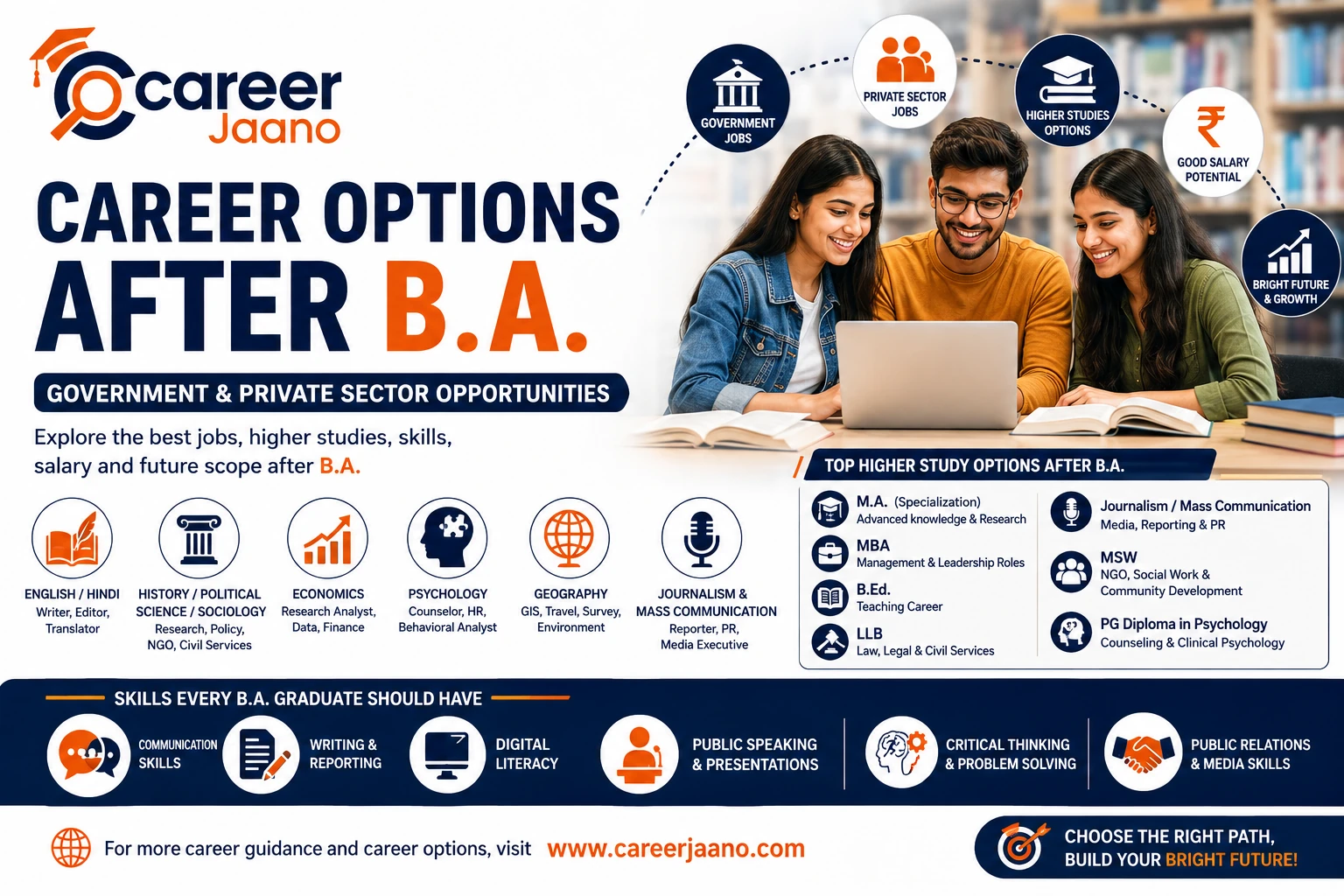
A Bachelor of Arts (B.A.) is a three-year undergraduate degree that gives students a strong understanding of humanities, social sciences and languages.
Students can study subjects such as:
English
Hindi
History
Geography
Political Science
Economics
Sociology
Psychology
Philosophy
Journalism and Mass Communication
Students who choose B.A. Honours usually study one subject in greater depth. For example, a student may specialise in English Literature, History, Political Science, Economics, Psychology or Sociology.
Because B.A. offers many subject combinations, students can explore careers in government services, media, education, research, counselling, administration, corporate jobs and social development.
Importance of Industry Skills After B.A.
A B.A. degree helps students develop communication, critical thinking and analytical skills.
However, in today’s job market, only having a degree may not be enough. Employers also look for practical skills that can be used in the workplace.
Whether you want to work in media, teaching, HR, public relations or a corporate office, practical skills can improve your job opportunities.
Important Skills for B.A. Graduates
Students should try to develop the following skills:
Communication skills
Writing skills
MS Office
Content management tools
Research skills
Report writing
Public speaking
Presentation skills
Critical thinking
Problem-solving
Public relations skills
Social media handling
Basic data analysis
These skills can be learned through internships, online courses, workshops and practical projects.
Private Sector Career Options After B.A.
B.A. graduates can work in many private-sector industries.
Some common areas include:
Media
Education
Public Relations
Content Writing
Human Resources
Social Media
Digital Marketing
Counselling
EdTech
Travel and Tourism
Research
Media and Mass Communication
Students interested in media can explore roles such as:
Reporter
Journalist
News Writer
News Editor
Public Relations Executive
Media Coordinator
Students with a background in Journalism, English, Political Science or Mass Communication may find these roles especially suitable.
Content and Digital Sector
The digital industry has created many career opportunities for Arts graduates.
Possible roles include:
Content Writer
Copywriter
Copy Editor
Social Media Executive
SEO Executive
Content Coordinator
Digital Marketing Executive
Strong writing and digital skills can help students grow in this sector.
Education and Training
Students interested in education can explore jobs such as:
Teaching Assistant
Online Tutor
Academic Coordinator
Education Counsellor
Content Developer
For school teaching roles, students generally need additional qualifications such as B.Ed., depending on the position and applicable rules.
Corporate and Human Resources
B.A. graduates can also work in corporate offices.
Common roles include:
HR Assistant
Recruitment Coordinator
Training Coordinator
Admin Executive
Operations Executive
Customer Relationship Executive
Good communication and organisational skills are especially useful in these roles.
Tourism and Hospitality
Students interested in travel and tourism can work as:
Tour Coordinator
Travel Consultant
Guest Relations Executive
Hospitality Executive
Travel Content Executive
Knowledge of languages and communication skills can be an advantage.
Career Options Based on B.A. Specialisation
Your B.A. subject can also influence your career opportunities.
B.A. English or Hindi
Students with a language or literature background can explore:
Content Writing
Editing
Translation
Publishing
Journalism
Teaching
Copywriting
B.A. History, Political Science or Sociology
Possible career options include:
Research Assistant
Public Policy Assistant
NGO Coordinator
Social Researcher
Political Research Assistant
Content Researcher
Civil Services Preparation
These subjects are also popular among students preparing for government examinations.
B.A. Economics
Economics graduates can explore roles such as:
Research Analyst
Market Research Executive
MIS Executive
Business Research Assistant
Financial Research Assistant
Data Support Executive
Additional skills in Excel, statistics and data analysis can improve career opportunities.
B.A. Psychology
Students with Psychology can explore areas such as:
Counselling support
HR
Training
Behavioural research
Career counselling support
Education services
For professional or regulated psychology roles, students may need additional postgraduate qualifications, supervised training or other credentials depending on the type of practice.
B.A. Geography
Geography students may explore opportunities in:
GIS
Mapping
Travel and Tourism
Survey Research
Environmental Research
Disaster Management
Learning GIS software can improve job prospects.
B.A. Philosophy
Possible career areas include:
Research
Education
Ethics-related work
Writing
Policy research
Academic support
B.A. Journalism and Mass Communication
Students can explore roles such as:
Reporter
Journalist
PR Executive
Digital Media Executive
Video Content Coordinator
Media Researcher
Government Jobs After B.A.
A B.A. degree also makes students eligible for many graduate-level government examinations.
Depending on the recruitment rules, students may apply for opportunities in:
UPSC
SSC
Banking
Railways
State Public Service Commissions
Defence services
Postal services
Government departments
Public-sector organisations
Civil Services
B.A. graduates can appear for the UPSC Civil Services Examination if they meet the eligibility requirements.
Successful candidates can enter services such as:
IAS
IPS
IRS
Other Group A and Group B services
Subjects such as History, Political Science, Sociology and Geography can also help students build a strong foundation for civil services preparation.
SSC Jobs
Through SSC examinations, graduates may become eligible for roles such as:
Assistant
Auditor
Inspector
Tax Assistant
Accountant
Administrative posts
Eligibility depends on the specific recruitment notification.
Banking Jobs
B.A. graduates can also apply for graduate-level banking recruitment processes.
Popular roles include:
Probationary Officer
Clerk
Office Assistant
Customer Service Associate
Railway Jobs
Possible railway roles may include:
Commercial posts
Administrative roles
Clerk-level posts
Graduate-level non-technical posts
Recruitment depends on the latest official notification.
Defence Careers
Eligible graduates can also explore officer-level opportunities in defence services through appropriate entry routes.
Depending on qualification and recruitment rules, possible areas may include:
Administration
Logistics
Education
Territorial Army
Other officer-level roles
Government Opportunities Based on Specialisation
History, Political Science and Sociology
Students may explore:
Civil Services
State Government Services
Rural Development
Research Projects
Policy Research
Legislative Research
Economics
Possible opportunities include:
Economic research
Banking examinations
Government statistical and research departments
Policy support roles
Some specialist economics or statistics posts may require specific subject combinations or postgraduate qualifications.
Psychology
Students may explore eligible roles in:
Social welfare departments
Educational institutions
Rehabilitation services
Training and research
Professional psychologist posts usually require additional qualifications.
Geography
Possible areas include:
GIS and mapping
Disaster management
Environmental projects
Survey-related work
Urban and rural planning support
Mass Communication
Students may explore opportunities in:
Government communication departments
Public relations
Information services
Public broadcasters
Media and communication projects
Best Higher Study Options After B.A.
B.A. graduates have several good options for higher education.
| Course | Career Benefit |
|---|---|
| M.A. | Advanced knowledge, research and academic careers |
| MBA | Management and corporate careers |
| B.Ed. | Teaching careers |
| LLB | Law, legal services and corporate law |
| Journalism / Mass Communication | Media, reporting, PR and digital communication |
| MSW | NGOs, development sector and social services |
| PG in Psychology | Counselling, psychology and behavioural careers |
M.A.
Students can pursue a master's degree in the same or related subject.
Popular options include:
M.A. English
M.A. History
M.A. Political Science
M.A. Economics
M.A. Sociology
M.A. Psychology
M.A. Geography
An M.A. can be useful for teaching, research and specialised careers.
MBA
B.A. graduates can also pursue an MBA.
Popular specialisations include:
Human Resources
Marketing
Finance
International Business
Operations
Business Analytics
An MBA can help students move into management and corporate roles.
B.Ed.
Students interested in school teaching can pursue B.Ed. after graduation, subject to applicable eligibility requirements.
LLB
LLB can be a good option for students interested in:
Law
Judiciary
Corporate legal roles
Civil services
Legal research
Journalism and Mass Communication
Students who want to build a career in media can pursue postgraduate courses in:
Journalism
Mass Communication
Digital Media
Public Relations
Master of Social Work (MSW)
MSW is suitable for students interested in:
NGOs
Social development
Community work
Public health programmes
Corporate social responsibility
Salary After B.A.
Salary after B.A. depends on many factors, including:
Job role
Skills
Specialisation
Location
Company
Experience
Additional qualifications
Fresh graduates may start with entry-level salary packages in private organisations.
Students with strong communication, digital, research, data or specialised skills may get better opportunities.
Government salaries depend on the post, pay level and recruitment rules.
Instead of focusing only on starting salary, students should also focus on gaining practical experience and building strong professional skills.
Which Career is Best After B.A.?
There is no single best career after B.A.
The right career depends on your:
Subject specialisation
Interests
Skills
Career goals
Personality
Higher education plans
For example:
If you enjoy writing, you can explore content, media or publishing.
If you are interested in government service, you can prepare for UPSC, SSC, banking or state-level exams.
If you enjoy teaching, you can consider B.Ed. and higher education.
If you are interested in business, MBA can be a good option.
If you are interested in law, LLB can open new career paths.
If you like psychology and human behaviour, you can pursue higher studies in Psychology.
Conclusion
A B.A. is not just a general graduation degree. It can open the door to many different career paths in government, private companies, education, media, research, law, management and social development.
The key is to combine your degree with practical skills and choose a career according to your interests and strengths.
Students should also consider internships, certifications and higher education to improve their career opportunities.
Before choosing a career, getting guidance from a qualified career counsellor can help you understand your strengths and make a better decision.
For more career guidance and career options, visit Career Jaano
Frequently Asked Questions (FAQs)
1. What are the best career options after B.A.?
Popular options include government jobs, teaching, content writing, journalism, HR, public relations, law, MBA, social work and research.
2. Can I get a government job after B.A.?
Yes. B.A. graduates can apply for many graduate-level government exams such as UPSC, SSC, banking, railways and state government recruitment exams.
3. Which course is best after B.A.?
Popular courses include M.A., MBA, B.Ed., LLB, Journalism, Mass Communication and MSW. The best choice depends on your career goal.
4. Can I do MBA after B.A.?
Yes. B.A. graduates can pursue an MBA after meeting the admission requirements of the institution.
5. Is B.A. good for UPSC preparation?
Yes. Subjects such as History, Political Science, Sociology, Economics and Geography can be useful for building knowledge relevant to civil services preparation.
6. What private jobs can I get after B.A.?
B.A. graduates can work in content writing, media, HR, public relations, customer service, research, digital marketing, education and administration.
7. Is B.A. enough to get a good job?
A B.A. can help you enter many fields, but practical skills, internships, certifications and higher education can significantly improve your career opportunities.