
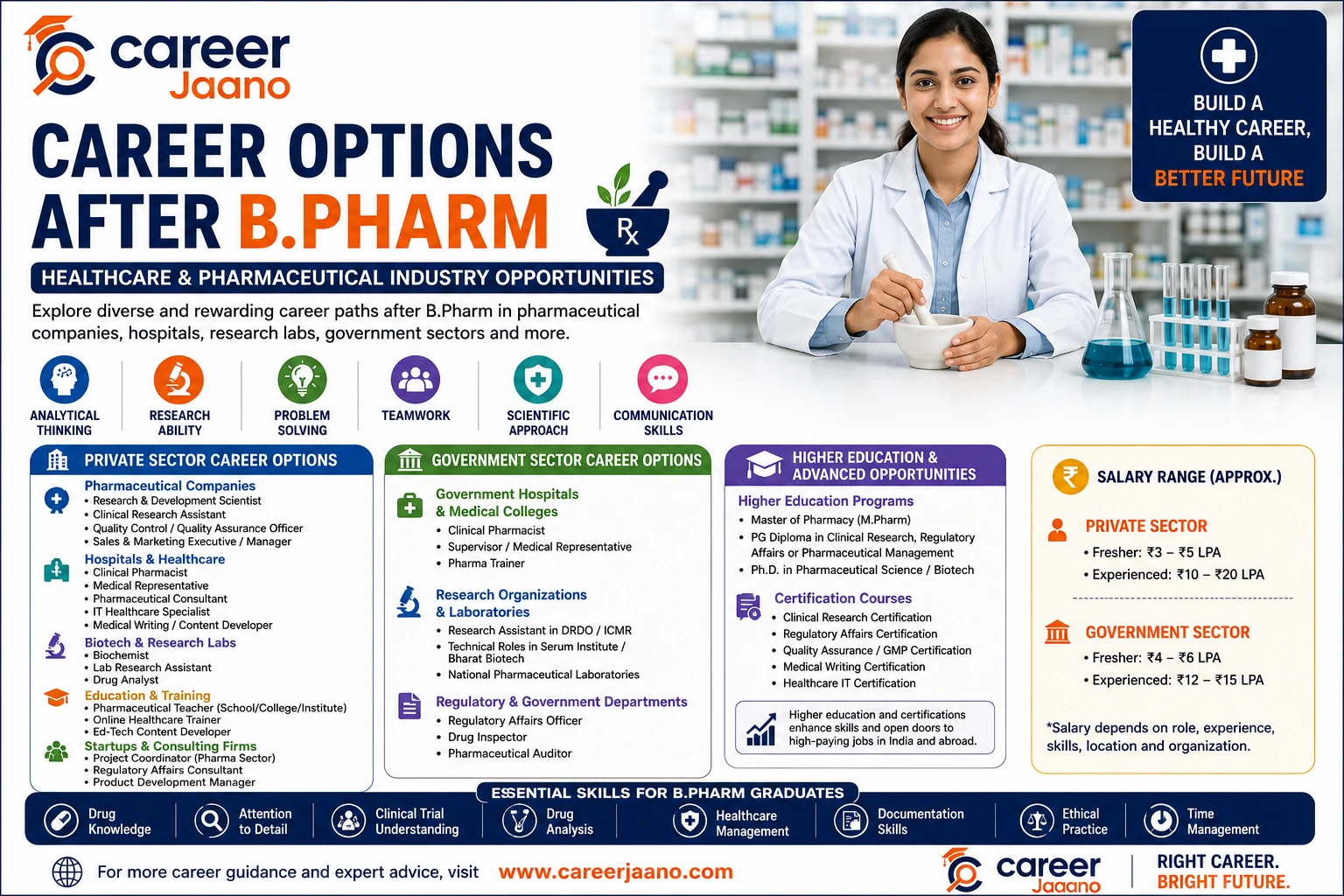
A Bachelor of Pharmacy (B.Pharm) is a four-year undergraduate programme that gives students a strong understanding of pharmaceutical science, drug development and healthcare.
During the course, students study subjects such as:
Pharmaceutical Chemistry
Pharmacology
Formulation Technology
Biochemistry
Pharmaceutical Analysis
Healthcare Management
The aim of B.Pharm is not only to teach students about medicines and drug science, but also to develop ethical thinking, research ability and awareness about patient safety and healthcare.
During B.Pharm, students can also build knowledge in areas such as:
Pharmaceutical Formulation
Clinical Pharmacy
Drug Research and Development
Quality Control
Regulatory Affairs
These areas help students choose a career according to their interests and long-term goals in the pharmaceutical and healthcare sector.
Important Skills Required
For B.Pharm graduates, academic knowledge alone is not enough.
To build a successful career in the pharmaceutical and healthcare industry, students should develop skills such as:
Analytical thinking
Research ability
Problem-solving
Teamwork
Scientific approach
Communication skills
Clinical trial understanding
Drug analysis
Healthcare management
Attention to detail
These skills help students work more confidently in research, production, hospitals, regulatory departments and other healthcare-related areas.
Private Sector Career Options
B.Pharm graduates can find career opportunities in:
Pharmaceutical companies
Hospitals
Research laboratories
Consulting firms
Biotechnology companies
Healthcare organisations
Today, the pharmaceutical and healthcare sectors need trained professionals in drug development, quality control, clinical pharmacy, regulatory affairs, sales, marketing, education and healthcare technology.
Pharmaceutical Companies
Possible job roles include:
Research and Development Scientist
Clinical Research Assistant
Quality Control Officer
Quality Assurance Officer
Sales Executive
Marketing Executive
Product Executive
Hospitals and Healthcare
B.Pharm graduates may work in roles such as:
Clinical Pharmacist
Hospital Pharmacist
Pharmaceutical Consultant
Healthcare Support Professional
Medical Writer
Healthcare Content Developer
Some pharmacy roles may require registration or other professional eligibility depending on the job and applicable rules.
Biotechnology and Research Laboratories
Possible roles include:
Lab Research Assistant
Drug Analyst
Research Associate
Biochemistry-related support roles
Pharmaceutical Research Assistant
Education and Training
Students interested in teaching and training can explore:
Pharmacy Trainer
Academic Content Developer
Online Healthcare Trainer
EdTech Content Developer
Research Assistant
For college-level teaching, higher qualifications may be required.
Startups and Consulting Firms
B.Pharm graduates can also work with healthcare and pharmaceutical startups.
Possible roles include:
Pharma Project Coordinator
Regulatory Affairs Associate
Regulatory Affairs Consultant
Product Development Executive
Healthcare Operations Executive
Salary in the Private Sector
The salary of a B.Pharm graduate depends on:
Company
Location
Job profile
Skills
Experience
Specialisation
Fresh graduates may start with entry-level packages in pharmaceutical companies, hospitals, laboratories or sales roles.
With experience and specialisation in areas such as regulatory affairs, quality assurance, clinical research, drug development or pharmaceutical management, salary can increase significantly.
Government Sector Career Options
B.Pharm graduates can also explore government jobs in pharmaceutical, healthcare and research departments.
They may find opportunities in:
Government hospitals
Medical colleges
Drug control departments
Research institutions
Public health organisations
Government laboratories
Government Hospitals and Medical Colleges
Possible roles may include:
Pharmacist
Hospital Pharmacist
Pharmacy-related technical posts
Research support roles
Training roles
Eligibility depends on the recruitment notification and required registration.
Research Organisations and Laboratories
B.Pharm graduates may explore eligible research and technical opportunities in public research organisations.
Possible roles include:
Research Assistant
Technical Assistant
Laboratory Assistant
Project Assistant
Drug Research Support
Some research positions may require M.Pharm, M.Sc. or other higher qualifications.
Regulatory and Government Departments
B.Pharm graduates may also explore roles such as:
Drug Inspector
Regulatory Officer
Pharmaceutical Auditor
Drug Control Department roles
Quality and compliance-related posts
Eligibility for roles such as Drug Inspector can depend on specific educational, experience and recruitment requirements.
Higher Education and Future Opportunities
Students who want to continue their studies after B.Pharm have several options.
Higher education can help them gain deeper knowledge and access specialised career opportunities.
Master of Pharmacy (M.Pharm)
M.Pharm is one of the most popular options after B.Pharm.
Students can specialise in areas such as:
Pharmaceutics
Pharmacology
Pharmaceutical Chemistry
Quality Assurance
Pharmaceutical Analysis
Regulatory Affairs
Postgraduate Diploma
Students can also pursue postgraduate diploma programmes in areas such as:
Clinical Research
Regulatory Affairs
Pharmaceutical Management
Drug Safety
Healthcare Management
Ph.D.
Students interested in research and academics can pursue a Ph.D. in areas related to:
Pharmaceutical Sciences
Pharmacology
Drug Development
Biotechnology
Pharmaceutical Technology
Special Certification Courses
B.Pharm graduates can also improve their career opportunities through short-term certifications.
Useful options include:
Clinical Research Certification
Regulatory Affairs Certification
Quality Assurance Certification
Good Manufacturing Practices (GMP) Certification
Medical Writing Certification
Healthcare IT Certification
Pharmacovigilance Certification
These certifications can help students gain practical knowledge and improve their chances of getting specialised jobs.
Career in Clinical Research
Clinical research is a growing career option for pharmacy graduates.
Professionals in this field may help with:
Clinical trials
Drug safety
Research documentation
Data collection
Trial coordination
Regulatory documentation
Possible job roles include:
Clinical Research Coordinator
Clinical Research Assistant
Clinical Trial Associate
Drug Safety Associate
Career in Regulatory Affairs
Regulatory Affairs professionals help pharmaceutical companies follow government rules and approval requirements.
Their work may include:
Product documentation
Drug registration
Regulatory submissions
Compliance
Government approvals
This can be a good career for students who are interested in both science and regulations.
Career in Quality Control and Quality Assurance
Quality Control and Quality Assurance are important areas in the pharmaceutical industry.
Professionals help ensure that medicines are:
Safe
Effective
Properly tested
Manufactured according to required standards
Possible roles include:
Quality Control Analyst
Quality Assurance Executive
Documentation Executive
GMP Compliance Associate
Career in Medical Writing
Students with good scientific knowledge and writing skills can explore Medical Writing.
Medical writers may work on:
Scientific articles
Drug information
Clinical research documents
Healthcare content
Regulatory documents
Career in Pharmaceutical Sales and Marketing
Students who have good communication skills may work in pharmaceutical sales and marketing.
Possible roles include:
Medical Representative
Sales Executive
Product Executive
Marketing Executive
With experience, professionals may move into managerial roles.
Conclusion
A Bachelor of Pharmacy offers many career options beyond traditional pharmacy work.
B.Pharm graduates can build careers in pharmaceutical companies, hospitals, research, clinical trials, regulatory affairs, quality control, medical writing, government departments and healthcare technology.
The right skills, higher education and practical experience can help students build strong career opportunities in India and abroad.
Before choosing a career path, it is always helpful to understand your interests, strengths and long-term goals.
For more career guidance and career options, visit Career Jaano.
Frequently Asked Questions (FAQs)
1. What are the best career options after B.Pharm?
Popular career options include Pharmacist, Quality Control Analyst, Clinical Research Associate, Regulatory Affairs Executive, Medical Writer, Drug Safety Associate and Pharmaceutical Sales Executive.
2. Can I get a government job after B.Pharm?
Yes. B.Pharm graduates can apply for eligible government jobs in hospitals, drug control departments, research organisations, public health departments and other government institutions.
3. Can I become a Drug Inspector after B.Pharm?
B.Pharm graduates may be eligible for Drug Inspector recruitment, but the exact eligibility, experience and examination requirements depend on the official recruitment notification.
4. Which course is best after B.Pharm?
M.Pharm is one of the most popular options. Students can also consider MBA, Clinical Research, Regulatory Affairs, Pharmacovigilance, Healthcare Management or other specialised postgraduate courses.
5. Is Clinical Research a good career after B.Pharm?
Yes. Clinical Research can be a good option for students interested in clinical trials, drug development, research documentation and healthcare studies.
6. What is the salary after B.Pharm?
Salary depends on the job role, employer, skills, location and experience. Fresh graduates usually start with entry-level packages, while experienced professionals in specialised pharma roles can earn significantly more.
7. Can B.Pharm graduates work in hospitals?
Yes. B.Pharm graduates may work in hospital pharmacy and other eligible healthcare roles, subject to the registration and qualification requirements of the position.
8. What skills are important for B.Pharm graduates?
Important skills include analytical thinking, research ability, communication, drug knowledge, attention to detail, teamwork and understanding of quality and regulatory standards.