
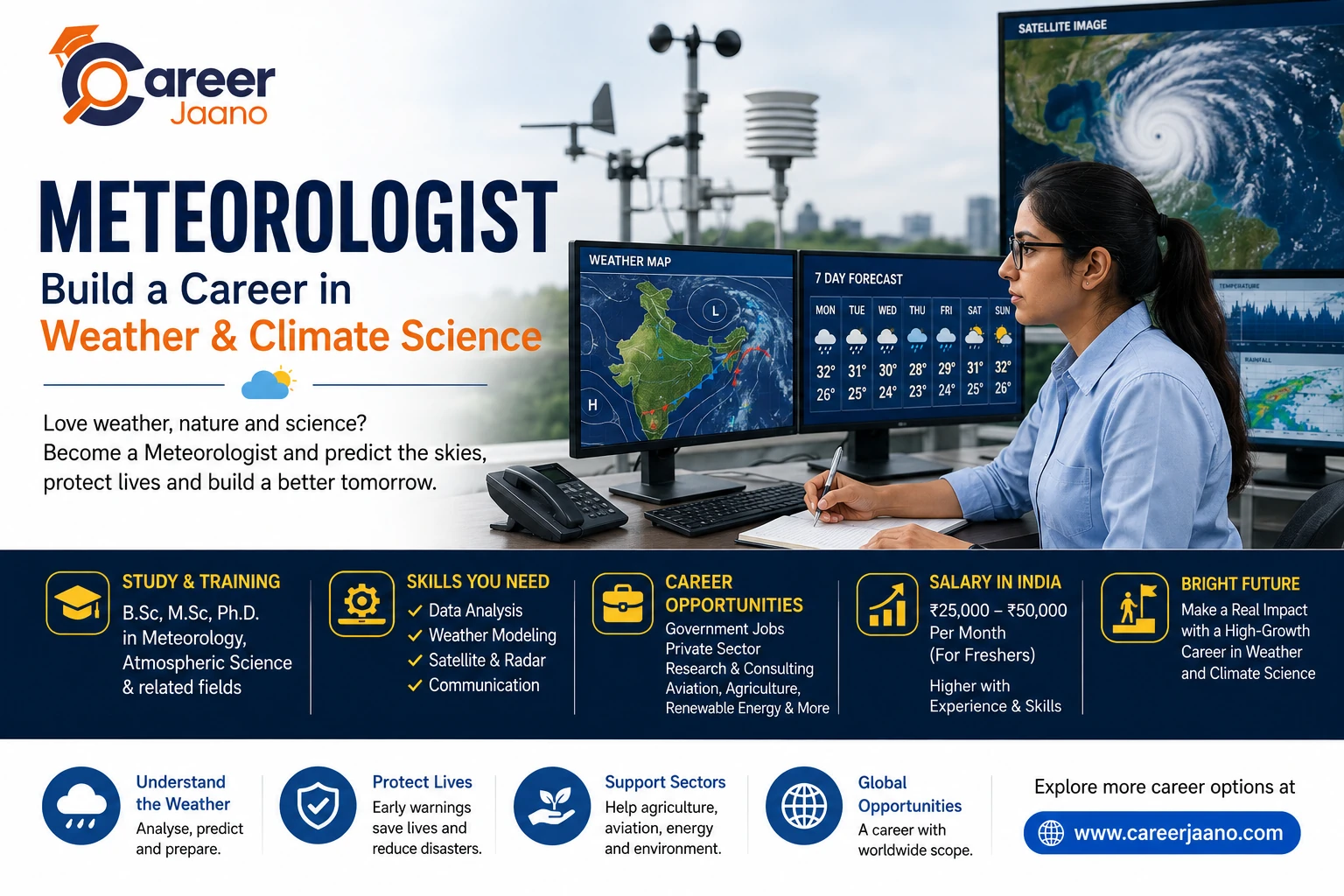
If you are interested in weather, temperature, rainfall, storms, clouds, wind, humidity, and climate, then a career as a Meteorologist can be a good option for you.
Meteorology is different from careers like medicine, law, or engineering. It is a science-based field where professionals study the atmosphere and try to understand how weather changes.
A Meteorologist studies weather conditions and uses scientific data to predict future weather. Their work is useful in many areas such as agriculture, aviation, shipping, disaster management, renewable energy, and climate research.
What is Meteorology?
Meteorology is the study of the atmosphere, weather, and climate.
It includes the study of:
Temperature
Air pressure
Wind
Humidity
Rainfall
Snowfall
Storms
Cyclones
Clouds
Climate patterns
The main purpose of meteorology is to understand weather conditions and make useful forecasts.
Weather forecasts also help authorities prepare for natural events such as heavy rainfall, cyclones, floods, heatwaves, and droughts.
Who is a Meteorologist?
A Meteorologist is a scientist who studies weather and atmospheric conditions.
Meteorologists use different tools and technologies such as:
Satellites
Weather radar
Weather stations
Computer models
Climate data
Forecasting software
They analyse this information to understand current weather and predict what may happen in the coming hours or days.
Some Meteorologists also work in climate research and study long-term changes in weather patterns.
Education and Training
To become a Meteorologist in India, students usually need a strong background in science.
Step 1: Complete Class 12
It is useful to complete Class 12 with subjects such as:
Physics
Chemistry
Mathematics
Step 2: Complete a Bachelor's Degree
After Class 12, students can choose courses such as:
B.Sc. Physics
B.Sc. Mathematics
B.Sc. Geology
B.Sc. Environmental Science
B.Sc. Atmospheric Science
B.Tech in a relevant engineering field
Step 3: Choose a Master's Degree
For specialised roles in meteorology, students can continue with courses such as:
M.Sc. Meteorology
M.Sc. Atmospheric Science
M.Sc. Climate Science
M.Sc. Ocean and Atmospheric Science
M.Tech in Atmospheric Science
Step 4: Higher Studies
Students interested in research, teaching, or advanced scientific work can also complete a Ph.D. in Meteorology, Atmospheric Science, Climate Science, or a related field.
Institutes for Meteorology and Atmospheric Science
Many institutions in India offer courses related to atmospheric science, earth science, climate science, ocean science, and meteorology.
Some well-known institutions include:
Indian Institutes of Technology (IITs)
Indian Institute of Science (IISc), Bengaluru
Savitribai Phule Pune University
Banaras Hindu University
Andhra University
Cochin University of Science and Technology
Selected National Institutes of Technology
Aligarh Muslim University
Institutions and training centres connected with the India Meteorological Department
Course names, eligibility, fees, and admission requirements may change from one institute to another.
Students should always check the latest information on the official website of the institute before applying.
Skills Required to Become a Meteorologist
A good Meteorologist needs scientific knowledge along with strong analytical skills.
1. Mathematics and Physics
Meteorology involves a lot of mathematics and physics.
You should be comfortable with formulas, calculations, scientific concepts, and data interpretation.
2. Data Analysis
Meteorologists work with large amounts of weather and climate data.
You should be able to study the data and find useful patterns.
3. Computer Skills
Modern weather forecasting depends heavily on computers.
Knowledge of tools and programming languages such as:
Python
R
MATLAB
can be useful.
4. Weather Modelling
Meteorologists use computer models to understand and predict changes in weather.
Basic knowledge of simulation and modelling can be helpful.
5. Satellite and Radar Data
Meteorologists should understand how to read satellite images, radar data, and other weather information.
6. Problem-Solving Skills
Weather conditions can change quickly.
Meteorologists need to understand complex situations and make careful decisions.
7. Communication Skills
Weather information should be easy for people to understand.
Meteorologists may need to explain forecasts to:
Government agencies
Media
Airlines
Farmers
Emergency teams
General public
8. Observation Skills
Small changes in clouds, wind, temperature, or air pressure can be important.
Good observation skills are therefore very useful.
9. Teamwork
Meteorologists often work with scientists, researchers, engineers, disaster-management teams, and government departments.
Being able to work well with others is important.
Career Opportunities in the Private Sector
Meteorologists can find opportunities in many private industries.
Some possible job roles include:
Weather Forecaster
Applied Meteorologist
Climatologist
Aviation Meteorologist
Environmental Consultant
Renewable Energy Analyst
Weather Data Analyst
Climate Data Analyst
Marine Meteorologist
GIS and Weather Data Specialist
Risk Analyst
Climate Technology Professional
Private companies use weather information for planning, safety, business decisions, energy production, agriculture, logistics, and insurance.
Possible industries include:
Private weather companies
Renewable energy companies
Aviation companies
Agriculture technology companies
Insurance companies
Logistics companies
Climate-tech startups
Environmental consulting firms
Data analytics companies
Career Opportunities in the Government Sector
Government organisations also offer career opportunities in meteorology, climate science, atmospheric research, disaster management, and environmental science.
Possible job profiles include:
Meteorologist
Scientist
Weather Forecaster
Research Scientist
Scientific Assistant
Technical Officer
Climate Researcher
Weather Data Analyst
Atmospheric Scientist
Disaster Management Specialist
Possible organisations and sectors include:
India Meteorological Department
Research institutions
Government universities
Disaster management organisations
Defence organisations
Space and atmospheric research organisations
Environmental departments
Agriculture departments
Recruitment rules, examinations, and eligibility depend on the post.
Students should always check official recruitment notifications for accurate information.
Salary and Career Growth
The salary of a Meteorologist depends on education, experience, organisation, job profile, and location.
At the beginning of a career, professionals may earn around ₹25,000 to ₹50,000 per month depending on the role and organisation.
With experience and specialised skills, salary may increase to around ₹50,000 to ₹1 lakh per month or more.
Senior scientists, researchers, consultants, and experienced specialists may earn higher salaries depending on their role and organisation.
These are only general estimates. Actual salary can be different for every employer and job profile.
Is Meteorology a Good Career?
Meteorology can be a good career if you are interested in:
Weather
Climate
Science
Mathematics
Data
Environment
Technology
This field is especially suitable for students who enjoy studying natural events and want to understand how the atmosphere works.
It also gives you a chance to work in areas that directly affect agriculture, aviation, disaster management, climate research, and public safety.
Before choosing any course or profession, it is always better to understand your interests, skills, personality, and long-term goals.
If you are confused about the right career path, you can take guidance from a professional career counsellor.
You can also explore different career options on Career Jaano>
FAQs About Meteorologist Career
1. What does a Meteorologist do?
A Meteorologist studies weather and atmospheric conditions. They analyse data and use satellites, radar, and computer models to forecast weather.
2. Can I become a Meteorologist after Class 12?
Yes. After Class 12 with a science background, you can study Physics, Mathematics, Atmospheric Science, Environmental Science, Geology, or a related subject and later specialise in Meteorology.
3. Is Mathematics important for Meteorology?
Yes. Mathematics is very important because Meteorologists use calculations, statistics, data analysis, and computer models in their work.
4. Which degree is best for becoming a Meteorologist?
Degrees in Physics, Mathematics, Atmospheric Science, Environmental Science, Earth Science, or related subjects can be useful. A master's degree in Meteorology or Atmospheric Science can help you specialise.
5. Where can Meteorologists work?
Meteorologists can work in government weather departments, research institutes, airlines, renewable energy companies, private weather companies, agriculture, climate-tech firms, and disaster-management organisations.
6. What is the salary of a Meteorologist in India?
A beginner may earn around ₹25,000 to ₹50,000 per month. Salary can increase with education, experience, specialisation, and the type of organisation.
7. Is Meteorology a good career in India?
Yes, it can be a good career for students who are interested in weather, climate, science, mathematics, and data. The field offers opportunities in research, government services, aviation, renewable energy, agriculture, and climate technology.