
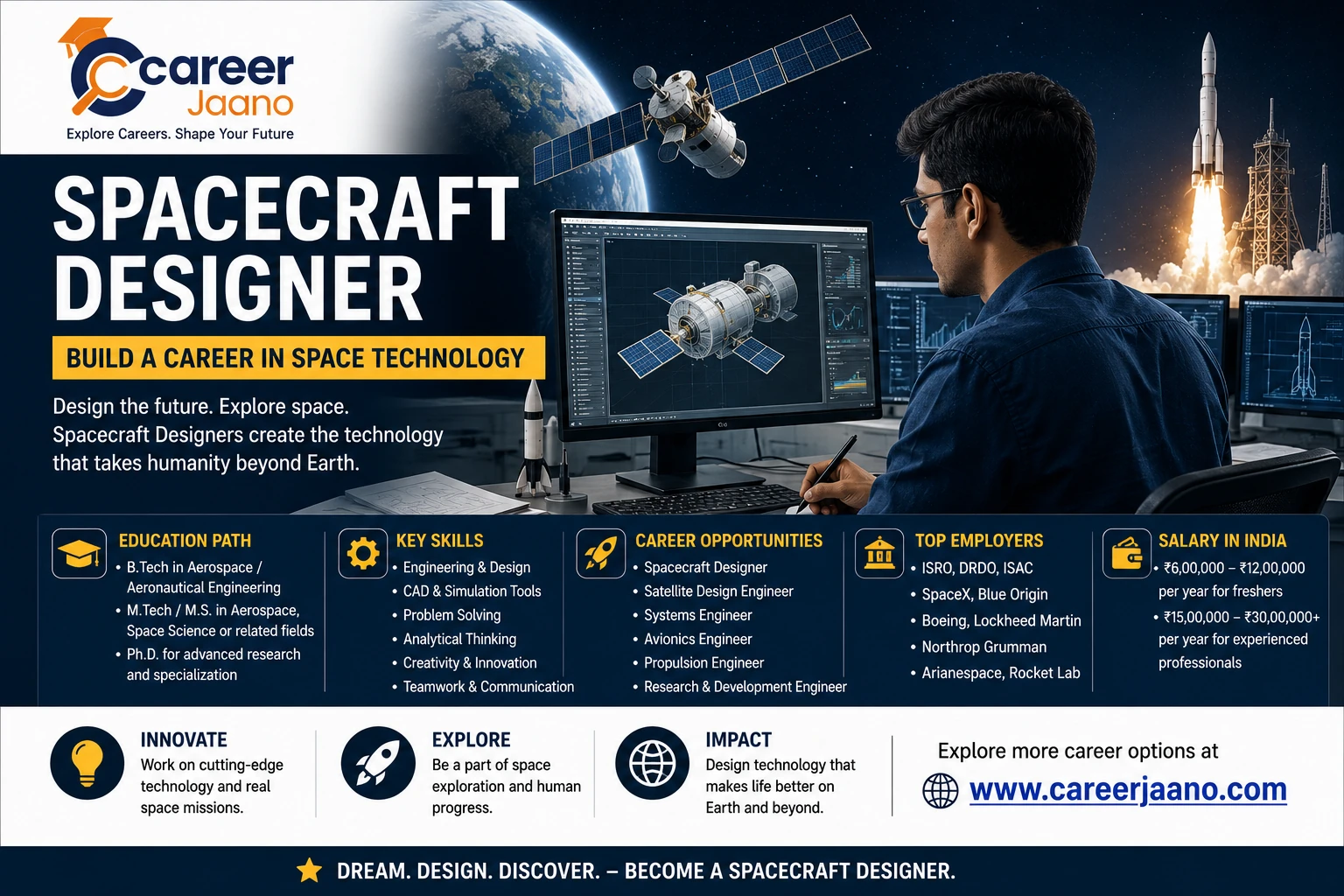
If you are interested in space, engineering, mathematics, satellites, rockets, and new technology, then a career as a Spacecraft Designer can be a very exciting option for you.
A Spacecraft Designer is a professional who works on the design and development of spacecraft, satellites, space vehicles, and other systems used for space missions.
Their main job is to make sure that a spacecraft is safe, efficient, strong, and capable of working in the difficult conditions of space.
This career combines engineering, science, creativity, and problem-solving.
Who is a Spacecraft Designer?
A Spacecraft Designer works on different parts of a spacecraft such as:
Structure
Aerodynamics
Propulsion
Electrical systems
Communication systems
Navigation systems
Thermal control
Satellite components
Safety systems
They may work with engineers, scientists, researchers, and mission planners to develop spacecraft for different types of missions.
What Does a Spacecraft Designer Do?
A Spacecraft Designer may work on many different tasks.
1. Spacecraft Design
They help create the basic design and structure of spacecraft and satellites.
2. Testing and Simulation
Before a spacecraft is launched, its design is tested using computer models and simulations.
This helps engineers understand whether the design can handle extreme temperature, pressure, vibration, and other space conditions.
3. Material Selection
Spacecraft need special materials that are lightweight, strong, and able to survive difficult conditions.
Spacecraft Designers help select the right materials for different parts.
4. System Integration
A spacecraft has many systems such as communication, navigation, power, propulsion, and electronics.
Designers work with different teams to make sure all systems work properly together.
5. Improving Existing Designs
Spacecraft technology keeps changing.
Designers regularly improve older systems and work on new ideas to make spacecraft safer and more efficient.
Education and Training
To become a Spacecraft Designer, you usually need a strong background in engineering and science.
Step 1: Complete Class 12
Students should preferably complete Class 12 with:
Physics
Chemistry
Mathematics
Step 2: Complete a Bachelor's Degree
Useful bachelor's degree options include:
B.Tech Aerospace Engineering
B.Tech Aeronautical Engineering
B.Tech Mechanical Engineering
B.Tech Electrical Engineering
B.Tech Electronics Engineering
B.Tech Avionics
Related engineering programmes
Aerospace Engineering is one of the most direct paths for students interested in spacecraft design.
Step 3: Higher Studies
For advanced roles, students can continue with courses such as:
M.Tech Aerospace Engineering
M.Tech Aerodynamics
M.Tech Avionics
M.Tech Space Technology
M.S. Aerospace Engineering
M.S. Space Science
M.S. Aeronautical Engineering
Step 4: Ph.D. and Research
Students who are interested in advanced research, spacecraft technology, propulsion, or space systems can also complete a Ph.D.
This can be useful for research and senior technical positions.
Institutes for Aerospace and Space Technology
Several institutions in India offer programmes related to aerospace engineering, avionics, space science, and space technology.
Students can explore institutions such as:
Indian Institutes of Technology
Indian Institute of Science
Indian Institute of Space Science and Technology
Anna University
Selected NITs and engineering universities
Universities offering Aerospace or Aeronautical Engineering
Before applying, always check the latest details about:
Eligibility
Entrance exams
Course duration
Fees
Specialisation
Admission process
from the official website of the institute.
Internship and Practical Experience
Practical experience is very important in this career.
Students should try to gain experience through:
Internships
Research projects
Aerospace labs
Satellite projects
Robotics projects
Engineering competitions
University space clubs
Design projects
Working on real projects helps you understand how spacecraft systems are designed and tested.
Skills Required to Become a Spacecraft Designer
A good Spacecraft Designer needs strong technical and creative skills.
1. Engineering Knowledge
You should have a good understanding of:
Mechanics
Aerodynamics
Thermodynamics
Electronics
Structures
Propulsion
2. CAD and Design Software
Spacecraft Designers often use software for 3D modelling and design.
Useful tools may include:
CATIA
SolidWorks
MATLAB
ANSYS
CAD software
Simulation tools
3. Problem-Solving Skills
Spacecraft design is complex.
You need to find solutions to problems related to weight, safety, energy, structure, and performance.
4. Creativity
Space technology is based on innovation.
Creative thinking helps engineers develop new designs and better systems.
5. Analytical Skills
Every design decision can affect the complete spacecraft.
You should be able to analyse data and understand the impact of different design changes.
6. Mathematics and Physics
Strong knowledge of mathematics and physics is very important.
These subjects are used in almost every part of spacecraft design.
7. Teamwork
A spacecraft is never designed by one person.
You may work with:
Engineers
Scientists
Programmers
Researchers
Mission planners
Technicians
Good teamwork is essential.
8. Communication Skills
You should be able to explain technical ideas clearly to other team members.
Career Opportunities in the Private Sector
The private space industry is growing and creating new opportunities in areas such as:
Satellite design
Rocket development
Space technology
Launch systems
Navigation
Communication systems
Space research
Aerospace manufacturing
Possible job roles include:
Spacecraft Design Engineer
Aerospace Engineer
Satellite Design Engineer
Structural Engineer
Avionics Engineer
Propulsion Engineer
Systems Engineer
Space Systems Engineer
CAD Design Engineer
Research and Development Engineer
Private aerospace and space technology companies may offer opportunities depending on your skills and experience.
Career Opportunities in the Government Sector
Government organisations also offer career opportunities in space technology, defence research, satellite systems, and aerospace engineering.
In India, possible areas include organisations connected with:
ISRO
DRDO
Space research centres
Satellite development
Propulsion research
Defence technology
Research laboratories
Government engineering institutions
Possible job profiles include:
Scientist
Engineer
Research Engineer
Space Systems Engineer
Aerospace Engineer
Design Engineer
Technical Officer
Avionics Engineer
The recruitment process and eligibility can be different for every organisation and post.
Always check official recruitment notifications before applying.
Salary and Career Growth
The salary of a Spacecraft Designer depends on education, skills, experience, organisation, and job role.
A fresher working in an aerospace or space-related design role in India may earn around ₹6 lakh to ₹12 lakh per year.
With experience, strong technical skills, and advanced qualifications, professionals may earn around ₹15 lakh to ₹30 lakh per year or more.
Senior professionals working in specialised roles may earn even higher packages.
These figures are general estimates. Actual salary can vary widely depending on the company, location, role, and level of experience.
Is Spacecraft Designing a Good Career?
Yes, it can be a very exciting career for students who are interested in:
Space
Engineering
Mathematics
Physics
Satellites
Rockets
Technology
Innovation
However, this is a technical and challenging field.
Students need strong subject knowledge, regular practice, practical experience, and patience.
Who Should Choose This Career?
You may enjoy this career if:
You love learning about space
You enjoy mathematics and physics
You like engineering and design
You enjoy solving complex problems
You are interested in technology
You like working on innovative projects
Before choosing any course or career, it is always better to understand your interests, skills, personality, and long-term goals.
If you are confused about the right career option, you can also take guidance from a professional career counsellor.
You can explore more career options on Career Jaano .
FAQs About Spacecraft Designer Career
1. What does a Spacecraft Designer do?
A Spacecraft Designer works on the design, development, testing, and improvement of spacecraft, satellites, and space systems.
2. Which course is best for becoming a Spacecraft Designer?
Aerospace Engineering is one of the best options. Mechanical, Electrical, Electronics, Avionics, and related engineering courses can also be useful.
3. Can I become a Spacecraft Designer after Class 12?
Yes. After Class 12 with Physics, Chemistry, and Mathematics, you can choose a relevant engineering degree and later specialise in aerospace or space technology.
4. Is mathematics important for Spacecraft Designing?
Yes. Mathematics is very important because spacecraft design involves calculations, modelling, structures, aerodynamics, and system analysis.
5. Where can Spacecraft Designers work?
They can work in space agencies, aerospace companies, satellite companies, defence organisations, research centres, and private space-tech companies.
6. What is the salary of a Spacecraft Designer in India?
A fresher may earn around ₹6 lakh to ₹12 lakh per year, while experienced professionals may earn ₹15 lakh to ₹30 lakh per year or more depending on the role.
7. Is Spacecraft Designing a good career in India?
Yes. It can be a strong career option for students who are interested in space, engineering, technology, and research. Practical skills and advanced technical knowledge are very important.