
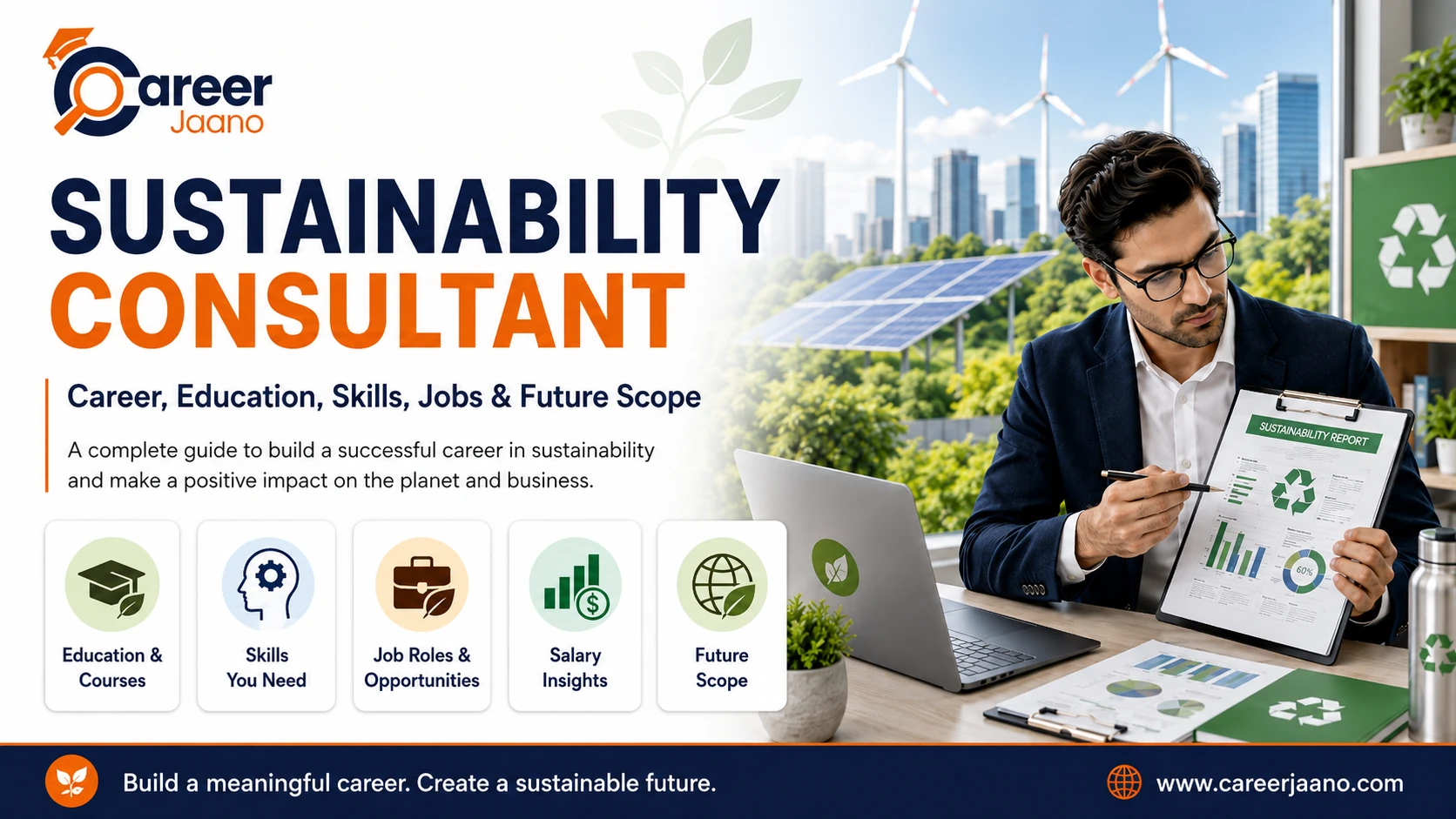
With growing awareness about climate change, environmental protection, and responsible business practices, the demand for Sustainability Consultants is increasing. Today, many companies, organisations, and government bodies are looking for professionals who can help them reduce their environmental impact while continuing to grow their business.
A Sustainability Consultant is a professional who advises organisations on how to make their operations more environmentally responsible, resource-efficient, and sustainable. They may work on areas such as energy use, waste reduction, carbon emissions, environmental policies, sustainable supply chains, and long-term business planning.
If you are interested in environmental protection and also want to understand how businesses work, a career as a Sustainability Consultant can be a good option for you.
What Does a Sustainability Consultant Do?
A Sustainability Consultant studies the environmental impact of a company or organisation and suggests practical ways to improve its sustainability performance.
Their work may include:
Studying energy and resource consumption
Identifying ways to reduce waste
Supporting carbon-emission reduction plans
Helping organisations develop sustainability strategies
Conducting environmental assessments
Preparing sustainability and ESG-related reports
Advising businesses on sustainable practices
Analysing environmental data
Supporting compliance with environmental regulations
Helping organisations balance environmental and business goals
The exact responsibilities may vary depending on the organisation and industry.
Education Required to Become a Sustainability Consultant
There is no single educational route to becoming a Sustainability Consultant. Students can enter this profession through environmental science, engineering, economics, business, public policy, or related fields.
1. Bachelor's Degree
After Class 12, students can consider bachelor's programmes in areas such as:
Environmental Science
Environmental Engineering
Ecology
Sustainability Studies
Economics
Business Administration
Geography
Energy and Environmental Studies
A bachelor's degree helps students understand the basic concepts of environmental management, climate change, business operations, and sustainable development.
2. Master's Degree
A postgraduate degree can help you develop specialised knowledge and may improve your career opportunities.
Relevant programmes may include:
Master's in Sustainability
Environmental Management
Sustainable Development
Climate Change Studies
Environmental Science
Energy Management
MBA with Sustainability or ESG-related specialisation
A master's degree can be especially useful for students who want to work in consulting firms, multinational companies, research organisations, or senior sustainability roles.
3. PhD and Research
Students interested in advanced research, academics, environmental policy, climate science, or sustainability innovation can also pursue a PhD.
A doctorate is usually not necessary for regular consulting roles, but it can be valuable for research-intensive or highly specialised careers.
Courses and Institutions in India
Students interested in this field can explore sustainability, environmental science, environmental engineering, climate studies, sustainable development, and related programmes offered by universities and institutes across India.
Some well-known institutions working in environmental, sustainability, management, or related areas include:
Indian Institutes of Technology (IITs)
TERI School of Advanced Studies
Tata Institute of Social Sciences (TISS)
University of Delhi
Savitribai Phule Pune University
Symbiosis International University
National Environmental Engineering Research Institute (NEERI)
Other universities offering Environmental Science, Sustainability, Energy, Climate Change, or Environmental Management programmes
Before applying, students should always check the latest course name, eligibility criteria, curriculum, fees, and admission process on the official website of the institution, as programmes may change over time.
Internship and Practical Experience
Academic knowledge alone is not enough in sustainability consulting. Practical experience can make a major difference when you start looking for jobs.
Students can look for internships with:
Sustainability consulting firms
Environmental consulting companies
NGOs
Research organisations
Renewable energy companies
Corporate sustainability departments
Government environmental bodies
Climate-tech companies
During an internship, you may learn how environmental audits are conducted, how sustainability data is collected, how reports are created, and how organisations develop environmental strategies.
Certifications
Professional certifications can also help you strengthen your profile.
Depending on your career direction, you can explore certifications related to:
ESG
Carbon accounting
Sustainability reporting
Environmental management
Energy management
Life Cycle Assessment
Climate risk
Green buildings
Corporate sustainability
Certifications are especially useful when combined with a relevant degree and practical experience.
Important Skills for a Sustainability Consultant
Environmental Knowledge
You should understand topics such as climate change, pollution, natural resources, energy use, carbon emissions, waste management, and sustainable development.
Business Understanding
Sustainability solutions should not only be environmentally responsible but also practical for an organisation. Understanding business strategy, costs, operations, and management can therefore be very useful.
Problem-Solving Skills
Every organisation has different sustainability challenges. A good consultant should be able to study a problem and develop practical solutions.
Data Analysis
Sustainability professionals often work with large amounts of data related to emissions, energy, waste, water consumption, and other performance indicators.
Knowledge of tools such as Excel, data visualisation software, and analytics platforms can be helpful.
Report Writing
Companies increasingly need structured sustainability, ESG, environmental, and impact reports. Strong report-writing skills can therefore improve your career prospects.
Communication Skills
A Sustainability Consultant may need to explain complex environmental issues to senior management, clients, employees, and other stakeholders.
Clear communication and presentation skills are extremely important.
Research Skills
Environmental regulations, sustainability standards, technologies, and reporting requirements continue to evolve. Professionals in this field need strong research and learning abilities.
Career Opportunities in the Private Sector
The private sector offers many opportunities for sustainability professionals.
You may find roles in:
Consulting firms
IT companies
Manufacturing companies
Renewable energy companies
Infrastructure firms
Real estate companies
Financial institutions
FMCG companies
Automotive companies
Climate-tech startups
Large consulting and professional-services firms such as Deloitte, PwC, EY and KPMG have sustainability, ESG, climate, risk, or related advisory practices.
Depending on your qualifications and experience, you may work as:
Sustainability Consultant
ESG Analyst
Sustainability Analyst
Environmental Consultant
Climate Change Consultant
Carbon Analyst
Sustainability Manager
ESG Consultant
Environmental Manager
Sustainable Supply Chain Analyst
Career Opportunities in the Government Sector
Sustainability professionals can also work with government departments, public-sector organisations, research institutes, pollution-control bodies, and environmental projects.
Opportunities may be available in areas such as:
Environmental policy
Climate-action programmes
Pollution control
Renewable energy
Waste management
Urban sustainability
Water-resource management
Environmental research
Sustainable development projects
Students interested in government careers should regularly check vacancies released by relevant ministries, departments, research institutes, and public-sector organisations.
Salary of a Sustainability Consultant in India
The salary of a Sustainability Consultant depends on several factors, including:
Educational qualification
Work experience
Job role
Employer
Location
Technical skills
ESG or sustainability expertise
Industry
Entry-level professionals may begin with analyst, associate, or junior consulting roles. With experience and specialised knowledge in areas such as ESG, carbon accounting, climate strategy, sustainability reporting, or environmental management, earning potential can increase significantly.
Instead of choosing this career only on the basis of salary, students should also consider the type of work, required skills, future growth opportunities, and their personal interest in environmental and business issues.
Future Scope of Sustainability Consulting
The future scope of sustainability consulting is promising because businesses are facing increasing pressure to reduce emissions, manage climate risks, improve resource efficiency, and communicate their environmental performance.
New career opportunities are also developing in areas such as:
ESG consulting
Carbon accounting
Net-zero strategy
Climate-risk assessment
Sustainable finance
Green buildings
Renewable energy
Circular economy
Sustainable supply chains
Environmental reporting
Professionals who combine environmental knowledge with business, technology, finance, and data-analysis skills can have strong opportunities in this field.
Is Sustainability Consulting the Right Career for You?
This career may suit you if:
You care about environmental issues
You enjoy research and analysis
You like solving practical problems
You are interested in both business and sustainability
You can work with data and reports
You have good communication skills
You want your work to create a positive environmental impact
Conclusion
Sustainability Consulting is an emerging career that brings together environmental responsibility, business strategy, data analysis, and problem-solving.
If you want to contribute towards environmental protection while helping organisations make smarter and more responsible business decisions, this profession can offer an interesting career path.
However, every student's interests, abilities, academic background, and career goals are different. Before choosing a career, it is helpful to understand your strengths and explore different career options carefully.
For career guidance and information about different career paths, you can explore Career Jaano
Frequently Asked Questions (FAQs)
1. What is a Sustainability Consultant?
A Sustainability Consultant is a professional who helps companies and organisations reduce their environmental impact and develop more sustainable business practices.
2. Which degree is best for becoming a Sustainability Consultant?
Degrees in Environmental Science, Environmental Engineering, Sustainability, Ecology, Economics, Business Administration, Energy Studies, or related fields can provide a good foundation.
3. Can a commerce or management student become a Sustainability Consultant?
Yes. Students from business, economics, finance, and management backgrounds can enter sustainability consulting, especially in areas such as ESG, sustainable finance, corporate sustainability, and sustainability strategy.
4. Is an MBA necessary to become a Sustainability Consultant?
No. An MBA is not compulsory. However, an MBA with exposure to sustainability, ESG, strategy, or environmental management can be useful for business-focused consulting roles.
5. What skills are required for Sustainability Consulting?
Important skills include environmental knowledge, data analysis, research, communication, report writing, business understanding, and problem-solving.
6. Where can Sustainability Consultants work?
They can work in consulting firms, multinational companies, environmental organisations, renewable energy companies, government bodies, NGOs, research institutions, manufacturing companies, and climate-tech startups.
7. Is Sustainability Consulting a good career in India?
It can be a promising career because more organisations are focusing on ESG, climate action, resource efficiency, environmental compliance, and sustainable business strategies.
8. Can I become a Sustainability Consultant after B.Tech?
Yes. Students with degrees in Environmental, Civil, Chemical, Mechanical, Energy, or other engineering disciplines can move into sustainability through specialised courses, internships, or postgraduate programmes.
9. What is the difference between an Environmental Consultant and a Sustainability Consultant?
An Environmental Consultant may focus more on environmental assessments, compliance, pollution, and environmental regulations. A Sustainability Consultant generally works across a broader range of environmental, social, operational, and business sustainability issues.
10. Does Sustainability Consulting have a future?
Yes. Areas such as ESG, carbon management, climate-risk assessment, net-zero planning, sustainable finance, and corporate sustainability are creating new career opportunities for qualified professionals.