
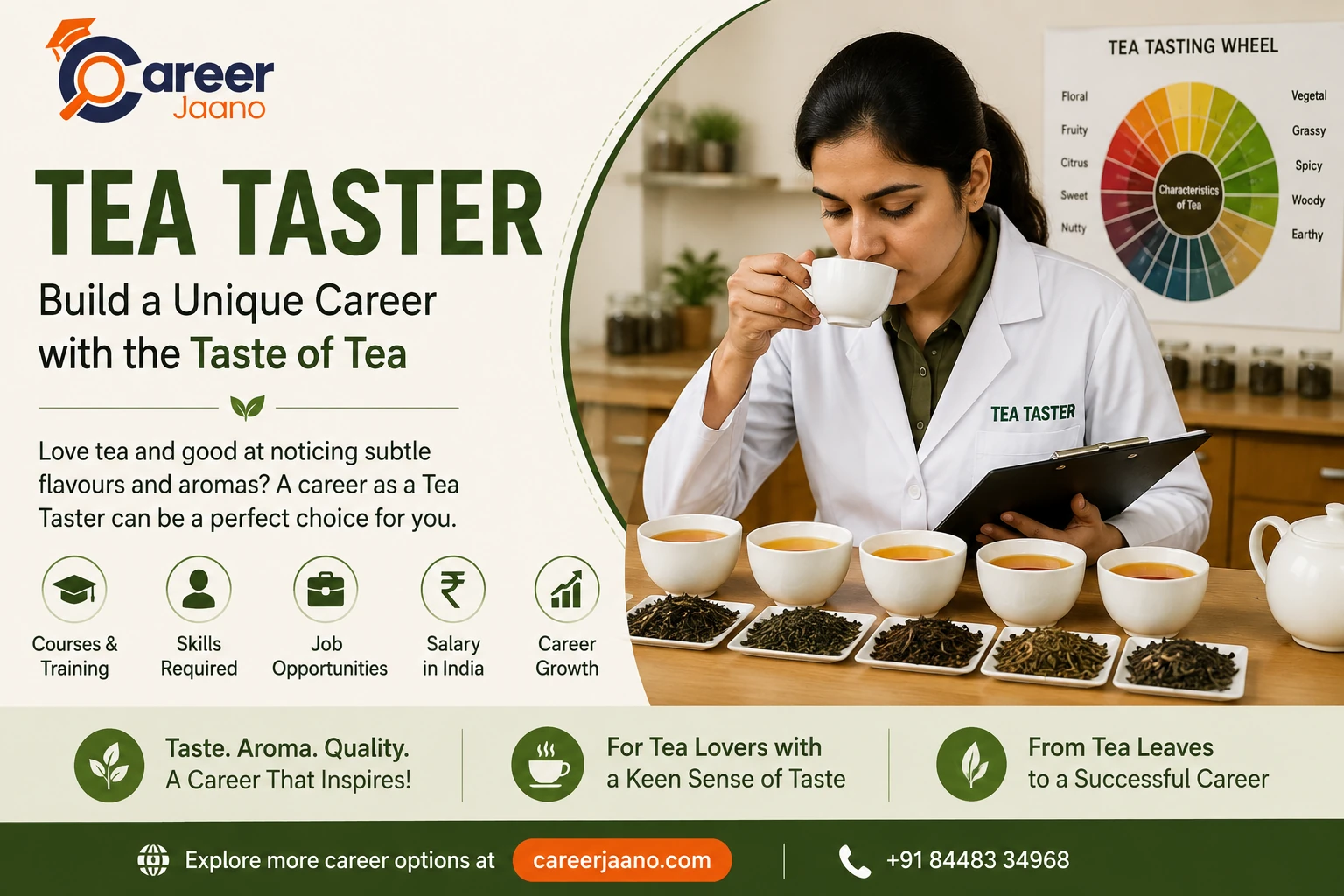
If you love tea and can easily notice the difference between different tastes and aromas, a career as a Tea Taster can be an interesting option for you.
This career is different from a normal office job. It can be a good choice for students who are interested in tea, food, flavours, and the beverage industry.
A Tea Taster is also known as a Tea Expert or Tea Sommelier. Their main job is to check the quality, taste, aroma, colour, and overall feel of tea.
An experienced Tea Taster can identify different types of tea and can often understand where the tea comes from by checking its taste and aroma. Tea Tasters also learn about tea farming, processing, production, and different tea varieties.
What Does a Tea Taster Do?
Tea tasting is not just about drinking tea. A professional Tea Taster needs training, practice, and good knowledge of tea.
Some important parts of the job are:
1. Check Taste and Aroma
A Tea Taster checks the sweetness, bitterness, freshness, strength, and aroma of different teas.
2. Check Colour and Appearance
They study the colour and appearance of dry tea leaves as well as the colour of the prepared tea.
3. Identify Tea from Different Regions
Experienced Tea Tasters can understand the differences between teas from places such as Assam, Darjeeling, and Nilgiri.
4. Quality Control
Tea Tasters help companies make sure that the quality of tea is good before it reaches the market.
5. Help in Tea Selection
They may also help tea companies, buyers, and customers choose the right type of tea according to quality, taste, and requirements.
Education and Training for a Tea Taster
There is no single fixed degree required to become a Tea Taster. However, proper training and practical experience are very important.
Different tea industry organisations, research centres, agriculture institutes, and training centres may offer programmes related to tea production, quality control, tea processing, and tea tasting.
Before joining any course, students should always check the latest details about eligibility, fees, course duration, and admission process on the official website of the institute.
Some courses that can also give you a good base for this career are:
B.Sc. Agriculture
B.Sc. Forestry
Bachelor of Hotel Management (BHM)
Food Technology
Plantation Management
Agriculture-related courses
These courses can help you understand plants, food quality, production, and management.
Skills Required to Become a Tea Taster
A successful Tea Taster needs some special skills.
Good Sense of Taste
You should be able to understand small differences between different tea flavours.
Good Sense of Smell
Tea aroma is very important. A Tea Taster should be able to notice different types of smells and fragrances.
Attention to Detail
Tea tasting requires a lot of concentration because even a small difference in taste or aroma can be important.
Comparison Skills
You should be able to compare different tea samples and understand the differences between them.
Sensitivity to Taste and Aroma
A strong sense of taste and smell can be very useful in this profession.
Technical Knowledge
Basic knowledge of tea farming, processing, production, storage, and quality control is also helpful.
Communication Skills
A Tea Taster should be able to clearly explain the quality and characteristics of a tea to other people.
Career Opportunities in the Private Sector
Tea Tasters can find career opportunities in tea companies, tea gardens, beverage companies, food companies, and tea trading businesses.
Some possible job roles are:
Tea Taster
Tea Quality Controller
Tea Production Controller
Tea Buyer
Tea Trader
Tea Garden Professional
Tea Research and Development Professional
Tea Marketing Executive
Tea Sales Executive
Tea Brand Specialist
With experience, you can move into senior positions in quality control, buying, production, or management.
Career Opportunities in the Government Sector
There can also be career opportunities in government organisations, agriculture institutions, research centres, food quality organisations, and departments connected with the tea industry.
Some possible job profiles may include:
Quality Control Officer
Research Assistant
Research Scientist
Technical Officer
Field Officer
Project Officer
Agriculture Research Officer
Trainer
The eligibility and selection process for government jobs may be different for every post. Candidates should always check the official recruitment notification before applying.
Tea Taster Salary in India
The salary of a Tea Taster depends on experience, company, location, skills, and job profile.
At the starting level, a Tea Taster may earn around ₹20,000 to ₹30,000 per month.
With a few years of experience, the salary may increase to around ₹30,000 to ₹50,000 per month or more.
Experienced and senior Tea Tasters working with large companies or in specialised roles may earn around ₹50,000 to ₹1 lakh per month or even more.
These salary figures are only general estimates. Actual salary can be different depending on the company and job role.
Is Tea Tasting a Good Career for You?
Tea tasting can be a good career option if you are truly interested in tea, flavours, aroma, food, and the beverage industry.
However, simply enjoying tea is not enough. You need regular practice, training, patience, and strong observation skills to become successful in this field.
Before choosing any career, it is always better to understand your interests, skills, personality, and future goals.
If you are confused about the right career option, you can also take guidance from a professional career counsellor. You can explore different career options onCareer Jaano.
FAQs About Tea Taster Career
1. Who is a Tea Taster?
A Tea Taster is a professional who checks the taste, aroma, colour, and quality of different types of tea.
2. Which course is best to become a Tea Taster?
There is no single compulsory course. Courses in Agriculture, Forestry, Food Technology, Hotel Management, or Plantation Management can be helpful. Practical tea tasting training is also very important.
3. Can I become a Tea Taster after Class 12?
Yes. After Class 12, you can join a suitable agriculture, food, hospitality, or tea-related training programme and start building experience in the tea industry.
4. What is the starting salary of a Tea Taster?
A beginner may earn around ₹20,000 to ₹30,000 per month. Salary depends on the company, location, training, and experience.
5. Are government jobs available for Tea Tasters?
There can be opportunities in tea-related government organisations, agriculture departments, research institutes, and quality control organisations. Eligibility depends on the particular job.
6. What is the most important skill for a Tea Taster?
A strong sense of taste and smell is very important. Good concentration, observation, communication, and technical knowledge are also useful.
7. Is Tea Tasting a good career in India?
Yes, it can be a good career for people who are genuinely interested in tea and the beverage industry. With the right training and experience, you can build a career in quality control, tea buying, production, research, or trading.